-
Use Cases
-
Resources
-
Pricing
The history of geometry traces humanity's study of shapes, sizes, and spatial relationships from practical land measurement in ancient Egypt and Mesopotamia, through the rigorous axiomatic systematization by Greek mathematicians like Euclid, to revolutionary developments such as analytic geometry, non-Euclidean geometries, and modern computational and differential geometry. More Less
3000 BCE
% complete
The earliest recorded beginnings of geometry can be traced to early peoples, such as the ancient Indus Valley (see Harappan mathematics) and ancient Babylonia (see Babylonian mathematics) from around 3000 BCE.
Image source: History of geometry
1850 BCE
% complete
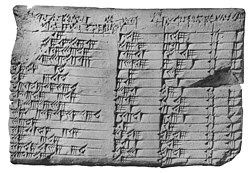
A Mesopotamian clay tablet from 1850 BCE contains fifteen Pythagorean triples with quite large entries, including (13500, 12709, 18541), a primitive triple, indicating sophisticated understanding of the topic.
Image source: Plimpton 322
1500 BCE
% complete
Both the Egyptians and the Babylonians were aware of versions of the Pythagorean theorem about 1500 years before Pythagoras, and the Egyptians had a correct formula for the volume of a frustum of a square pyramid.
800 BCE
% complete
The Indian Sulba Sutras, composed around 800 BCE, contained the first statements of the Pythagorean theorem.
Image source: Shulba Sutras
384 BCE - 322 BCE
% complete
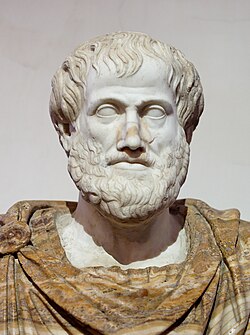
Aristotle, Plato's greatest pupil, wrote a treatise on methods of reasoning used in deductive proofs (see Logic) which was not substantially improved upon until the 19th century.
Image source: Aristotle
300 BCE
% complete
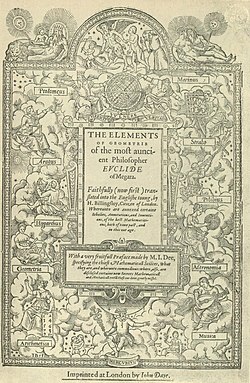
Euclid's book The Elements is widely considered the most influential textbook of all time, and was known to all educated people in the West until the middle of the 20th century.
Image source: Euclid's Elements
300 CE - 400 CE
% complete
Civil wars, decreasing investments in maintenance and acquisition of new scrolls, and generally declining interest in non-religious pursuits likely contributed to a reduction in the body of material available in the Library, especially in the 4th century.
Image source: Library of Alexandria
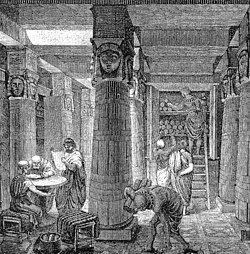
391 CE
% complete
There is a growing consensus among historians that the Library of Alexandria likely suffered from several destructive events, but that the destruction of Alexandria's pagan temples in the late 4th century was probably the most severe and final one.
100 BCE
% complete
Although rough estimates for pi were given in the Zhou Li, compiled in the 2nd century BCE, it was Zhang Heng who was the first to make a concerted effort at creating a more accurate formula for pi.
Image source: Rites of Zhou
100 CE
% complete
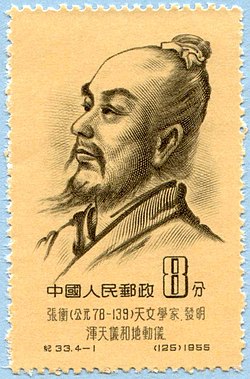
Zhang Heng approximated pi as 730/232 (approximately 3.1466), although he used another formula of pi in finding a spherical volume, using the square root of 10 (approximately 3.162) instead.
Image source: Zhang Heng
179 CE
% complete
The Nine Chapters on the Mathematical Art, the title of which first appeared by 179 CE on a bronze inscription, was edited and commented on by the 3rd century mathematician Liu Hui from the Kingdom of Cao Wei.
Image source: The Nine Chapters on the Mathematical Art
250 CE
% complete
Liu Hui's contemporary Wang Fan, a mathematician and astronomer from Eastern Wu, rendered pi as 3.1555 by using 142/45.
263 CE
% complete
Liu Hui listed pi as 3.141014 by using a 192-sided polygon, and then calculated pi as 3.14159 using a 3072-sided polygon.
Image source: Liu Hui
900 CE - 1200 CE
% complete
The transmission of the Greek Classics to medieval Europe via the Arabic literature of the 9th to 10th century Islamic Golden Age began in the 10th century and culminated in the Latin translations of the 12th century.
Image source: Transmission of the Greek Classics
1150 CE
% complete
Gerard of Cremona (1114–1187) translated Ptolemy's Optics into Latin, drawing on his knowledge of Arabic, Greek, and Latin in the task.
Image source: Gerard of Cremona
1162
% complete
In 1162, Greek manuscripts were sent as a gift from the Emperor to King William I of Sicily, aiding the transmission of classical learning to medieval Europe.
Image source: William I of Sicily
1300 - 1500
% complete
Advances in the treatment of perspective were made in Renaissance art of the 14th to 15th century which went beyond what had been achieved in antiquity.
Image source: Perspective (graphical)
1413
% complete
In 1413 Filippo Brunelleschi demonstrated the geometrical method of perspective, used today by artists, by painting the outlines of various Florentine buildings onto a mirror.
Image source: Filippo Brunelleschi
1419
% complete
A prime example of Renaissance use of geometrical principles is the Basilica di San Lorenzo in Florence by Filippo Brunelleschi (1377–1446).
Image source: Basilica of San Lorenzo, Florence
1435 - 1436
% complete
Decades after Brunelleschi's demonstration, his friend Leon Battista Alberti wrote De pictura (1435/1436), a treatise on proper methods of showing distance in painting based on Euclidean geometry.
Image source: De pictura
1490
% complete
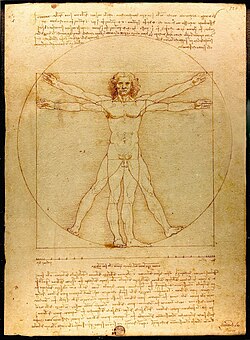
Leonardo da Vinci's Vitruvian Man (c. 1490) depicts a man in two superimposed positions with his arms and legs apart and inscribed in a circle and square.
Image source: Vitruvian Man
1593
% complete
In comparison to later works, the formula for pi given by the French mathematician Franciscus Vieta (1540–1603) fell halfway between Zu Chongzhi's approximations.
Image source: François Viète
1637
% complete
The first and most important development of the early 17th century was the creation of analytic geometry, or geometry with coordinates and equations, by René Descartes (1596–1650) and Pierre de Fermat (1601–1665).
Image source: Analytic geometry
1639
% complete
The second geometric development of this period was the systematic study of projective geometry by Girard Desargues (1591–1661).
Image source: Girard Desargues
1665 - 1700
% complete
In the late 17th century, calculus was developed independently and almost simultaneously by Isaac Newton (1642–1727) and Gottfried Wilhelm Leibniz (1646–1716).
Image source: History of calculus
1700
% complete
By 1700 a great deal had been discovered about what can be proved from the first four of Euclid's postulates, and what the pitfalls were in attempting to prove the fifth.
Image source: Parallel postulate
1733 - 1800
% complete
Saccheri, Lambert, and Legendre each did excellent work on the problem of the fifth postulate in the 18th century, but still fell short of success.
1829 - 1832
% complete
In the early 19th century, Gauss, Johann Bolyai, and Lobachevsky, each independently, took a different approach to the parallel postulate, developing non-Euclidean geometry.
Image source: Non-Euclidean geometry
1868
% complete
It remained to be proved mathematically that non-Euclidean geometry was just as self-consistent as Euclidean geometry, and this was first accomplished by Beltrami in 1868.
Image source: Eugenio Beltrami
1878
% complete
In 1878 William Kingdon Clifford introduced what is now termed geometric algebra, unifying William Rowan Hamilton's quaternions with Hermann Grassmann's algebra and revealing the geometric nature of these systems, especially in four dimensions.
Image source: Geometric algebra
Or browse the full history timeline directory, with more than 2,000 topics.
This History of Geometry timeline was generated with the help of AI, using information found on the internet.
We work hard to keep these timelines accurate, but mistakes do get through. If you spot one, email us at [email protected] and we'll fix it for future visitors.
Generate yours with AI or build it from scratch, for free.
Export your timeline, add your own events, edit or remove AI-generated events, and much more
No credit card required.
Cancel anytime.
Cancel anytime.
You can create an unlimited number of timelines with up to 10 events on each one, customize how they look, export them to PDF, PNG, PowerPoint, CSV, and Excel, and share them with a link. Paid plans raise the event limit and add features like spreadsheet imports and collaborators.
Yes. You can cancel your subscription from your account page at any time, and you will not be charged again. Your subscription stays active for the rest of the period you already paid for.
Yes. We will email you a reminder before the annual renewal, and we will also email you a receipt.
Yes. You can email us within 15 days of any payment, and we will issue you a full refund.
Check out our pricing docs or send us an email anytime: [email protected].