
-
Resources
-
Pricing
The history of glue traces the development of adhesives from natural substances used in prehistory to advanced synthetic products used in manufacturing, construction, medicine, and everyday life. More Less
Build a timeline like this one in minutes, for free. Start Yours →
120,000 BC
Birch-tar residues found on stone tools from Neanderthal sites show that Neanderthals used chemically produced adhesive compounds long before recorded history. The material could bond tools to shafts and may have been made through controlled heating techniques.
4000 BC
Ancient Egyptians used collagen-based animal glues made from hides, bones, and connective tissue. Glue was applied in woodworking, furniture construction, veneering, and the manufacture and repair of composite objects.
2000 BC
Egyptian tomb paintings and objects from the second millennium BC provide some of the earliest visual evidence for glue production and use. Craftspeople heated animal parts in water and applied the resulting gelatinous adhesive to wood and decorative materials.
1000 BC
Chinese craftspeople developed fish-based glues from skin, scales, and swim bladders. These adhesives were valuable in woodworking, lacquer work, painting, and the construction of delicate objects because they could be prepared in relatively thin, clear forms.
500 BC
Starches made from rice and other grains became important water-based adhesives in East Asia. Rice paste was used for paper, bookbinding, decorative arts, textiles, and later the mounting of paintings and calligraphy.
100 BC
Roman writers described milk-derived casein adhesives, made by curdling milk and mixing the curd with alkaline substances. Casein glue was particularly useful for bonding wood and other porous materials.
300
Chinese composite bows relied on animal glue to join wood, horn, and sinew into a powerful laminated weapon. The adhesive joints were protected with coverings and carefully controlled during drying, demonstrating advanced practical knowledge of bonding.
Image source: Composite bow
700
Nori, a cooked wheat-starch paste, became a traditional Japanese adhesive for paper crafts, calligraphy mounting, sliding screens, and conservation. Its reversibility and low toxicity later made starch pastes important in museum and book conservation.
1000
Mesoamerican peoples used plant exudates, including natural latex from rubber-producing trees, as waterproofing and bonding materials. These practices formed part of a broader indigenous knowledge of gums, resins, and sticky plant substances.
1100
Medieval scribes and illuminators used animal glue, gelatin, and plant gums in parchment preparation, pigment binding, gold-leaf work, and book construction. Glue was also used to size surfaces before painting and gilding.
Image source: Illuminated manuscript
1400
By the late Middle Ages, European woodworkers commonly prepared hot hide glue in heated pots. The process supported furniture making, musical-instrument construction, veneering, and the repair of wooden objects.
1450
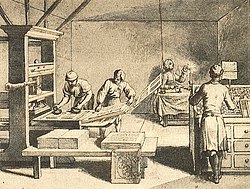
The spread of European printing increased demand for starch pastes and animal glues in bookbinding, paper labeling, and the manufacture of covers. Adhesives became an essential but largely invisible part of the expanding book trade.
Image source: History of printing
1700
Porcelain and ceramic workshops used animal, casein, and starch-based binders in decoration, mold preparation, and repairs. These materials complemented the mineral binders used in ceramic bodies and glazes.
Image source: Porcelain
1823
Charles Macintosh patented a waterproof fabric made by sandwiching rubber dissolved in naphtha between textile layers. The process was an early large-scale use of rubber as a bonding and coating material and led to the name macintosh for waterproof garments.
Image source: Mackintosh (raincoat)
1826
American inventor Peter Cooper established a large glue-manufacturing operation in New York in 1826. His factory helped demonstrate that animal glue could be produced on an industrial scale rather than only in small craft workshops.
1830 - 1839
During the 1830s, American glue factories increasingly processed hides and other animal by-products into standardized hide and bone glues. Industrial production supplied furniture makers, bookbinders, paper manufacturers, and other growing industries.
1839
Charles Goodyear's vulcanization process improved the strength and stability of natural rubber. Although vulcanization was not itself a glue technology, it later enabled rubber-based contact adhesives and pressure-sensitive adhesive formulations.
Image source: Vulcanization
1875
Alfred Nobel patented blasting gelatin, a mixture of nitroglycerin and collodion. The cellulose-nitrate component acted as a gel-forming binder, illustrating how chemically modified polymers could create cohesive, moldable materials.
1886
Early pressure-sensitive adhesive products emerged in the late nineteenth century, using tacky rubber or resin coatings that bonded when pressed onto a surface. These products laid the foundation for modern adhesive tapes and labels.
1921
Richard Gurley Drew joined Minnesota Mining and Manufacturing, later 3M, in 1921. His work on coated abrasives and tapes helped establish the company as a major innovator in pressure-sensitive adhesive technology.
1925
Richard Drew developed Scotch masking tape for automotive painting. Its pressure-sensitive adhesive allowed painters to create clean boundaries between paint colors while removing the tape without severely damaging the underlying finish.
Image source: Masking tape
1930
3M introduced transparent cellulose-based tape in 1930. The product, later widely known as Scotch Tape, brought pressure-sensitive adhesive into offices, homes, retail packaging, and repair work.
Image source: Scotch Tape
1940 - 1949
Water-based polyvinyl acetate emulsions became widely available during the 1940s. Often called white glue or wood glue, they offered convenient, low-cost bonding for paper, crafts, woodworking, and household repairs.
1942
A team led by Harry Coover encountered cyanoacrylates while searching for clear plastics for gun sights. The compounds adhered strongly to surfaces and were initially rejected as impractical before their adhesive potential was recognized.
1950 - 1959
Epoxy resins and curing agents became important commercial adhesives during the 1950s. Their high strength, chemical resistance, and ability to bond dissimilar materials made them valuable in construction, transportation, electronics, and engineering.
1953
American inventor Vernon Krieble developed anaerobic adhesives that remain liquid in air but cure when confined between metal surfaces without oxygen. Such products became widely used to lock threaded fasteners and seal pipe and flange joints.
1958
Eastman Kodak commercialized methyl cyanoacrylate as Eastman 910 in 1958. The adhesive cured rapidly in the presence of trace moisture and became the basis of modern instant glues and super glues.
1960 - 1969
Thermoplastic hot-melt adhesives expanded during the 1960s. Applied in a molten state and solidifying as they cool, they enabled fast, solvent-free bonding in packaging, bookbinding, product assembly, and disposable-hygiene manufacturing.
1960 - 1969
The aerospace industry increasingly used epoxy and other structural adhesives to join aluminum, composites, honeycomb panels, and other lightweight components. Adhesive bonding reduced fasteners and distributed loads across broad surfaces.
1960 - 1969
Modified cyanoacrylates began to be evaluated and used as tissue adhesives for closing wounds. Medical formulations were designed to reduce toxicity and irritation compared with some early industrial cyanoacrylates.
1970 - 1979
Advances in acrylic and rubber-based pressure-sensitive adhesives helped self-adhesive labels, stickers, tapes, and packaging become mass-market products. Their convenience transformed retail identification, logistics, mailing, and consumer products.
1990 - 1999
Research into the microscopic structures on gecko feet inspired synthetic dry adhesives based on van der Waals forces. These materials sought strong, reversible adhesion without liquid glue, with possible uses in robotics, manufacturing, and climbing devices.
2000 - 2099
Researchers intensified development of bioadhesives modeled on mussel proteins, barnacle attachment, spider silk, and natural polysaccharides. The goal was to create strong adhesives that function in wet environments and have improved biological compatibility.
2007
Studies of mussel adhesion led to widespread research on polydopamine coatings derived from dopamine. These coatings can adhere to many materials in water and provide reactive surfaces for biomedical devices, membranes, sensors, and other technologies.
2010 - 2019
Researchers and manufacturers developed adhesives that can be released by heat, light, electrical stimulation, chemicals, or mechanical triggers. Debond-on-demand systems support repair, recycling, component recovery, and safer disassembly of complex products.
2010 - 2019
Concerns about fossil resources, volatile organic compounds, and difficult-to-recycle bonded products drove development of starch-, lignin-, tannin-, soy-, cellulose-, and other bio-based adhesives. Research focused on matching the performance of petroleum-derived formulations while reducing environmental impact.
Build a timeline like this one in minutes, for free. Start Yours →
Or browse the full history timeline directory, with more than 2,500 topics.
This History of Glue timeline was generated with the help of AI, using information found on the internet.
We work hard to keep these timelines accurate, but mistakes do get through. If you spot one, email us at [email protected] and we'll fix it for future visitors.
Generate yours with AI or build it from scratch, for free.
Export your timeline, add your own events, edit or remove AI-generated events, and much more
No credit card required.
15-day money-back guarantee.
You can create an unlimited number of timelines with up to 10 events on each one, customize how they look, export them to PDF, PNG, PowerPoint, CSV, and Excel, and share them with a link. Timelines made with Timeline Maker AI keep every event the generator created, and you can add up to 5 events of your own. Paid plans remove the event limit, add spreadsheet imports and hide Preceden's branding, and the higher-priced plan also adds collaborators, a custom logo and a custom domain.
Yes. You can cancel your subscription from your account page at any time, and you will not be charged again. Your subscription stays active for the rest of the period you already paid for.
Yes. We email you a reminder 15 days before your annual renewal, and we email you a receipt after every payment.
Yes. You can email us within 15 days of any payment, and we will issue you a full refund.
Check out our pricing docs or send us an email anytime: [email protected].