-
Resources
-
Pricing
The history of oncology traces humanity’s evolving understanding, diagnosis, prevention, and treatment of cancer from antiquity to today. More Less
Build a timeline like this one in minutes, for free. Start Yours →
460 BC - 370 BC
Hippocrates used the term carcinos for malignant tumors. His descriptions helped establish early medical terminology for cancer and influenced medical thinking for centuries.
Image source: Hippocrates

400 BC - 1800
Over the centuries, physicians recognized that cancer could occur in many parts of the body. Treatment nevertheless continued to rely heavily on Hippocrates' humor-based theory of disease until the nineteenth century.
Image source: History of cancer
150
In the second century AD, the Greek physician Galen used oncos, the Greek word for swelling, to describe all tumors. He reserved Hippocrates' term carcinos for malignant tumors.
Image source: Galen
1500 - 1699
During the sixteenth and seventeenth centuries, it became more acceptable for doctors to dissect bodies. This allowed physicians to investigate anatomical changes and seek physical causes of death.
Image source: History of anatomy
1600 - 1799
As dissection became more accepted and microscopy spread, physicians increasingly examined tissues and organs to understand disease. These developments helped move cancer study beyond purely humoral explanations.
Image source: Surgical pathology
1700 - 1799
The widespread use of the microscope in the eighteenth century contributed to the discovery that the so-called cancer poison could spread from a primary tumor through lymph nodes to other sites.
Image source: Microscope
1775
In 1775, British surgeon Percivall Pott identified a common cancer of the scrotum among chimney sweeps. His observation became an early landmark in linking cancer with an occupational exposure.
Image source: Percivall Pott
1800 - 1899
In the nineteenth century, improvements in asepsis and surgical hygiene increased survival after operations. As a result, surgical removal of tumors became the primary treatment for cancer.
Image source: Asepsis
1800 - 1899
With cancer treatment centered on surgery, outcomes became strongly dependent on the individual surgeon's skill in removing a tumor. The art of operative removal dominated treatment during the nineteenth century.
1871 - 1874
Between 1871 and 1874, English surgeon Campbell De Morgan formulated the view that cancer spreads from a primary tumor through the lymphatic system to other sites, helping establish the modern concept of metastasis.
1891 - 1899
William Coley believed that cure rates after surgery had been higher before the adoption of asepsis. In the late nineteenth century, he injected bacteria into tumors, producing mixed results and pioneering an early form of cancer immunotherapy.
Image source: William Coley
1896 - 1899
When Marie Skłodowska-Curie and Pierre Curie discovered radiation at the end of the nineteenth century, their work led to the first effective nonsurgical treatment for cancer.
Image source: Marie Curie
1902
In 1902, German zoologist Theodor Boveri recognized a genetic basis for cancer. His work connected abnormal cellular heredity with tumor development and helped establish a foundation for cancer genetics.
Image source: Theodor Boveri
1913
In 1913, 15 physicians and businessmen in New York City founded the American Society for the Control of Cancer, later known as the American Cancer Society.
Image source: American Cancer Society
1926
Janet Lane-Claypon published a comparative study for the British Ministry of Health involving 500 breast cancer cases and 500 control patients with similar backgrounds and lifestyles. The work became a founding paper of cancer epidemiology.
Image source: Janet Lane-Claypon
1945
The organization founded in 1913 as the American Society for the Control of Cancer adopted its current name, the American Cancer Society, in 1945.
1956
A Second Report on the Mortality of British Doctors followed earlier epidemiological work in 1956. The report is also known as the British doctors study.
Image source: British Doctors Study
1968
In 1968, Richard Doll left the London Medical Research Centre to start the Oxford unit for cancer epidemiology, strengthening the institutional study of cancer causes and patterns.
Image source: Richard Doll
1971 - 2007
From 1971 to 2007, the United States invested more than $200 billion in cancer research. The total included funding from public and private sectors and foundations.
Image source: War on cancer
Dec 23, 1971
On 23 December 1971, legislation associated with the intensified United States national effort against cancer was signed into law by President Richard Nixon.
1950 - 2005
Despite substantial investment in cancer research, the United States saw only a five percent decrease in the cancer death rate between 1950 and 2005 after adjustment for population size and age.
Image source: Cancer survival rates
1968
In 1968, Michael A. Epstein, Bert Achong, and Yvonne Barr identified the first human cancer virus, which was named the Epstein–Barr virus.
Image source: Epstein–Barr virus
1973
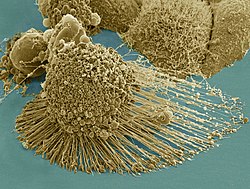
In 1973, cancer research contributed to a Cold War incident when cooperative samples of reported oncoviruses were discovered to have been contaminated by HeLa cells.
Image source: HeLa
1984
In 1984, Harald zur Hausen discovered HPV16. His work identified a specific human papillomavirus associated with cervical cancer.
Image source: Harald zur Hausen
1984
After identifying HPV16, Harald zur Hausen identified HPV18. Together, HPV16 and HPV18 were found to be responsible for approximately 70 percent of cervical cancers.
1984
Harald zur Hausen's research demonstrated that human papillomaviruses cause human cancer, particularly a large proportion of cervical cancers. This established viral infection as a major cancer cause.
Image source: Human papillomavirus infection
2008
Harald zur Hausen won the 2008 Nobel Prize for the discovery that human papillomaviruses cause human cancer.
Image source: List of Nobel laureates in Physiology or Medicine
2016
In 2016, Dr Edward John Odes and colleagues reported a 1.7-million-year-old osteosarcoma. The finding represented the oldest documented malignant hominin cancer.
Image source: Osteosarcoma
2016
The reported 1.7-million-year-old osteosarcoma provided evidence that malignant cancer occurred in hominins deep in the prehistoric past, extending the documented history of oncology far beyond written medicine.
Build a timeline like this one in minutes, for free. Start Yours →
Or browse the full history timeline directory, with more than 2,500 topics.
This History of Oncology timeline was generated with the help of AI, using information found on the internet.
We work hard to keep these timelines accurate, but mistakes do get through. If you spot one, email us at [email protected] and we'll fix it for future visitors.
Generate yours with AI or build it from scratch, for free.
Export your timeline, add your own events, edit or remove AI-generated events, and much more
No credit card required.
15-day money-back guarantee.
You can create an unlimited number of timelines with up to 10 events on each one, customize how they look, export them to PDF, PNG, PowerPoint, CSV, and Excel, and share them with a link. Timelines made with Timeline Maker AI keep every event the generator created, and you can add up to 5 events of your own. Paid plans remove the event limit, add spreadsheet imports and hide Preceden's branding, and the higher-priced plan also adds collaborators, a custom logo and a custom domain.
Yes. You can cancel your subscription from your account page at any time, and you will not be charged again. Your subscription stays active for the rest of the period you already paid for.
Yes. We email you a reminder 15 days before your annual renewal, and we email you a receipt after every payment.
Yes. You can email us within 15 days of any payment, and we will issue you a full refund.
Check out our pricing docs or send us an email anytime: [email protected].