
-
Use Cases
-
Resources
-
Pricing
This timeline traces the history of Portland, Oregon, from its founding in the mid-1840s at the confluence of the Willamette and Columbia rivers through its rise as a major Pacific Northwest port city, its growth during the timber and shipbuilding booms, and its evolution into a modern hub known for urban planning, culture, and sustainability. More Less
Nov 3, 1805
% complete
The Lewis and Clark expedition traveled through the Portland area on their journey to the Pacific Ocean, camping near the confluence of the Willamette and Columbia rivers and documenting the region's geography and Native communities.
Image source: Lewis and Clark Expedition
1829
% complete
William Overton and Asa Lovejoy claimed 640 acres of land on the west bank of the Willamette River, a site known as 'the Clearing,' which would later become the city of Portland. Overton soon sold his share to Francis Pettygrove.
1845
% complete
Founders Asa Lovejoy of Boston, Massachusetts, and Francis Pettygrove of Portland, Maine, reportedly flipped a coin to decide the new town's name. Pettygrove won two out of three flips, naming the settlement after his hometown in Maine.
Image source: History of Portland, Oregon
1845
% complete
The first plat for the townsite of Portland was surveyed and filed, establishing the street grid that still defines downtown today, including the numbered east-west streets and named north-south avenues.
Image source: Portland, Oregon
Aug 14, 1848
% complete
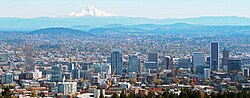
Congress formally organized the Oregon Territory, bringing official U.S. governance to the region and spurring migration along the Oregon Trail that boosted Portland's population and economic prospects.
Image source: Oregon Territory
Dec 4, 1850
% complete
The Oregonian published its first issue, beginning a long run as Portland's newspaper of record and one of the oldest continuously published newspapers on the West Coast.
Feb 8, 1851
% complete
Portland was officially incorporated with about 800 residents. Its deep-water access via the Willamette River gave it an advantage over rival towns like Oregon City and Milwaukie as a shipping hub.
Feb 14, 1859
% complete
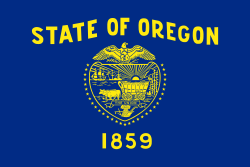
Oregon became the 33rd state of the Union, with Portland rapidly emerging as its dominant commercial center due to its strategic river port position.
Image source: Oregon
1869
% complete
Railroad magnate Ben Holladay extended rail lines into Portland, cementing its role as the transportation hub of the Pacific Northwest and fueling rapid commercial growth.
Aug 2, 1873
% complete
A catastrophic fire destroyed much of Portland's downtown business district, destroying over 50 blocks of wooden buildings. The disaster prompted reconstruction using brick and iron, shaping the city's architectural character.
Image source: Great Fire of 1873
1887
% complete
A railroad bridge across the Willamette River connected Portland's east and west sides, opening up East Portland for development and accelerating metropolitan growth.
Image source: Morrison Bridge
Jun 1, 1905 - Oct 14, 1905
% complete
Portland hosted the Lewis and Clark Centennial Exposition, drawing over 1.5 million visitors and boosting the city's population, economy, and national reputation during a period of explosive growth.
Image source: Lewis and Clark Centennial Exposition
1907
% complete
Portland held its first Rose Festival, establishing a civic tradition inspired by the city's nickname 'the City of Roses.' The festival became one of the nation's most celebrated annual civic events.
Image source: Portland Rose Festival
1912
% complete
Lumber baron Simon Benson funded the installation of the famous Benson Bubbler drinking fountains throughout downtown Portland, which remain an iconic feature of the city's public spaces.
Image source: Benson Bubbler
1903
% complete
John Charles Olmsted of the famed Olmsted firm produced a park plan for Portland, laying the foundation for the city's extensive park system, including Forest Park, one of the largest urban forests in the United States.
Image source: John Charles Olmsted
1942 - 1945
% complete
Henry Kaiser's shipyards along the Columbia River employed more than 100,000 workers during World War II, producing Liberty ships at record speed and transforming Portland into a major industrial center.
Image source: Kaiser Shipyards
May 30, 1948
% complete
A dike failure flooded Vanport, then Oregon's second-largest city built to house WWII shipyard workers, killing 15 people and displacing tens of thousands, many of them African American families who reshaped Portland's demographics.
Image source: Vanport, Oregon
1974 - 1978
% complete
Harbor Drive was removed from downtown's riverfront and replaced with Tom McCall Waterfront Park, a pioneering example of urban freeway removal that became central to Portland's identity as a green, livable city.
Image source: Tom McCall Waterfront Park
Jun 5, 1977
% complete
The Portland Trail Blazers defeated the Philadelphia 76ers to win their first and only NBA championship, sparking massive celebrations known as 'Blazermania' across the city.
1979
% complete
Portland implemented its famous urban growth boundary, limiting development outside designated areas and preserving farmland while encouraging density — a landmark policy studied by planners worldwide.
Image source: Urban growth boundary
1979
% complete
Voters created Metro, the only directly elected regional government in the United States, giving the Portland area coordinated control over land use planning, the urban growth boundary, and regional services.
Image source: Metro (Oregon regional government)
1984
% complete
After replacing a parking garage, Pioneer Courthouse Square opened as 'Portland's living room,' becoming the city's central gathering place and host to hundreds of events each year.
Image source: Pioneer Courthouse Square
Sep 5, 1986
% complete
Portland opened the Metropolitan Area Express (MAX) light rail line, launching a transit network now operated by TriMet that has expanded across the metro area and become a model for American light rail.
Image source: MAX Light Rail
1993
% complete
Vera Katz took office as mayor, championing projects like the Eastbank Esplanade, streetcar expansion, and Pearl District redevelopment that reshaped central Portland.
Image source: Vera Katz
May 26, 2001
% complete
The Eastbank Esplanade opened, creating a 1.5-mile floating walkway and bike path along the Willamette River, completing a loop around downtown with Waterfront Park.
Image source: Eastbank Esplanade
Jul 20, 2001
% complete
The Portland Streetcar launched, connecting downtown neighborhoods and spurring transit-oriented development, particularly in the Pearl District and South Waterfront.
Image source: Portland Streetcar
Oct 6, 2011 - Nov 13, 2011
% complete
As part of the nationwide Occupy Wall Street movement, thousands of protesters camped in downtown parks, drawing national attention and highlighting tensions over policing and economic inequality in the city.
Image source: Occupy Portland
2019
% complete
Historic Providence Park, home to the Timbers and Thorns soccer clubs since the early 20th century, completed a $200 million renovation adding seating and modern amenities while preserving its classic character.
Image source: Providence Park
Mar 2020
% complete
The COVID-19 pandemic brought lockdowns, event cancellations, and economic disruption to Portland, compounding challenges from civil unrest in summer 2020 but also accelerating changes in how the city works and lives.
Or browse the full history timeline directory, with more than 2,000 topics.
This History of Portland timeline was generated with the help of AI, using information found on the internet.
We work hard to keep these timelines accurate, but mistakes do get through. If you spot one, email us at [email protected] and we'll fix it for future visitors.
Generate yours with AI or build it from scratch, for free.
Export your timeline, add your own events, edit or remove AI-generated events, and much more
No credit card required.
Cancel anytime.
Cancel anytime.
You can create an unlimited number of timelines with up to 10 events on each one, customize how they look, export them to PDF, PNG, PowerPoint, CSV, and Excel, and share them with a link. Paid plans raise the event limit and add features like spreadsheet imports and collaborators.
Yes. You can cancel your subscription from your account page at any time, and you will not be charged again. Your subscription stays active for the rest of the period you already paid for.
Yes. We will email you a reminder before the annual renewal, and we will also email you a receipt.
Yes. You can email us within 15 days of any payment, and we will issue you a full refund.
Check out our pricing docs or send us an email anytime: [email protected].