-
Use Cases
-
Resources
-
Pricing
Indianapolis, the capital of Indiana, was founded in 1821 as a purpose-built state capital near the center of the state. It grew steadily with the arrival of railroads in the mid-1800s, became an important automotive manufacturing center in the early 20th century, and evolved into a modern hub for motorsports, higher education, healthcare, and amateur athletics, hosting major events like the Indianapolis 500 since 1911. More Less
Jan 6, 1821
% complete
The Indiana General Assembly selected a site along the White River for the new state capital, and Indianapolis was officially founded in 1821. Surveyor Alexander Ralston, who had assisted Pierre L'Enfant with Washington, D.C., designed the city around a central Circle, creating the radial street plan that still defines downtown today.
Apr 1, 1822
% complete
Marion County was organized with Indianapolis as its county seat, cementing the young town's administrative role and spurring early settlement by pioneers drawn to the capital site.
Image source: Marion County, Indiana
Oct 27, 1834
% complete
Indianapolis was formally incorporated as a town, allowing it to establish local government structures and begin providing municipal services to its roughly 1,000 residents.
Mar 30, 1847
% complete
The Indiana legislature granted Indianapolis a city charter, and its first municipal elections were held. Samuel Henderson became the city's first mayor, establishing full self-government.
1861 - 1865
% complete
During the Civil War, Indianapolis served as a major Union logistics center, and Camp Morton became a training ground for Union soldiers and later a notorious prison camp for Confederate captives.
Image source: Camp Morton
1865
% complete
Following the Civil War, Indianapolis experienced rapid industrialization and population growth, with railroads converging on the city and earning it the nickname 'Crossroads of America.'
Image source: History of Indianapolis
Nov 6, 1888
% complete
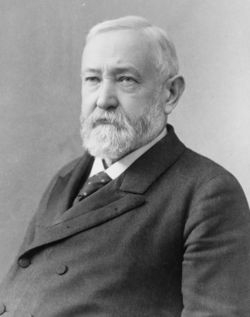
Indianapolis resident Benjamin Harrison, grandson of President William Henry Harrison, was elected the 23rd president of the United States, bringing national prominence to the city.
Image source: Benjamin Harrison
1916 - 1970
% complete
Thousands of African Americans moved to Indianapolis from the South during the Great Migration, expanding neighborhoods like Indiana Avenue, which became a celebrated jazz and cultural district.
Image source: Great Migration (African American)
1837
% complete
The National Road, America's first major federally funded highway, reached Indianapolis, connecting the city to eastern markets and boosting commerce and migration through central Indiana.
Image source: National Road
Oct 1, 1847
% complete
Completion of the Madison and Indianapolis Railroad linked the capital to the Ohio River, transforming Indianapolis into a regional transportation hub and accelerating its population and economic growth.
1937
% complete
Eli Lilly and Company established the Lilly Endowment, which became one of the largest private philanthropic foundations in the world and a transformative force in Indianapolis civic life.
Image source: Lilly Endowment
1941 - 1945
% complete
During World War II, Indianapolis factories pivoted to wartime production, with companies like Allison Engine and Republic Aviation employing tens of thousands and fueling postwar economic expansion.
2010 - 2019
% complete
Indianapolis diversified beyond manufacturing, with life sciences firms like Eli Lilly and Elanco, plus a growing tech startup scene centered around the 16 Tech innovation district, driving modern job growth.
Image source: Elanco
1873
% complete
Garfield Park opened as Indianapolis's first major public park, part of a growing movement to provide urban green space for residents of the rapidly industrializing city.
Image source: Garfield Park (Indianapolis)
May 15, 1902
% complete
The Indiana Soldiers' and Sailors' Monument was completed at the center of Monument Circle, honoring Hoosiers who served in the Civil War and becoming the enduring symbol of Indianapolis.
Image source: Soldiers' and Sailors' Monument (Indianapolis)
Aug 19, 1909
% complete
Carl Fisher's Indianapolis Motor Speedway opened northwest of the city, later paved with 3.2 million bricks that gave the track its famous nickname, 'The Brickyard.'
Image source: Indianapolis Motor Speedway
May 30, 1911
% complete
Ray Harroun won the inaugural Indianapolis 500 at the Indianapolis Motor Speedway before an estimated 80,000 fans, launching what would become 'The Greatest Spectacle in Racing.'
Image source: 1911 Indianapolis 500
1921 - 1933
% complete
Construction began on the five-block Indiana World War Memorial Plaza, one of the largest war memorials in the United States, honoring veterans of World War I.
Image source: Indiana World War Memorial Plaza
Sep 15, 1974
% complete
Market Square Arena opened downtown, becoming home to the Indiana Pacers and anchoring a new era of professional sports and downtown entertainment in Indianapolis.
1976
% complete
After dominating the ABA with three championships, the Indiana Pacers joined the NBA in the ABA–NBA merger, cementing basketball's central place in Indianapolis sports culture.
Aug 24, 1983
% complete
The Hoosier Dome opened adjacent to the Indiana Convention Center, enabling Indianapolis to host major conventions, NCAA events, and eventually an NFL franchise.
Image source: RCA Dome
Mar 28, 1984
% complete
Robert Irsay moved the Colts franchise from Baltimore to Indianapolis overnight, giving the city its first NFL team and sparking a lasting rivalry between the two cities' fan bases.
Aug 8, 1987 - Aug 23, 1987
% complete
Indianapolis hosted the tenth Pan American Games, welcoming thousands of athletes from across the Americas and showcasing the city's growing reputation as the 'Amateur Sports Capital of the World.'
Image source: 1987 Pan American Games
1999
% complete
The NCAA moved its national headquarters to Indianapolis, solidifying the city's status as a hub of amateur athletics alongside USA Track & Field and other governing bodies already based there.
Image source: National Collegiate Athletic Association
Aug 24, 2008
% complete
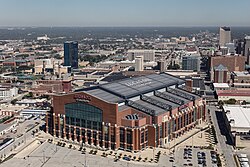
Lucas Oil Stadium opened as the retractable-roof home of the Colts, replacing the RCA Dome and positioning Indianapolis to host Super Bowl XLVI and countless Final Fours.
Image source: Lucas Oil Stadium
Feb 5, 2012
% complete
Indianapolis hosted Super Bowl XLVI at Lucas Oil Stadium, where the New York Giants defeated the New England Patriots, drawing global attention and acclaim for the city's hospitality.
Image source: Super Bowl XLVI
1908 - 1920
% complete
Inspired by the City Beautiful movement, George Kessler's park and boulevard plan transformed Indianapolis with landscaped waterways, boulevards, and expanded parkland.
Image source: City Beautiful movement
Jan 1, 1970
% complete
The Unigov legislation merged Indianapolis and Marion County governments under Mayor Richard Lugar, instantly making Indianapolis one of the largest U.S. cities by population.
Image source: Unigov
1990
% complete
A coalition led by Simon Property Group announced plans for Circle Centre Mall, a major downtown retail and entertainment complex intended to revitalize the city core; it opened in 1995.
Image source: Circle
2012
% complete
Ahead of the Super Bowl, Georgia Street was redesigned into a pedestrian-friendly cultural corridor connecting the convention center and stadium, symbolizing ongoing downtown investment.
Image source: St. John the Evangelist Catholic Church (Indianapolis, Indiana)
Or browse the full history timeline directory, with more than 2,000 topics.
This History of Indianapolis timeline was generated with the help of AI, using information found on the internet.
We work hard to keep these timelines accurate, but mistakes do get through. If you spot one, email us at [email protected] and we'll fix it for future visitors.
Generate yours with AI or build it from scratch, for free.
Export your timeline, add your own events, edit or remove AI-generated events, and much more
No credit card required.
Cancel anytime.
Cancel anytime.
You can create an unlimited number of timelines with up to 10 events on each one, customize how they look, export them to PDF, PNG, PowerPoint, CSV, and Excel, and share them with a link. Paid plans raise the event limit and add features like spreadsheet imports and collaborators.
Yes. You can cancel your subscription from your account page at any time, and you will not be charged again. Your subscription stays active for the rest of the period you already paid for.
Yes. We will email you a reminder before the annual renewal, and we will also email you a receipt.
Yes. You can email us within 15 days of any payment, and we will issue you a full refund.
Check out our pricing docs or send us an email anytime: [email protected].