-
Use Cases
-
Resources
-
Pricing
Brussels, the capital of Belgium and de facto capital of the European Union, has evolved from a 10th-century settlement on the Senne River into a major international political hub. Its history spans medieval prosperity under the Dukes of Brabant, rule by Burgundy, Spain, Austria, France, and the Netherlands, its role as Belgium's capital after independence in 1830, and its transformation into a center of European and global governance. More Less
1000 BCE - 800 BCE
% complete
Around 1000–800 BCE, Celtic tribes settled in the region of what would later become Brussels, establishing some of the earliest known human presence in the area.
Image source: Brussels
800 BC
% complete
During the Bronze and Iron Ages, farmers settled on cleared land in the Brussels region, laying the agricultural foundations of the future city.
500 BC - 100 BC
% complete
From the 5th to the 1st century BCE, the La Tène culture maintained a settlement on the Champ Saint-Anne/Sint-Annaveld in Anderlecht.
Image source: La Tène culture
1 CE - 200
% complete
In the Roman period, villas were established on both banks of the Senne during the 1st and 2nd centuries CE, including sites in Stalle, Laeken, Jette, and Anderlecht, the latter built on the former Neolithic settlement site.
Image source: Gallo-Roman culture
300 - 600
% complete
By the 4th–6th centuries CE, Frankish tribes occupied the territories between the Meuse and Scheldt rivers, reshaping the population of the Brussels area.
Image source: Franks
700
% complete
Current research suggests that Brussels developed gradually from an agricultural community that expanded rapidly from the 8th century onwards.
1000 - 1200
% complete
By the 11th–12th centuries, Brussels consisted of a loose network of residential centres, a pattern described as the 'polynuclear' character of medieval towns.
1015 - 1020
% complete
The first reliable mention of Brussels dates from around 1015–1020, describing the settlement as a portus, a loading and unloading site on the Senne, likely associated with nearby dwellings whose locations remain uncertain.
1050
% complete
Alongside Gaugericus Church and the Coudenberg lordship, a chapter of secular canons was founded in the mid-11th century at the area around Saint Michael's Church, one of Brussels' key religious centres.
Image source: Cathedral of St. Michael and St. Gudula
1100
% complete
Archaeological evidence points to small settlements near today's Place de la Vieille Halle aux Blés/Oud Korenhuis, and planned districts like the early 12th-century textile neighbourhood around the Chapel Church, today's Marollen district.
Image source: Marollen
1209 - 1406
% complete
Between 1209 and 1406, Brussels evolved into a major political, economic, and cultural centre of the Low Countries.
1213
% complete
The early 13th century saw the establishment of key civic institutions: the Grand Royal and Noble Oath of the Crossbowmen of Our Lady of Sablon, and the planting of the Meyboom, a tradition that continues to this day.
Image source: Meyboom
1300 - 1400
% complete
In the 14th century, Schaerbeek, Etterbeek, Laeken, Anderlecht, Obbrussel, and Forest joined the Coop, while the Brussels Revolt and subsequent suppression of craftsmen shaped the city's governance.
Image source: Schaerbeek
1356
% complete
Everard t'Serclaes liberated Brussels in 1356. He later suffered mutilation and death in 1388, prompting a military expedition against Gaasbeek Castle.
Image source: Everard t'Serclaes
1380
% complete
Civic governance advanced as Geert Pipenpoy became the city's first mayor in 1380. In this era the Halle Gate was built, construction of the Town Hall began, and the Court of Auditors was established.
Image source: Brussels Town Hall
1400 - 1406
% complete
Brussels' population reached around 20,000 by 1400, despite destructive fires that ravaged the city in 1405–1406.
1406
% complete
In 1406, Anthony the Great Bastard made his Joyous Entry into Brussels, and by 1407 a fire brigade had been organised, though water supply remained limited.
Image source: Joyous entry
1410
% complete
The early 15th century saw significant social and religious movements in Brussels, including the prosecution of the Homines Intelligentiae and the settlement of the Brethren of the Common Life.
1421
% complete
Political tensions between Duke John IV and the States of Brabant led to the guilds' participation in city governance alongside the Seven Noble Houses in 1421, part of early democratic reforms in Brussels.
1430
% complete
In 1430, Brussels became part of the Burgundian State under Duke Philip the Good, beginning a period of significant political and cultural flourishing under Burgundian rule.
Image source: Burgundian State
1500 - 1556
% complete
From the late 15th to the mid-16th century, Brussels developed under Habsburg influence: postal services were established, the Miracle of 1511 occurred, De Moluccis Insulis was published, and Lutheran, Munsterite, and Mennonite communities arose.
Image source: Stille Omgang
1556 - 1711
% complete
Between 1556 and 1711, Brussels was a focal point of change under Spanish rule. Iconic developments included the recasting of Manneken Pis in bronze, construction of theatres and fortifications, and the creation of brotherhoods and civic charities throughout the 17th century.
Image source: Manneken Pis
1575
% complete
Brussels suffered devastating plague epidemics in 1575 and again in 1634, killing many inhabitants during the turbulent era of Spanish rule.
1695
% complete
The French bombardment of 1695 was the most devastating military attack on Brussels, but the city rebuilt its Grand-Place and continued to flourish.
Image source: Bombardment of Brussels
1700
% complete
After rebuilding from the bombardment, Brussels flourished culturally, culminating in the opening of the Theatre of La Monnaie and the Royal Academy of Fine Arts.
Image source: La Monnaie
Apr 1717
% complete
In April 1717, Peter the Great visited Brussels, and later that year the Theatre of La Monnaie was sold to Jean-Baptiste Meeûs.
Sep 1719
% complete
In September 1719, François Anneessens, a symbol of resistance to Austrian authority, was executed on the Grand-Place. In March 1724, the Senne flooded, leaving the lower town under water.
Image source: Place Anneessens
Feb 1731
% complete
The Palace of Coudenberg was destroyed by fire in February 1731, a major loss for the city. In 1733, new burial regulations were introduced to limit the spread of disease.
Image source: Palace of Coudenberg
1744 - 1749
% complete
Prince Charles Alexander of Lorraine entered Brussels in 1744, the year before English troops stole the Manneken Pis statue, later returned by the residents of Geraardsbergen. In early 1746, French forces besieged and captured the city during the War of the Austrian Succession, though it was returned to Austria by the Treaty of Aix-la-Chapelle in 1749.
Image source: Prince Charles Alexander of Lorraine
1750 - 1800
% complete
In the second half of the 18th century, urban development accelerated: Brussels Park, the Rue Royale/Koningsstraat, Place des Martyrs/Martelaarsplein, and Place Royale/Koningsplein were laid out, while the Palace of the Council of Brabant (today's Palace of the Nation), the Royal Palace, and the Palace of Laeken were constructed.
Image source: Place Royale, Brussels
1787 - 1790
% complete
Street clashes with Austrian troops in 1787–88 helped trigger the Brabant Revolution, during which Brussels briefly became the capital of the short-lived United Belgian States.
Image source: Brabant Revolution
1792 - 1794
% complete
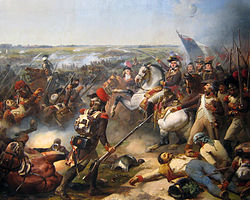
Austrian control was soon restored after the Brabant Revolution, but the city was occupied by French troops in 1792, lost, and retaken in 1794 following the Battle of Fleurus.
Image source: Battle of Fleurus (1794)
1795
% complete
In 1795, Brussels was formally annexed by France and became the capital of the department of the Dyle.
Image source: Dyle (department)
1800
% complete
By 1800, Brussels counted over 66,000 inhabitants and had founded its first professional Fire Brigade, marking its growth into a major modern city.
Or browse the full history timeline directory, with more than 2,000 topics.
This History of Brussels timeline was generated with the help of AI, using information found on the internet.
We work hard to keep these timelines accurate, but mistakes do get through. If you spot one, email us at [email protected] and we'll fix it for future visitors.
Generate yours with AI or build it from scratch, for free.
Export your timeline, add your own events, edit or remove AI-generated events, and much more
No credit card required.
Cancel anytime.
Cancel anytime.
You can create an unlimited number of timelines with up to 10 events on each one, customize how they look, export them to PDF, PNG, PowerPoint, CSV, and Excel, and share them with a link. Paid plans raise the event limit and add features like spreadsheet imports and collaborators.
Yes. You can cancel your subscription from your account page at any time, and you will not be charged again. Your subscription stays active for the rest of the period you already paid for.
Yes. We will email you a reminder before the annual renewal, and we will also email you a receipt.
Yes. You can email us within 15 days of any payment, and we will issue you a full refund.
Check out our pricing docs or send us an email anytime: [email protected].