-
Use Cases
-
Resources
-
Pricing
Zurich, Switzerland's largest city, has evolved from a Roman customs station into a major European center of finance, culture, and innovation. Its history spans Celtic and Roman settlements, medieval guild rule, the Swiss Reformation led by Huldrych Zwingli, industrialization, and its rise as one of the world's leading financial capitals. More Less
15 BC
% complete
The Romans founded a tax-collecting settlement called Turicum at Lindenhof on the Limmat river, marking the earliest documented origins of what would become the city of Zurich.
Image source: Turicum
286
% complete
According to legend, saints Felix, Regula, and Exuperantus were executed for their Christian faith; the site of their martyrdom became associated with the Grossmünster church.
Image source: Felix and Regula
850
% complete
Tradition holds that Charlemagne founded a monastery at the site where the tombs of Felix and Regula were discovered. The Grossmünster became one of Zurich's defining landmarks and a religious center.
Image source: Grossmünster
853
% complete
Louis the German founded an abbey for his daughter Hildegard on the left bank of the Limmat. The Fraumünster abbess held considerable power, effectively governing Zurich for centuries.
Image source: Fraumünster
1218
% complete
With the extinction of the Zähringen dynasty, Zurich came under direct authority of the Holy Roman Emperor, gaining status as a free imperial city and greater self-governance.
Image source: Zürich
1336
% complete
Rudolf Brun led the craft guilds in overthrowing the aristocratic council, establishing guild-based government and becoming Zurich's first independent mayor, or burgomaster.
Image source: Rudolf Brun
May 1, 1351
% complete
Zurich allied with the cantons of Uri, Schwyz, Unterwalden, and Lucerne, formally joining the Old Swiss Confederacy and strengthening its position against Habsburg influence.
Image source: Switzerland
1440 - 1450
% complete
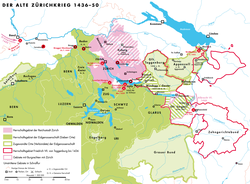
Zurich fought against the other Swiss cantons over succession to the county of Toggenburg. The war ended with Zurich rejoining the Confederacy, having briefly allied with Austria.
Image source: Old Zurich War
1519 - 1531
% complete
Zwingli began preaching reforms at the Grossmünster in 1519, leading to Zurich's transformation into a Protestant center with iconoclasm, new liturgy, and religious debates that shaped Europe.
Image source: Huldrych Zwingli
Jan 21, 1525
% complete
Conrad Grebel and George Blaurock performed the first adult baptisms in Zurich, founding the Anabaptist movement. Authorities persecuted them, but the movement spread across Europe.
Image source: Anabaptism
Oct 11, 1531
% complete
Reformist Zurich was defeated by Catholic cantons; reformer Huldrych Zwingli was killed in battle, ending Zurich's attempt to impose Protestantism across the Confederacy.
Image source: Second War of Kappel
1685
% complete
After Louis XIV revoked the Edict of Nantes, Huguenot refugees arrived in Zurich, bringing silk weaving and textile skills that boosted the city's economy.
Image source: Huguenots
1761
% complete
Zurich scholars founded the Helvetic Society to promote Enlightenment ideals, education, and patriotic sentiment, making the city an intellectual hub of Switzerland.
1798 - 1803
% complete
French revolutionary forces toppled the old Swiss order, and Zurich lost its status as a sovereign city-state under the centralized Helvetic Republic before regaining autonomy later.
Image source: Helvetic Republic
Jun 4, 1799 - Jun 7, 1799
% complete
Austrian forces under Archduke Charles defeated the French army of General Masséna near Zurich during the War of the Second Coalition.
Image source: First Battle of Zurich
Sep 25, 1799 - Sep 26, 1799
% complete
Masséna's French army decisively defeated a combined Austro-Russian force, forcing the Russians out of Switzerland and securing French control of the region.
Image source: Second Battle of Zurich
1803
% complete
Napoleon's Act of Mediation restored Swiss federalism, and Zurich became one of the sovereign cantons within the reconstituted Swiss Confederation.
Image source: Act of Mediation
1830 - 1831
% complete
The 'Ustertag' assembly forced the conservative government to accept a liberal constitution, granting broader voting rights and launching Zurich's regeneration era.
Image source: Restoration and Regeneration in Switzerland
Apr 29, 1833
% complete
Zurich founded its university as the first university in Europe established by a democratic political system rather than a monarch or church, becoming a major research institution.
Image source: University of Zurich
Aug 9, 1847
% complete
The Spanisch Brötli Bahn, linking Zurich and Baden, became Switzerland's first railway line, kickstarting the country's railway boom and industrial growth.
Image source: Spanisch Brötli
1855
% complete
The Eidgenössisches Polytechnikum, now ETH Zurich, opened and grew into one of the world's leading technical universities, counting Einstein among its alumni.
Image source: ETH Zurich
1886
% complete
The street from the main station to Lake Zurich was transformed into an elegant shopping avenue, eventually becoming one of the world's most exclusive retail streets.
Image source: Bahnhofstrasse
1893
% complete
Zurich became a hub for socialist and workers' movements, hosting international congresses that shaped European labor politics amid rapid industrialization.
Image source: International Workingmen's Association
Feb 1916 - Mar 1917
% complete
Vladimir Lenin lived in Zurich writing 'Imperialism, the Highest Stage of Capitalism' before returning to Russia via sealed train to lead the Bolshevik Revolution.
Image source: Vladimir Lenin
Feb 5, 1916
% complete
During World War I, Hugo Ball and Emmy Hennings opened Cabaret Voltaire in Zurich's Niederdorf, giving birth to Dadaism, an anti-war avant-garde movement that transformed modern art.
Image source: Cabaret Voltaire (Zurich)
1929
% complete
The Zurich Zoological Garden opened on the Zürichberg, growing into one of Europe's finest zoos, famous for its Masoala rainforest ecosystem exhibit opened decades later.
Image source: Zürich Zoologischer Garten
Aug 29, 1948
% complete
Zurich's international airport opened at Kloten, becoming Switzerland's largest airport and cementing the city's role as a global travel and business hub.
Image source: Zurich Airport
1950
% complete
Postwar stability and Swiss neutrality made Zurich a leading world financial center, home to major banks like UBS and Credit Suisse, and host to gold trading markets.
Image source: Zurich
1960
% complete
The Fédération Internationale de Football Association moved its headquarters to Zurich, making the city a world capital of football administration alongside UEFA nearby.
Image source: FIFA
1990 - 2000
% complete
Former shipbuilding and industrial areas west of the main station were converted into trendy districts with clubs, galleries, and offices, revitalizing urban life.
Image source: Zurich West
May 27, 1990
% complete
Zurich inaugurated its S-Bahn suburban rail network along with the underground Museumstrasse station, creating one of Europe's most efficient regional transit systems.
Image source: Zurich S-Bahn
2005
% complete
Global surveys such as Mercer's consistently placed Zurich at or near the top of quality-of-life rankings, reflecting its prosperity, safety, culture, and natural beauty.
Image source: Quality of life
Or browse the full history timeline directory, with more than 2,000 topics.
This History of Zurich timeline was generated with the help of AI, using information found on the internet.
We work hard to keep these timelines accurate, but mistakes do get through. If you spot one, email us at [email protected] and we'll fix it for future visitors.
Generate yours with AI or build it from scratch, for free.
Export your timeline, add your own events, edit or remove AI-generated events, and much more
No credit card required.
Cancel anytime.
Cancel anytime.
You can create an unlimited number of timelines with up to 10 events on each one, customize how they look, export them to PDF, PNG, PowerPoint, CSV, and Excel, and share them with a link. Paid plans raise the event limit and add features like spreadsheet imports and collaborators.
Yes. You can cancel your subscription from your account page at any time, and you will not be charged again. Your subscription stays active for the rest of the period you already paid for.
Yes. We will email you a reminder before the annual renewal, and we will also email you a receipt.
Yes. You can email us within 15 days of any payment, and we will issue you a full refund.
Check out our pricing docs or send us an email anytime: [email protected].