-
Use Cases
-
Resources
-
Pricing
Santa Fe, founded in 1610 by Spanish colonist Pedro de Peralta, is the oldest capital city in the United States. Located in present-day New Mexico, it served as a key administrative center of Spanish colonial rule, survived the Pueblo Revolt of 1680, and was later governed by Mexico before becoming part of the United States in 1846 following the Mexican-American War. Over time, Santa Fe evolved into a renowned hub of Native American, Hispanic, and Anglo cultures, celebrated today for its historic adobe architecture, thriving arts scene, and unique multicultural heritage. More Less
1598
% complete
In 1598, Don Juan de Oñate led the first Spanish effort to colonize the region, establishing Santa Fe de Nuevo México as a province of New Spain.
Image source: Juan de Oñate
1607
% complete
New Mexico's second Spanish governor, Don Pedro de Peralta, founded a new city at the foot of the Sangre de Cristo Mountains in 1607, which he called La Villa Real de la Santa Fé de San Francisco de Asís, the Royal Town of the Holy Faith of Saint Francis of Assisi.
Image source: Santa Fe, New Mexico
1610
% complete
Founded in 1610 as the capital of Nuevo México, a province of New Spain, Santa Fe is the oldest state capital in the United States and the earliest European settlement west of the Mississippi River. In 1610, Peralta designated it as the capital of the province, which it has almost constantly remained.
1680
% complete
Lack of Native American representation within the province of Santa Fe de Nuevo México led to the 1680 Pueblo Revolt, when groups of different Native Pueblo peoples were successful in driving the Spaniards out of New Mexico to El Paso.
Image source: Pueblo Revolt
1680 - 1692
% complete
The Pueblo people continued running New Mexico from the Palace of the Governors in Santa Fe from 1680 to 1692, following their successful revolt against Spanish rule.
Image source: Palace of the Governors
1692
% complete
The territory was reconquered in 1692 by Don Diego de Vargas through the so-called "Bloodless Reconquest", which was criticized as violent even at the time.
Image source: Diego de Vargas
1810
% complete
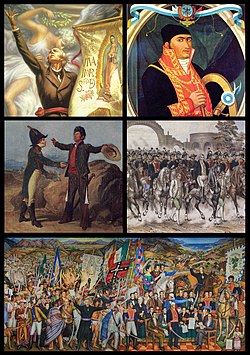
Santa Fe was Spain's provincial seat at the outbreak of the Mexican War of Independence in 1810.
Image source: Mexican War of Independence
1821
% complete
Nuevo México became a territory of Mexico after Mexican independence from Spain in 1821. The city's status as the capital was formalized in the 1824 Constitution after Mexico achieved independence.
1832 - 1841
% complete
The District Court of the Territory of New Mexico existed from 1832, when José María Nájera took possession of the court, until its de facto conclusion in 1837 when substitute judge Santiago Abreu was murdered, and its de jure closure in 1841 under orders from Antonio López de Santa Anna.
1836
% complete
When the Republic of Texas seceded from Mexico in 1836, it attempted to claim Santa Fe and other parts of Nuevo México as part of the western portion of Texas along the Río Grande.
1841
% complete
In 1841, a small military and trading expedition set out from Austin, intending to take control of the Santa Fe Trail.
Image source: Texan Santa Fe Expedition
1846
% complete
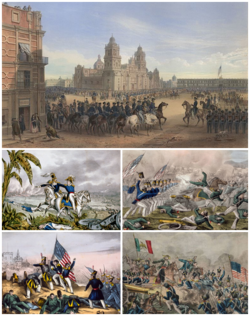
In 1846, the United States declared war on Mexico. Following the annexation of Texas, they claimed Santa Fe along with other territory in eastern New Mexico.
Image source: Mexican–American War
1846
% complete
Colonel Alexander William Doniphan, under the command of Kearny, recovered ammunition from Santa Fe labeled "Spain 1776", showing both the lack of communications and quality of military support New Mexico received under Mexican rule.
Image source: Alexander William Doniphan
1848
% complete
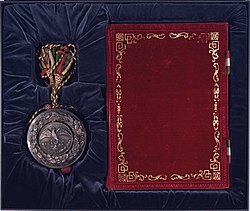
It was ceded to the United States in 1848 following the Mexican–American War, ending decades of Mexican governance over the region.
Image source: Treaty of Guadalupe Hidalgo
1850
% complete
These territorial disputes were finally resolved by the Compromise of 1850, which designated the 103rd meridian west as Texas's western border and resulted in California's statehood, and the establishment of the land claims of the Utah and New Mexico Territory.
Image source: Compromise of 1850
1851
% complete
In 1851 Santa Fe was named the capital of the U.S. Territory of New Mexico, continuing its long role as the seat of government for the region.
Image source: New Mexico Territory
Mar 1862
% complete
As part of the New Mexico Campaign of the Civil War, General Henry Sibley occupied the city, flying the Confederate flag over Santa Fe for a few days in March 1862.
Image source: New Mexico campaign
1870
% complete
The Santa Fe National Cemetery was created by the federal government after the war in 1870 to inter the Union soldiers who died fighting there.
Image source: Santa Fe National Cemetery
Jun 17, 1891
% complete
The Territory of New Mexico incorporated the City of Santa Fe on June 17, 1891.
1912
% complete
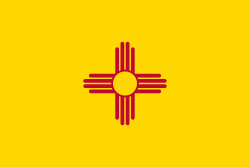
In 1912, New Mexico was admitted as the 47th U.S. state, making Santa Fe New Mexico's state capital. After 1912 the Pueblo Revival style became official: all buildings were to be built using these elements.
Image source: New Mexico
1851
% complete
In 1851, Jean Baptiste Lamy arrived, becoming bishop of New Mexico, Arizona, Utah, and Colorado in 1853. He built the Santa Fe Saint Francis Cathedral and shaped Catholicism in the region until his death in 1888.
Image source: Jean-Baptiste Lamy
Oct 21, 1887
% complete
On October 21, 1887, Anton Docher, "The Padre of Isleta", went to New Mexico where he was ordained as a priest in the St Francis Cathedral of Santa Fe by Bishop Jean-Baptiste Salpointe. After serving in Santa Fe, Bernalillo and Taos, he moved to Isleta on December 28, 1891.
Image source: Anton Docher
1907
% complete
Activists created a number of resources for the arts and archaeology, notably the School of American Research, created in 1907 under the leadership of the prominent archaeologist Edgar Lee Hewett.
Image source: School for Advanced Research
1917 - 1929
% complete
Adelina Otero-Warren, a leading suffragist in New Mexico, became one of the state's first female government officials when she served as superintendent of Santa Fe public schools from 1917 to 1929. In 1922, she also became the first Hispanic woman to run for the U.S. Congress.
Image source: Adelina Otero-Warren
1919
% complete
Edgar Lee Hewett began the Santa Fe Fiesta in 1919, reviving a celebration of the city's multicultural heritage that continues today.
Image source: Fiestas de Santa Fe
1922
% complete
Hewett began the Southwest Indian Fair in 1922, now known as the Indian Market, celebrating Native American art and culture.
Image source: Santa Fe Indian Market
1930
% complete
By 1930 there was a broadening to include the "Territorial" style, a style of the pre-statehood period which included the addition of portales (large, covered porches) and white-painted window and door pediments, with flat roofs still dominating.
1937
% complete
Founded in 1937, Performance Santa Fe brings celebrated and legendary musicians as well as some of the world's greatest dancers and actors to the city year-round.
Image source: Santa Fe, New Mexico
1957
% complete
By an ordinance passed in 1957, new and rebuilt buildings, especially those in designated historic districts, must exhibit a Spanish Territorial or Pueblo style of architecture, with flat roofs and other features suggestive of the area's traditional adobe construction.
1973
% complete
The Courthouse building, constructed in 1889, was added to the National Register of Historic Places in 1973.
1995
% complete
Launched in 1995, SITE Santa Fe organizes an international biennial of contemporary art in the United States, similar to exhibitions such as the Whitney Biennial and the Venice Biennale but at a smaller scale.
Image source: SITE Santa Fe
2005
% complete
Since 2005, Santa Fe has been designated as a UNESCO Creative City in Crafts and Folk Art, reflecting its renown as a center for arts and multiculturalism.
Image source: Creative Cities Network
2016
% complete
With support from George R. R. Martin, Meow Wolf opened an elaborate art installation space, called House of Eternal Return, in 2016.
Image source: Meow Wolf
2022
% complete
In 2022, Adelina Otero-Warren was one of five women chosen for the American Women Quarters Program, which honors women who have made notable contributions to the country.
Image source: American Women quarters
1880
% complete
A branch line was completed from Lamy to Santa Fe in 1880, connecting the city to the national rail network.
Image source: Atchison, Topeka and Santa Fe Railway
1886
% complete
The Denver and Rio Grande Western Railroad extended the narrow gauge Chili Line from the nearby city of Española to Santa Fe in 1886.
1926 - 1937
% complete
In its earliest alignment (1926–1937), US 66 ran through Santa Fe, bringing travelers and commerce through the city before the route was realigned.
Image source: U.S. Route 66 in New Mexico
Jun 1942
% complete
Beginning in June 1942, the Department of Justice arrested 826 Japanese-American men after the attack on Pearl Harbor; they held them near Santa Fe, in a former Civilian Conservation Corps site that had been acquired and expanded for the purpose. In February 1943, these civilian detainees were transferred to Department of Justice custody.
Image source: Santa Fe riot
Mar 1945
% complete
In 1945, four internees were seriously injured when violence broke out between the internees and guards in an event known as the Santa Fe Riot. The camp remained open past the end of the war; the last detainees were released in mid-1946.
1971 - 1997
% complete
Horse racing events were held at The Downs at Santa Fe from 1971 until 1997.
May 2012
% complete
In May 2012, Santa Fe became the home of the Santa Fe Fuego of the Pecos League of Professional Baseball Clubs.
2014
% complete
While previously the mayor could only vote when there was a tie among the city council, the city charter was amended by referendum in 2014 to allow the mayor to vote on all matters in front of the council.
2018
% complete
Since 2018, the role of mayor has been a full-time professional paid position within city government.
2020
% complete
As of the 2020 census, Santa Fe had a population of 87,505, growing by nearly 20,000 residents, or 28.8%, compared to 2010 — proportionally, the fastest recorded decennial growth rate since 1950. The median age in 2020 was 45.4 years.
Nov 2025
% complete
In November 2025, Santa Fe became the first city in the United States to pass an ordinance that directly links wages to housing affordability, addressing high rents and housing prices. Beginning in 2027, the city's minimum wage will increase to $17.50 and rise annually based on CPI and fair market rent data.
Jan 2026
% complete
The current mayor of Santa Fe is Michael Garcia, who succeeded Alan Webber in January 2026.
Jul 30, 2026
% complete
On July 30, 2026, the Santa Fe City Council and Santa Fe County Board of County Commissioners held their first Joint Governing Body Meeting under a new joint resolution calling for regular collaboration through 2029 focused on improvements for residents throughout the region.
1943
% complete
Santa Fe has been associated with science and technology since 1943, when it served as the gateway to Los Alamos National Laboratory (LANL), a 45-minute drive from the city.
Image source: Los Alamos National Laboratory
1984
% complete
In 1984, the Santa Fe Institute (SFI) was founded to research complex systems in the physical, biological, economic, and political sciences; it has hosted Nobel laureates such as Murray Gell-Mann, Philip Warren Anderson, and Kenneth Arrow.
Image source: Santa Fe Institute
1994
% complete
The National Center for Genome Resources (NCGR) was founded in 1994 to focus on research at the intersection of bioscience, computing, and mathematics.
2020
% complete
In 2020, Santa Fe announced efforts to become the "Silicon Valley of the Southwest" through partnerships with various educational, scientific, and business organizations aimed at creating a "technology ecosystem". The city is also part of the New Mexico Innovation Triangle (NMIT), launched in 2020 with Los Alamos and Albuquerque.
Or browse the full history timeline directory, with more than 2,000 topics.
This History of Santa Fe timeline was generated with the help of AI, using information found on the internet.
We work hard to keep these timelines accurate, but mistakes do get through. If you spot one, email us at [email protected] and we'll fix it for future visitors.
Generate yours with AI or build it from scratch, for free.
Export your timeline, add your own events, edit or remove AI-generated events, and much more
No credit card required.
Cancel anytime.
Cancel anytime.
You can create an unlimited number of timelines with up to 10 events on each one, customize how they look, export them to PDF, PNG, PowerPoint, CSV, and Excel, and share them with a link. Paid plans raise the event limit and add features like spreadsheet imports and collaborators.
Yes. You can cancel your subscription from your account page at any time, and you will not be charged again. Your subscription stays active for the rest of the period you already paid for.
Yes. We will email you a reminder before the annual renewal, and we will also email you a receipt.
Yes. You can email us within 15 days of any payment, and we will issue you a full refund.
Check out our pricing docs or send us an email anytime: [email protected].