-
Use Cases
-
Resources
-
Pricing
Ska is a music genre that originated in Jamaica in the late 1950s, combining Caribbean mento and calypso with American jazz and rhythm and blues. Characterized by its upbeat, offbeat rhythm, ska laid the foundation for rocksteady and reggae. The genre evolved through three major waves: the original Jamaican era, the British 2 Tone movement of the late 1970s, and the American third-wave scene of the 1980s and 1990s. More Less
1956
% complete
The R&B/shuffle tune "My Boy Lollypop" was first recorded in New York in 1956 by 14-year-old Barbie Gaye, providing the song that Millie Small would later cover.
Image source: Millie Small
1959
% complete
The first ska recordings were initially made to be played on "soft wax", a lacquer on metal disc acetate later to become known as a "dub plate".
Image source: Ska
1959
% complete
A further theory about the origin of the word ska is that it derives from Johnson's word skavoovie, with which he was known to greet his friends.
1959
% complete
At a recording session produced by Coxsone Dodd, double bassist Cluett Johnson instructed guitarist Ranglin to "play like ska, ska, ska". Ranglin later denied this account, stating that Clue couldn't tell him what to play.
Jul 1, 1959 - Dec 31, 1959
% complete
As demand for the early recordings grew, sometime in the second half of 1959, believed by most to be in the last quarter, producers such as Coxsone Dodd and Duke Reid began to issue these recordings on 45 rpm 7-inch discs.
1962
% complete
The ska sound coincided with the celebratory feelings surrounding Jamaica's independence from the UK in 1962, an event commemorated by songs such as Derrick Morgan's "Forward March" and the Skatalites' "Freedom Sound".
1964
% complete
Small's rhythmically similar version of "My Boy Lollypop", released in 1964, was Jamaica's first commercially successful international hit.
1964
% complete
Byron Lee & the Dragonaires performed ska with Prince Buster, Eric "Monty" Morris, and Jimmy Cliff at the 1964 New York World's Fair, helping to bring the Jamaican sound to an international audience.
1965 - 1966
% complete
In 1965 and 1966, when American soul music became slower and smoother, ska changed its sound accordingly and evolved into rocksteady.
1967
% complete
Rocksteady's heyday was brief, peaking in 1967 before the genre itself gave way to a newer Jamaican sound.
1968
% complete
By 1968, ska evolved again into reggae, marking the next major transformation of Jamaica's popular music.
Image source: Reggae
1979
% complete
The Specials recorded "A Message to You Rudy" in 1979, featuring Rico Rodriguez, who played trombone on both the original Dandy Livingstone recording and the Specials' version.
Image source: A Message to You Rudy
1981
% complete
The Uptones from Berkeley, California, formed in 1981, were among the first active ska bands in North America during the emerging third wave.
Image source: The Uptones
1981
% complete
The Toasters from New York City, formed in 1981, were among the first active ska bands in North America, playing a key role in launching the American ska revival.
Image source: The Toasters
1983
% complete
Some of the Australian ska revival bands found success on the national music charts, most notably Allniters, who had a number 10 hit with a ska cover of "Montego Bay" in 1983.
1983
% complete
In New York, Toasters frontman Robert "Bucket" Hingley formed the independent record label Moon Ska Records in 1983, which became a cornerstone label for the American ska revival.
1985
% complete
The Tokyo Ska Paradise Orchestra, formed in 1985, have been one of the most commercially successful progenitors of Japanese ska.
Image source: Tokyo Ska Paradise Orchestra
1986
% complete
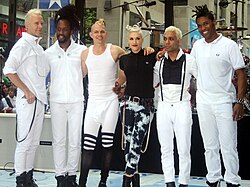
In 1986, No Doubt, a ska punk band, was formed. The band would go on to become one of the most commercially successful acts associated with the third wave of ska.
Image source: No Doubt
1989
% complete
Ska historian Albino Brown, of the radio program The Ska Parade, coined the term third-wave ska in 1989 and helped to catalyze such multi-platinum bands as No Doubt and Sublime.
1993
% complete
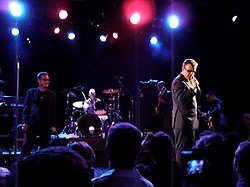
In 1993, the Mighty Mighty Bosstones signed with Mercury Records, becoming the first American ska punk band to find mainstream commercial success.
Image source: The Mighty Mighty Bosstones
1994
% complete
It was here that the term third-wave ska was popularized by Albino Brown and Tazy Phyllipz, hosts of the Ska Parade radio show, to describe the new wave of ska-influenced bands steadily gaining notoriety; Brown wrote the first treatise on ska's third wave in 1994.
1994
% complete
Latin American ska flourished with prominent bands including the Grammy nominated Desorden Público from Venezuela and Grammy awarded Los Fabulosos Cadillacs from Argentina, who scored an international hit single with "El Matador" in 1994.
Image source: Los Fabulosos Cadillacs
1994
% complete
The Mighty Mighty Bosstones' 1994 album Question the Answers achieved gold record status and peaked at number 138 on the Billboard 200.
1995
% complete
In 1995, punk band Rancid, featuring former members of Operation Ivy, released the ska punk single "Time Bomb", which reached number 8 on the Billboard Modern Rock Tracks, becoming the first major ska punk hit of the 1990s and launching the genre into the public eye.
1996
% complete
Asian Man Records, formerly Dill Records, founded in 1996, started out primarily releasing ska punk albums before branching out to other music styles.
1996
% complete
By 1996, third-wave ska was one of the most popular forms of alternative music in the United States.
2000
% complete
Moon Ska Records folded in 2000, but Moon Ska Europe, a licensed affiliate based in Europe, continued operating in the 2000s and was later relaunched as Moon Ska World.
Jan 1, 2001
% complete
In the early 21st century, ska was mostly absent from the radio, though there were exceptions keeping the genre visible to wider audiences.
2003
% complete
In 2003, Robert "Bucket" Hingley launched a new ska record label, Megalith Records, continuing his role in supporting the ska scene after Moon Ska's closure.
Image source: Megalith Records
2017
% complete
In 2017, Captain SKA reached number 4 on the UK Singles Chart with "Liar Liar GE2017", demonstrating that ska could still achieve mainstream chart success.
2018
% complete
In 2018, the Interrupters broke into the U.S., bringing renewed attention to ska music for a new generation of listeners.
Image source: The Interrupters (band)
2019
% complete
By 2019, several publications started speculating about whether a "fourth wave" of ska was about to emerge, pointing to a resurgence of interest in the genre.
Or browse the full history timeline directory, with more than 2,000 topics.
This History of Ska timeline was generated with the help of AI, using information found on the internet.
We work hard to keep these timelines accurate, but mistakes do get through. If you spot one, email us at [email protected] and we'll fix it for future visitors.
Generate yours with AI or build it from scratch, for free.
Export your timeline, add your own events, edit or remove AI-generated events, and much more
No credit card required.
Cancel anytime.
Cancel anytime.
You can create an unlimited number of timelines with up to 10 events on each one, customize how they look, export them to PDF, PNG, PowerPoint, CSV, and Excel, and share them with a link. Paid plans raise the event limit and add features like spreadsheet imports and collaborators.
Yes. You can cancel your subscription from your account page at any time, and you will not be charged again. Your subscription stays active for the rest of the period you already paid for.
Yes. We will email you a reminder before the annual renewal, and we will also email you a receipt.
Yes. You can email us within 15 days of any payment, and we will issue you a full refund.
Check out our pricing docs or send us an email anytime: [email protected].