
-
Use Cases
-
Resources
-
Pricing
Stockholm, the capital of Sweden, was founded around 1252 by Birger Jarl as a fortified town on Lake Mälaren. Over the centuries it grew into Sweden's political, cultural, and economic center, becoming the seat of royal power during the Vasa dynasty, flourishing as a trading hub of the Hanseatic world, and evolving into a modern Scandinavian metropolis known for its architecture, museums, and innovation. More Less
1000 - 1240
% complete
While no solid proof exists, it is often assumed that the Three Crown Castle, which preceded the present Stockholm Palace, originated from these wooden structures, and that the medieval city quickly expanded around it.
Image source: Tre Kronor (castle)
1000
% complete
According to a 17th-century myth, the population at the Viking settlement Birka decided to found a new settlement. To determine its location, they had a log bound with gold drifting in Lake Mälaren, which came ashore where Stockholm now stands.
Image source: History of Stockholm
1000
% complete
The most established explanation for the name Stockholm are logs driven into the strait passing north of today's old town, which dendrochronological examinations in the late 1970s dated to around the year 1000.
1252
% complete
The name Stockholm first appears in historical records in letters written by Birger Jarl and King Valdemar in 1252, marking the earliest documented reference to the city.
Image source: Birger Jarl
1275 - 1300
% complete
During the end of the 13th century, Stockholm quickly grew to become not only the largest city in Sweden, but also the de facto Swedish political centre and royal residence.
1452
% complete
In 1452, a Danish fleet made a failed attack on Stockholm during the turbulent era of the Kalmar Union, when controlling the city was crucial for anyone aspiring to control the kingdom.
1471
% complete
Sten Sture the Elder defeated Christian I of Denmark at the Battle of Brunkeberg in 1471, only to lose the city of Stockholm to Hans of Denmark in 1497.
Image source: Battle of Brunkeberg
1490 - 1500
% complete
By the end of the 15th century, the population in Stockholm can be estimated at 5,000–7,000 people, making it a relatively small town compared to several other contemporary European cities.
1501 - 1509
% complete
Sten Sture managed to seize power again in 1501, which resulted in a Danish blockade lasting from 1502 to 1509 and eventually a short peace.
1520
% complete
Christian II of Denmark finally conquered Stockholm in 1520 and had many leading nobles and burghers beheaded in the so-called Stockholm Bloodbath.
Image source: Stockholm Bloodbath
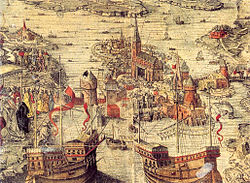
1523
% complete
Gustav Vasa invited the clergyman Olaus Petri (1493–1552) to become the city secretary of Stockholm, bringing new ideas to the city's administration.
Image source: Olaus Petri
1525
% complete
With Gustav Vasa and Olaus Petri working side by side, the new ideas of the Protestant Reformation could be quickly implemented; sermons in the church were held in Swedish starting in 1525, and Latin was abolished in 1530.
1530 - 1539
% complete
The Reformation created a need for separate churches for the numerous German and Finnish-speaking citizens, and during the 1530s the still-existent German and Finnish parishes were created.
1550 - 1599
% complete
Stockholm's social and economic importance grew to such an extent that no king could permit the city to determine its own faith — its most important export item being bar iron, with Lübeck as the most important destination.
1560 - 1580
% complete
Around 1560–80, most of Stockholm's citizens, some 8,000 people, still lived on Stadsholmen, the island at the heart of the medieval city.
Image source: Gamla Stan
1561 - 1611
% complete
During the reign of the sons of Gustav Vasa (1561–1611), the city council remained escorted by a royal representative, and both magistrates and aldermen were appointed by the king.
1600 - 1699
% complete
Throughout the 17th century, countless foreign visitors marvelled at the sight of large ships 'with 60 or 70 cannons' moored along the eastern quay next to the royal castle, one of the best natural harbours of the era.
Image source: Stockholm
1620
% complete
With the introduction of a mercantile doctrine around 1620, trade became a keystone to governmental income and the Swedish economy focused on exporting refined products rather than raw materials.
Image source: Mercantilism
1624
% complete
In 1624, the first prison in Stockholm, called 'Tukthuset', was established as part of the growing state apparatus in the capital.
1625
% complete
The process of reshaping Stockholm was initiated by a major fire in 1625 which destroyed the south-western part of today's old town, opening the way for modernization.
1633
% complete
In 1633, the 'Great Orphanage' (Stora barnhuset) was established in Norrmalm to care for the many children left destitute in the rapidly growing capital.
Image source: Stora Barnhuset
1635 - 1644
% complete
Stockholm's income rose from 18,595 daler in 1635–36 to 81,480 daler in 1644, reflecting the city's booming economy during Sweden's era as a great power.
1636
% complete
In a letter in 1636, Chancellor Axel Oxenstierna wrote that evolving the Swedish capital was a prerequisite for the nation's power and strength, and that this would bring all other cities on their feet.
Image source: Axel Oxenstierna
1642
% complete
In 1642, approximately 60 per cent of Stockholm's income was spent on construction works, transforming the medieval city into a worthy capital of a European great power.
1642
% complete
Beggars were prohibited in Stockholm in 1642, including those who were legally allowed to beg, as part of efforts to impose order on the expanding capital.
1673 - 1691
% complete
In the 17th century, the textile industry developed with the establishments of Paulinska manufakturerna (active 1673–1776) and Barnängens manufaktur (active 1691–1826), two of the greatest sources of employment in the capital during the entire 18th century.
Image source: Barnängens manufaktur
1700 - 1799
% complete
During the 18th century, several devastating fires destroyed entire neighbourhoods, resulting in building codes being introduced that prohibited wooden buildings and implemented the ambitious 17th-century city plans.
1722
% complete
Following the Greater Wrath and the Treaty of Nystad in 1722, Sweden's role as a major European power was over, and the decades that followed brought even more disasters to Stockholm.
Image source: Treaty of Nystad
1782
% complete
King Gustav III created the Gustav Adolf square and had the Royal Opera inaugurated there in 1782, in accordance with the original intentions of Tessin the Younger for a monumental square north of the palace.
Image source: Royal Swedish Opera
1790 - 1807
% complete
The neoclassical bridge Norrbro, designed by Erik Palmstedt (1741–1807), was completed over ten years, connecting the old town with Norrmalm across the waterways.
Image source: Norrbro
1806
% complete
Steam engines were introduced in Stockholm in 1806 with the Eldkvarn mill, though it would take until the mid-19th century for industrialization to truly take off in the city.
Image source: Eldkvarn (band)
1809
% complete
The period ended as King Gustav IV Adolf was deposed in 1809 in a coup d'état, an event that also coincided with Sweden's loss of Finland, deepening the despair felt in Stockholm.
Image source: Gustav IV Adolf
1819 - 1909
% complete
As a result of the vulnerability exposed by the loss of Finland, the fortress Karlsborg was built between 1819 and 1909 to serve as a backup capital in wartime.
Image source: Karlsborg Fortress
1840 - 1870
% complete
Two factories, Ludvigsberg and Bolinder, constructed in the 1840s were followed by many others, resulting in some 800 new buildings constructed between 1850 and 1870 — many later demolished in the Redevelopment of Norrmalm 1950–70.
1866
% complete
In 1866, a commission led by Albert Lindhagen produced a city plan for the ridges (malmarna), designed to offer citizens light, fresh air, and access to Swedish nature by means of parks and plantations.
Image source: Albert Lindhagen
1871
% complete
As the railway was extended further north, Stockholm Central Station was inaugurated in 1871, becoming the hub of Sweden's expanding railway network.
Image source: Stockholm Central Station
1877
% complete
The first horse-pulled trams were introduced in Stockholm in 1877, improving public transportation in the rapidly expanding capital.
Image source: Trams in Stockholm
1877 - 1880
% complete
Between 1877 and 1880, new city plans were finally passed for central Stockholm, which made the city well-prepared for the major expansion that followed.
1897
% complete
The General Art and Industrial Exposition, an international exhibition of World's Fair status, was held on the island of Djurgården in 1897, showcasing Stockholm's ambitions as a modern capital.
Image source: General Art and Industrial Exposition of Stockholm
1898 - 1904
% complete
The new century saw the introduction of Art Nouveau with the Central Post Office Building by Boberg (1898–1904), alongside Neo-Baroque exemplified by the Riksdag building (1894–1906).
Image source: Manila Central Post Office
1923
% complete
In 1923, the Stockholm municipal government moved to a new building, the Stockholm City Hall, one of the city's most iconic landmarks and today the site of the Nobel Prize banquet.
Image source: Stockholm City Hall
1930
% complete
The Stockholm International Exhibition was held in 1930, introducing functionalist architecture to Sweden and shaping the city's modern urban development.
Image source: Stockholm Exhibition (1930)
1967
% complete
In 1967, the city of Stockholm was integrated into Stockholm County, aligning municipal boundaries with regional administration as the metropolitan area expanded.
Image source: Stockholm County
Apr 22, 1991
% complete
On April 22, 1991, thirty world leaders gathered in Stockholm, including Prime Minister Ingvar Carlsson, Willy Brandt, Julius Nyerere, Gro Harlem Brundtland, Kalevi Sorsa, and Edward Heath, underscoring the city's role on the international stage.
Or browse the full history timeline directory, with more than 2,000 topics.
This History of Stockholm timeline was generated with the help of AI, using information found on the internet.
We work hard to keep these timelines accurate, but mistakes do get through. If you spot one, email us at [email protected] and we'll fix it for future visitors.
Generate yours with AI or build it from scratch, for free.
Export your timeline, add your own events, edit or remove AI-generated events, and much more
No credit card required.
Cancel anytime.
Cancel anytime.
You can create an unlimited number of timelines with up to 10 events on each one, customize how they look, export them to PDF, PNG, PowerPoint, CSV, and Excel, and share them with a link. Paid plans raise the event limit and add features like spreadsheet imports and collaborators.
Yes. You can cancel your subscription from your account page at any time, and you will not be charged again. Your subscription stays active for the rest of the period you already paid for.
Yes. We will email you a reminder before the annual renewal, and we will also email you a receipt.
Yes. You can email us within 15 days of any payment, and we will issue you a full refund.
Check out our pricing docs or send us an email anytime: [email protected].