-
Use Cases
-
Resources
-
Pricing
Tehran, the capital of Iran, has a rich history spanning thousands of years. Originally a small village near the ancient city of Ray, it grew in prominence during the Safavid era and became the capital of Persia in 1786 under the Qajar dynasty. Today, Tehran is Iran's largest city and political, economic, and cultural center. More Less
850
% complete
In the ninth century, Tehran was a well-known village, but less so than the flourishing city of Rhages nearby.
Image source: Tehran
950
% complete
In the tenth century, Muslim geographers described Rhages in detail, reflecting its importance as a major regional city before the rise of Tehran itself.
Image source: Ray, Iran
1035
% complete
The Oghuz Turks invaded Rhages in 1035 and again in 1042, but the city was later recovered under the Seljuks and then the Khwarezmians.
1220
% complete
In the 13th century, the Mongols invaded Rhages, laid the city to ruins, and massacred many of its inhabitants, paving the way for Tehran's later growth in the region.
Image source: Mongol invasion of the Khwarazmian Empire
Jul 1404
% complete
Castilian ambassador Ruy González de Clavijo visited Tehran on his journey to Samarkand, capital of Turco-Mongol conqueror Timur, ruler of Iran at the time.
Image source: Ruy González de Clavijo
1618
% complete
Italian traveler Pietro della Valle passed through Tehran overnight in 1618, calling the city Taheran in his memoirs.
Image source: Pietro Della Valle
1627
% complete
English traveler Thomas Herbert entered Tehran in 1627 and mentioned it as Tyroan in his writings.
1760
% complete
In the early 18th century, Karim Khan of the Zand dynasty ordered a palace and government office built in Tehran, possibly to make it his capital, but he later moved his government to Shiraz.
Image source: Karim Khan Zand
1786
% complete
Qajar king Agha Mohammad Khan chose Tehran as the capital of Iran in 1786—its 51st such designation—due to its proximity to contested Caucasian territories and to avoid vying factions of prior dynasties.
Image source: Agha Mohammad Khan Qajar
1848 - 1896
% complete
During Naser al-Din Shah's long reign (1848–1896), Tehran witnessed Iran's first institute of higher learning, bank, railway line, and museum.
Image source: Naser al-Din Shah Qajar
1855
% complete
The first development plan of Tehran, drawn up in 1855, emphasized the city's traditional spatial structure.
1878
% complete
The second development plan, supervised by Dar al-Fonun in 1878, included new city walls forming a perfect octagon with an area of 19 square kilometers, mimicking the Renaissance cities of Europe.
Image source: Dar al-Fonun
1920
% complete
Large-scale construction works began in the 1920s, and Tehran became a destination for mass migrations from all over Iran, especially throughout the 20th century.
1925
% complete
After World War I, the constituent assembly elected Reza Shah of the Pahlavi dynasty as monarch, who immediately suspended the Baladie law of 1907, replacing autonomous city councils with centralist governance and planning.
Image source: Reza Shah
1933
% complete
Changes to Tehran's urban fabric began with the street-widening act of 1933, which served as a framework for changes in all other Iranian cities.
1937
% complete
In 1937 the old citadel and city walls were demolished and replaced by wide streets cutting through the urban fabric; by then Tehran was heavily influenced by modernist zoning and gridiron planning patterns.
1947
% complete
A notable structure from the old citadel was eventually demolished and replaced with a bank building in 1947, following reforms during the reign of Reza Shah.
1948
% complete
The establishment of the planning organization of Iran in 1948 resulted in the first socioeconomic development plan covering 1949 to 1955, though it failed to slow Tehran's unbalanced growth.
1962
% complete
With the 1962 land reforms that Mohammad Reza Shah named the White Revolution, Tehran's already chaotic growth was further accentuated.
Image source: White Revolution
1968
% complete
To resolve the problem of social exclusion, the first comprehensive plan for Tehran was approved in 1968, though it was later marginalized by the 1979 Revolution and the Iran–Iraq War.
2010
% complete
In 2010, the government announced that 'for security and administrative reasons' the plan to move the capital from Tehran had been finalized, including relocating 163 state firms and several universities due to earthquake risk—no major quake has struck Tehran since 1830.
2016
% complete
The 2016 census recorded 8,693,706 people in 2,911,065 households, up from 8,154,051 in 2011 and 7,711,230 in 2006. A 2010 University of Tehran survey found 63% born in Tehran and 75% identifying as ethnic Persian.
1865
% complete
The Golestan Palace was significantly rebuilt and expanded in 1865 by Haji Ab ol Hasan Mimar Navai, including the Brilliant Hall, the Mirror Hall, and the Edifice of the Sun.
Image source: Golestan Palace
1904
% complete
The first movie theater in Tehran was established by Mirza Ebrahim Khan in 1904.
Image source: Cinema of Iran
Oct 1967
% complete
Vahdat Hall, formerly known as Roodaki Hall, was inaugurated in October 1967 and named after prominent Persian poet Rudaki, serving as Iran's national stage for opera and ballet.
Image source: Vahdat Hall
1971
% complete
Tehran's most famous landmark, the Azadi Tower, was built by order of the Shah in 1971 to mark the 2,500th anniversary of the Persian Empire.
Image source: Azadi Tower
1972
% complete
The City Theater of Tehran, one of Iran's biggest theatre complexes containing several performance halls, was opened in 1972. Famous Persian cabarets were also active until 1979.
Image source: City Theater of Tehran
Sep 1974
% complete
The Azadi Sport Complex was originally built to host the 7th Asian Games in September 1974, followed by hosting the final of the 1968 AFC Asian Cup legacy events, the 6th AFC Asian Cup in June 1976, and the first West Asian Games in November 1997.
Image source: 1974 Asian Games
2007
% complete
The 435-meter-high Milad Tower, one of the proposed development projects of pre-revolutionary Iran, was completed in 2007 and became a famous landmark—the world's sixth-tallest self-supporting tower.
Image source: Milad Tower
2009
% complete
During the 2009 Iranian presidential election protests, many graffiti works supporting the Green Movement were created across Tehran. Several graffiti festivals followed, including one by the Tehran University of Art in October 2014.
Image source: 2009 Iranian presidential election protests
2012
% complete
Tehran has a small third-generation Indian Sikh community with a local gurdwara that was visited by Indian Prime Minister Manmohan Singh in 2012.
Image source: Holy Mary Metro Station
2014
% complete
Tabiat Bridge, a 270-meter pedestrian overpass designed by award-winning architect Leila Araghian and the largest pedestrian overpass in Tehran, was completed in 2014 and is considered a landmark.
Image source: Tabiat Bridge
2014
% complete
In 2014, Tehran hosted the FILA Wrestling World Cup event at the Azadi Indoor Stadium.
1906
% complete
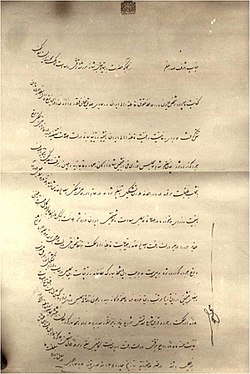
Growing awareness of civil rights resulted in the Constitutional Revolution and the first constitution of Iran in 1906.
Jun 2, 1907
% complete
On 2 June 1907, parliament passed the Baladie law on local governance, detailing the role of councils, members' qualifications, election processes, and voting requirements. October 6 is now celebrated as Tehran Day marking 1907.
Image source: Persian Constitutional Revolution
Jun 23, 1908
% complete
On 23 June 1908, Mohammad Ali Shah abolished the constitution and bombarded the parliament with the help of the Russian-controlled Cossack Brigade.
Image source: Mohammad Ali Shah Qajar
Jul 13, 1909
% complete
On 13 July 1909, revolutionary forces under Ali-Qoli Khan (Sardar Asad II) and Mohammad Vali Khan (Sepahsalar e Tonekaboni) captured Tehran.
1979
% complete
Tehran was at the center of the 1979 Iranian Revolution, after which the political system changed from constitutional monarchy to Islamic republic, profoundly transforming the city's urban landscape and social dynamics.
Image source: Iranian Revolution
Oct 6, 2016
% complete
In 2016, the Tehran City Council declared 6 October 'Tehran Day', celebrating the date in 1907 when the city officially became the capital of Iran. That year Tehran also ranked among the top ten fastest-growing tourism destinations globally.
Nov 28, 1943 - Dec 1, 1943
% complete
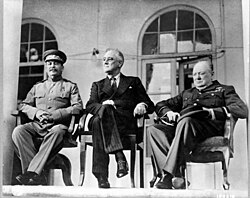
In 1943, Tehran was the site of the Tehran Conference attended by U.S., British, and Soviet leaders, a pivotal Allied summit during World War II.
Image source: Tehran Conference
1980 - 1988
% complete
During the Iran–Iraq War (1980–1988) and as part of the War of the Cities, Tehran was repeatedly targeted by airstrikes and Scud missile attacks, causing substantial infrastructural damage.
Image source: Iran–Iraq War
Jun 2025
% complete
In the Twelve-Day War of June 2025, Tehran was attacked by Israeli airstrikes and, in an unprecedented move, the people of Tehran committed mass evacuations.
Image source: Twelve-Day War
Mar 8, 2026
% complete
On 8 March 2026, Israeli strikes on oil depots near Tehran caused the city to be engulfed in a cloud of thick black smoke, resulting in dangerous black acid rainfall amid the ongoing 2026 Iran war.
1960
% complete
The Parks and Green Spaces Organization of Tehran was established in 1960 and is responsible for protecting urban nature in the city.
Feb 2005
% complete
In February 2005, heavy snow covered all parts of Tehran.
Jan 5, 2008 - Jan 7, 2008
% complete
On 5 and 6 January 2008, heavy snow and low temperatures covered Tehran in thick snow and ice, forcing the Council of Ministers to declare a state of emergency and close down the capital from 6 to 7 January.
2009
% complete
In 2009, Ab-o-Atash Park ('Water and Fire park') was founded in Tehran, later connected by the Tabiat pedestrian bridge.
Feb 3, 2014
% complete
On 3 February 2014, Tehran received heavy snowfall, especially in northern parts of the city, with a depth of 2 metres (6.6 ft).
Jun 3, 2014
% complete
On 3 June 2014, a severe thunderstorm with powerful microbursts created a haboob engulfing Tehran in sand and dust, causing five deaths and more than 57 injuries.
Jul 2025 - Aug 2025
% complete
In July and August 2025, Tehran experienced extreme heat and severe drought conditions, marking one of the most acute environmental crises in the city's recent history.
2008
% complete
Tehran's bus rapid transit (BRT) system was officially inaugurated in 2008; by 2011 it had a network of 100 km transporting 1.8 million passengers daily.
Image source: Tehran Bus Rapid Transit
Mar 2016
% complete
After closing around 2013, Tehran's trolleybus system reopened in March 2016 on a single 1.8-km route between Khorasan Square and Bozorgrah-e-Be'sat, having earlier operated five routes from Imam Hossein Square since its 1992 opening.
Image source: Trolleybuses in Tehran
Or browse the full history timeline directory, with more than 2,000 topics.
This History of Tehran timeline was generated with the help of AI, using information found on the internet.
We work hard to keep these timelines accurate, but mistakes do get through. If you spot one, email us at [email protected] and we'll fix it for future visitors.
Generate yours with AI or build it from scratch, for free.
Export your timeline, add your own events, edit or remove AI-generated events, and much more
No credit card required.
Cancel anytime.
Cancel anytime.
You can create an unlimited number of timelines with up to 10 events on each one, customize how they look, export them to PDF, PNG, PowerPoint, CSV, and Excel, and share them with a link. Paid plans raise the event limit and add features like spreadsheet imports and collaborators.
Yes. You can cancel your subscription from your account page at any time, and you will not be charged again. Your subscription stays active for the rest of the period you already paid for.
Yes. We will email you a reminder before the annual renewal, and we will also email you a receipt.
Yes. You can email us within 15 days of any payment, and we will issue you a full refund.
Check out our pricing docs or send us an email anytime: [email protected].