-
Use Cases
-
Resources
-
Pricing
1664 - 1685
% complete
Some of the earliest known experiments with acoustic transmission were conducted by the British physicist and polymath Robert Hooke from 1664 to 1685.
Image source: Tin-can telephone
1667
% complete
Robert Hooke invented an acoustic string phone that conveys sounds over an extended wire by mechanical vibrations. An acoustic string phone made in 1667 has been attributed to him.
1753
% complete
Charles Morrison proposed the idea that electricity could be used to transmit messages, by using different wires for each letter.
Image source: History of the telephone
1804
% complete
In 1804, Spanish polymath and scientist Francisco Salva Campillo constructed an electrochemical telegraph, one of the earliest attempts at electric communication.
Image source: Electrical telegraph
1816
% complete
The first working telegraph was built by the English inventor Francis Ronalds in 1816 and used static electricity.
1832
% complete
An electromagnetic telegraph was created by Baron Schilling in 1832, advancing the technology toward practical electric communication.
1833
% complete
Carl Friedrich Gauss and Wilhelm Weber built another electromagnetic telegraph in 1833 in Göttingen.
1837
% complete
Another electrical telegraph was independently developed and patented in the United States in 1837 by Samuel Morse.
Jan 6, 1838
% complete
America's first telegraph was sent by Morse on January 6, 1838, across 2 miles (3 km) of wiring.
Apr 9, 1839
% complete
The line ran for 13 mi (21 km) from Paddington station to West Drayton and came into operation on April 9, 1839.
1844
% complete
Innocenzo Manzetti first mooted the idea of a "speaking telegraph" (telephone) in 1844.
1849
% complete
Antonio Meucci developed a voice-communication apparatus that several sources credit as the first telephone.
Image source: Antonio Meucci
1854
% complete
Charles Bourseul wrote a memorandum on the principles of the telephone in 1854.
Jun 2, 1854
% complete
Antonio Meucci demonstrated an electric voice-operated device in New York; exactly what kind of device he demonstrated is unknown.
Dec 28, 1871
% complete
Antonio Meucci filed a patent caveat (No. 3353), a notice of intent to invent but not a formal patent application, at the U.S. Patent Office. In June 2002, the U.S. House of Representatives passed a resolution recognizing Meucci's contributions 'in' the invention of the telephone.
1875
% complete
Thomas Edison experimented with acoustic telegraphy and in November built an electro-dynamic receiver, but did not exploit it.
Image source: Thomas Edison
Jul 1, 1875
% complete
Bell used a bi-directional "gallows" telephone that was able to transmit "voicelike sounds", but not clear speech.
Jan 20, 1876
% complete
Bell signed and notarized his patent application for the telephone on January 20, 1876.
Feb 11, 1876
% complete
Elisha Gray designed a liquid transmitter for use with a telephone, but did not build one.
Image source: Elisha Gray
Mar 7, 1876
% complete
Bell's U.S. patent was granted on March 7, 1876, becoming the first telephone patent.
Image source: Invention of the telephone
Mar 10, 1876
% complete
Bell transmitted the sentence: "Mr. Watson, come here, I want to see you", marking the first successful transmission of clear speech by telephone.
Aug 10, 1876
% complete
Using the telegraph line between Brantford and Paris, Ontario, eight miles (thirteen kilometres) distant, Bell made a telephone call said by some to be the "world's first long-distance call".
Image source: Alexander Graham Bell
1877
% complete
Emile Berliner invented an improved telephone transmitter in 1877. After protracted litigation, a federal court ruled in 1892 that Edison, not Berliner, was the inventor of the carbon microphone.
Image source: Emile Berliner
Jan 30, 1877
% complete
Bell's second U.S. patent for the telephone was granted on January 30, 1877.
Apr 27, 1877
% complete
Edison filed for a patent on a carbon (graphite) transmitter. Patent No. 474,230 was granted on May 3, 1892, after a 15-year delay because of litigation.
Image source: Carbon microphone
Oct 6, 1877
% complete
Scientific American published the invention from Bell—at that time still without a ringer—spreading awareness of the new device.
Jan 14, 1878
% complete
Bell demonstrated the telephone to Queen Victoria and made the first publicly witnessed long-distance calls in the UK.
1879
% complete
Edison was granted patent No. 222,390 for a carbon granules transmitter in 1879. In 1877 and 1878, Edison had invented and developed the carbon microphone used in all telephones along with the Bell receiver until the 1980s.
1892
% complete
After protracted patent litigation, a federal court ruled in 1892 that Edison and not Emile Berliner was the inventor of the carbon microphone. The Edison patents kept the Bell monopoly viable into the 20th century.
1872
% complete
Elisha Gray established the Western Electric Manufacturing Company in 1872, which would become a major player in telephone equipment manufacturing.
1875
% complete
Hungarian Tivadar Puskás, the inventor of the telephone exchange, arrived in the USA in 1875.
Image source: Tivadar Puskás
1876
% complete
The telephone exchange was an idea of the Hungarian engineer Tivadar Puskás (1844–1893) in 1876, while he was working for Thomas Edison on a telegraph exchange.
1877
% complete
The first experimental Telephone Exchange was established in Boston in 1877.
Image source: Telephone exchange
Apr 27, 1877
% complete
George Coy was inspired by Alexander Graham Bell's lecture at the Skiff Opera House in New Haven on April 27, 1877.
Image source: Frontier Communications of Connecticut
Nov 3, 1877
% complete
On November 3, 1877, Coy applied for and received a franchise from the Bell Telephone Company for New Haven and Middlesex Counties.
Nov 12, 1877
% complete
The first commercial telephone company entered telephone business in Friedrichsberg close to Berlin using the Siemens pipe as ringer and telephone devices built by Siemens.
Jan 15, 1878
% complete
Frost and Walter Lewis, who provided the capital, established the District Telephone Company of New Haven on January 15, 1878.
Jan 28, 1878
% complete
The first commercial telephone exchange opened at New Haven, Connecticut, with 21 subscribers, in a storefront of the Boardman Building.
Feb 21, 1878
% complete
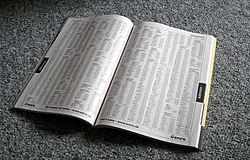
By February 21, 1878, when the first telephone directory was published by the company, fifty subscribers were listed.
Image source: Telephone directory
1880
% complete
By 1880, the company had the right from the Bell Telephone Company to service all of Connecticut and western Massachusetts.
1882
% complete
As it expanded, the company was first renamed Connecticut Telephone, and then Southern New England Telephone in 1882.
1888
% complete
The Pulsion Telephone Supply Company, created by Lemuel Mellett in Massachusetts, designed its version in 1888 and deployed it on railroad right-of-ways.
1893
% complete
Around 1893, the country leading the world in telephones per 100 persons was Sweden with 0.55 in the whole country but 4 in Stockholm (10,000 out of a total of 27,658 subscribers). The United States became the world leader after the Bell patents expired in 1893 and 1894.
1904
% complete
By 1904, over three million phones were connected by manual switchboard exchanges in the U.S., reflecting rapid adoption of the telephone.
1900
% complete
What turned out to be the most popular and longest-lasting physical style of telephone was introduced in the early 20th century, including Bell's model 102 telephone.
Image source: Western Electric hand telephone sets
1915
% complete
The first U.S. coast-to-coast long-distance telephone call was made in 1915, demonstrating the reach of the expanding national network.
1919 - 1931
% complete
Wodehouse, a British author, showed that at least during the era including 1919 and possibly up until 1931, the British answered the phone by saying, "Are you there?", finding "hello" too abrupt.
Image source: Hello
Jan 7, 1927
% complete
The first transatlantic phone call was made from the United States to the United Kingdom via radio, connecting the continents by voice for the first time.
Image source: Transatlantic communications cable
Dec 1947
% complete
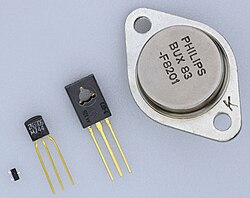
In December 1947, Bell Labs engineers Douglas H. Ring and others laid groundwork for advances in telecommunications electronics that would transform telephony.
Image source: Transistor
1956
% complete
The 1956 inauguration of the TAT-1 cable and later international direct dialing were important steps in putting together the various continental telephone networks into a global network.
Image source: TAT-1
1959
% complete
Mohamed Atalla and Dawon Kahng developed the MOSFET at Bell Telephone Laboratories in 1959, and the MOS integrated circuit chip was proposed soon after, though MOS technology was initially overlooked by Bell before being commercialized by Fairchild and RCA.
Image source: MOSFET
1963
% complete
After the rotary dial was added to telephones, the instrument itself changed little until Touch-Tone signaling started replacing the rotary dial in the 1960s.
Image source: DTMF signaling
1970
% complete
The British companies Pye TMC, Marconi-Elliott and GEC developed the digital push-button telephone, based on MOS IC technology, in 1970, and demonstrated it in the United Kingdom.
Image source: Telephony
1971 - 1973
% complete
Between 1971 and 1973, Bell combined MOS technology with touch-tone technology to develop a push-button MOS touch-tone phone called the "Touch-O-Matic" telephone, which could store up to 32 phone numbers.
Apr 3, 1973
% complete
Motorola manager Martin Cooper placed a cellular-phone call (in front of reporters) to Dr. Joel Engel of Bell Labs, marking the birth of mobile telephony.
Image source: Martin Cooper (inventor)
1974
% complete
In 1974, Hodges and Gray worked with R.E. Kerwin and others on CMOS technology that would underpin digital telephony.
Image source: CMOS
1980
% complete
Work by Black in 1980 has since been the industry standard for digital telephony, shaping how voice is digitized and transmitted worldwide.
1990
% complete
One of the early cable operators in the UK, Cable London, connected its first cable telephone customer in about 1990.
2000
% complete
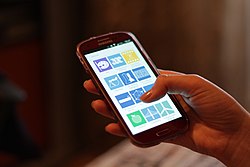
Telecommunication of the 21st century has been dominated by the development of the smartphone, which merged telephony with computing, internet access, and multimedia.
Image source: Smartphone
Or browse the full history timeline directory, with more than 2,000 topics.
This History of the Telephone timeline was generated with the help of AI, using information found on the internet.
We work hard to keep these timelines accurate, but mistakes do get through. If you spot one, email us at [email protected] and we'll fix it for future visitors.
Generate yours with AI or build it from scratch, for free.
Export your timeline, add your own events, edit or remove AI-generated events, and much more
No credit card required.
Cancel anytime.
Cancel anytime.
You can create an unlimited number of timelines with up to 10 events on each one, customize how they look, export them to PDF, PNG, PowerPoint, CSV, and Excel, and share them with a link. Paid plans raise the event limit and add features like spreadsheet imports and collaborators.
Yes. You can cancel your subscription from your account page at any time, and you will not be charged again. Your subscription stays active for the rest of the period you already paid for.
Yes. We will email you a reminder before the annual renewal, and we will also email you a receipt.
Yes. You can email us within 15 days of any payment, and we will issue you a full refund.
Check out our pricing docs or send us an email anytime: [email protected].