-
Use Cases
-
Resources
-
Pricing
The history of radio traces the development of wireless communication technology from the late 19th century experiments of Heinrich Hertz and Guglielmo Marconi, through the rise of commercial broadcasting in the 1920s, radio's golden age during the mid-20th century, and its evolution into FM stereo, satellite, digital, and internet streaming formats that continue to shape global communication today. More Less
1864 - 1865
% complete
In an 1864 presentation, published in 1865, James Clerk Maxwell proposed theories of electromagnetism and mathematical proofs demonstrating that light, radio and x-rays were all types of electromagnetic waves propagating through free space.
Image source: James Clerk Maxwell
1886 - 1888
% complete
Between 1886 and 1888, Heinrich Rudolf Hertz published the results of experiments wherein he was able to transmit electromagnetic waves (radio waves) through the air, proving Maxwell's electromagnetic theory.
Image source: Heinrich Hertz
1890 - 1892
% complete
Between 1890 and 1892 physicists such as John Perry, Frederick Thomas Trouton and William Crookes proposed electromagnetic or Hertzian waves as a navigation aid or means of communication, with Crookes writing on the possibilities of wireless telegraphy based on Hertzian waves in 1892.
Image source: William Crookes
Jun 1, 1894
% complete
Following Hertz's untimely death in 1894, British physicist and writer Oliver Lodge presented a widely covered lecture on Hertzian waves at the Royal Institution on June 1 of the same year.
Image source: Oliver Lodge
1895
% complete
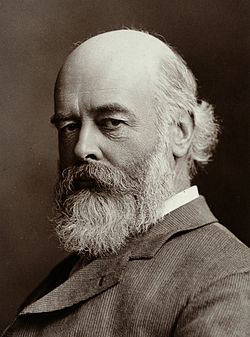
Russian physicist Pyotr Lebedev in 1895 conducted experiments in the 50 GHz (6 millimeter) range.
Image source: Pyotr Lebedev
May 7, 1895
% complete
In 1895, adapting techniques presented in Lodge's published lectures, Russian physicist Alexander Stepanovich Popov built a lightning detector that used a coherer-based radio receiver. He presented it to the Russian Physical and Chemical Society on May 7, 1895, known as Radio Day in Russia.
Image source: Aleksandr Popov (physicist)
Nov 1895
% complete
In his essay 'Adrisya Alok' ('Invisible Light'), he described how in November 1895 he conducted a public demonstration at the Town Hall of Kolkata, India using millimeter-range-wavelength microwaves to trigger detectors that ignited gunpowder and rang a bell at a distance.
Image source: Jagadish Chandra Bose
1894
% complete
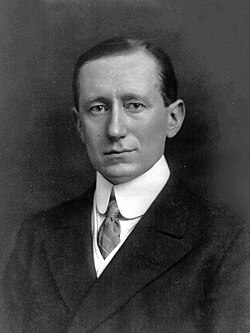
In 1894, the young Italian inventor Guglielmo Marconi began working on the idea of building long-distance wireless transmission systems based on the use of Hertzian waves (radio waves), a line of inquiry that he noted other inventors did not seem to be pursuing.
Image source: Guglielmo Marconi
Aug 1895
% complete
By August 1895, Marconi was field testing his system but even with improvements he was only able to transmit signals up to one-half mile, a distance Oliver Lodge had predicted in 1894 as the maximum transmission distance for radio waves.
1896
% complete
His apparatus proved to be the first engineering-complete, commercially successful radio transmission system and Marconi filed British patent GB189612039A, Improvements in transmitting electrical impulses and signals and in apparatus there-for, in 1896.
1897 - 1898
% complete
In 1897, Marconi established a radio station on the Isle of Wight, England and opened his 'wireless' factory in the former silk-works at Hall Street, Chelmsford, England, in 1898, employing around 60 people.
Jul 2, 1897
% complete
The patent for improvements in transmitting electrical impulses and signals was granted in the UK on 2 July 1897.
Dec 12, 1901
% complete
On 12 December 1901, using a 500-foot kite-supported antenna for reception with signals transmitted by the company's new high-power station at Poldhu, Cornwall, Marconi transmitted a message across the Atlantic Ocean to Signal Hill in St. John's.
Image source: Transatlantic telegraph cable
1904
% complete
In 1904, he established a commercial service to transmit nightly news summaries to subscribing ships, which could incorporate them into their on-board newspapers.
Oct 17, 1907
% complete
A regular transatlantic radio-telegraph service was finally begun on 17 October 1907 between Clifden, Ireland, and Glace Bay, but even after this the company struggled for many years to provide reliable communication to others.
1897
% complete
Using various patents, the British Marconi company was established in 1897 by Guglielmo Marconi and began communication between coast radio stations and ships at sea. It operated much the way American Telephone and Telegraph operated until 1983, owning all of its equipment and refusing to communicate with non-Marconi equipped ships.
May 27, 1903
% complete
The company Telefunken was founded on May 27, 1903 as 'Telefunken society for wireless telefon' of Siemens & Halske and the Allgemeine Elektrizitäts-Gesellschaft as joint undertakings for radio engineering in Berlin. It continued as a joint venture until Siemens left in 1941.
Image source: Telefunken
1910
% complete
To enhance safety, the Wireless Ship Act of 1910 marked the first time the U.S. government regulated radio, requiring ships to carry wireless equipment.
Image source: Wireless Ship Act of 1910
1911
% complete
In 1911, Kaiser Wilhelm II sent Telefunken engineers to West Sayville, New York to erect three 600-foot (180-m) radio towers there.
1912
% complete
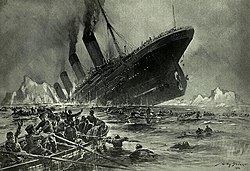
This factor played a role during the sinking of the Titanic in 1912. In 1912 distress calls to aid the sinking Titanic were met with a large amount of interfering radio traffic, severely hampering the rescue effort. Subsequently, the US government passed the Radio Act of 1912 to help mitigate the repeat of such a tragedy.
Image source: Sinking of the Titanic
1922 - 1924
% complete
The test case was against Bamberger's Department Store in Newark, New Jersey in 1922. With this ruling ASCAP began collecting licensing fees from radio stations in 1923, and had to defend their right to charge fees again in 1924. Radio and TV licensing became the single greatest source of revenue for ASCAP.
Image source: American Society of Composers, Authors and Publishers
1927
% complete
The Radio Act of 1927 gave the Federal Radio Commission the power to grant and deny licenses, and to assign frequencies and power levels for each licensee. In 1928 it began requiring licenses of existing stations and setting controls on who could broadcast from where on what frequency and at what power. Section 29 stated broadcast content should be freely present without government interference.
Image source: Radio Act of 1927
1931 - 1938
% complete
Radio ownership grew from two out of five homes in 1931 to four out of five homes in 1938. Meanwhile, record sales fell from $75 million in 1929 to $26 million in 1938 (with a low point of $5 million in 1933), though the economics were also affected by the Great Depression.
1934
% complete
The introduction of the Communications Act of 1934 led to the establishment of the Federal Communications Commission (FCC).
Image source: Communications Act of 1934
1948
% complete
At a meeting in Copenhagen in 1948, a new wavelength plan was set up for Europe.
Image source: History of radio
1996
% complete
The Telecommunications Act of 1996 was the first significant overhaul in over 60 years amending the work of the Communications Act of 1934. Its effects have been seen, but some changes it set out to fix are still ongoing problems, such as being unable to create an open competitive market.
1900
% complete
By the fall of 1900, he successfully transmitted speech over a distance of about 1.6 kilometers (one mile), which appears to have been the first successful audio transmission using radio signals.
1904
% complete
In 1904, Austrian physicist Otto Nußbaumer was the first to transmit music wirelessly at Albert von Ettingshausen's university lab in Graz.
Image source: Otto Nußbaumer
1922 - 1930
% complete
The first car radio was introduced in 1922, but it was so large that it took up too much space in the car. The first commercial car radio that could easily be installed in most cars went for sale in 1930.
Image source: Vehicle audio
1924 - 1929
% complete
The invention of the superheterodyne receiver solved tuning problems, and the first radios with a heterodyne radio receiver went for sale in 1924. But it was costly, and the technology was shelved while waiting to mature; in 1929 the Radiola 66 and Radiola 67 went for sale.
Image source: Superheterodyne receiver
1924
% complete
Documents including maps and photographs went by radiofax, or wireless photoradiogram, invented in 1924 by Richard H. Ranger. This method prospered in the mid-20th century and faded late in the century.
Image source: Radiofax
1926
% complete
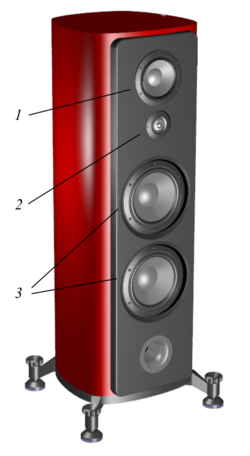
In 1926 the first radios with electrodynamic loudspeakers went for sale, which improved sound quality significantly. Other inventions included automatic volume control (AVC), first commercially available in 1928, and in 1930 a tone control knob was added to radios.
Image source: Loudspeaker
1926 - 1929
% complete
The first radios still required batteries, but in 1926 the 'battery eliminator' was introduced to the market. They still required batteries to heat vacuum-tube filaments, but after the invention of indirectly heated vacuum tubes, the first completely battery free radios became available in 1927. In 1929 a new screen grid tube called UY-224 was introduced, an amplifier designed to operate directly on alternating current.
Image source: AC adapter
1933
% complete
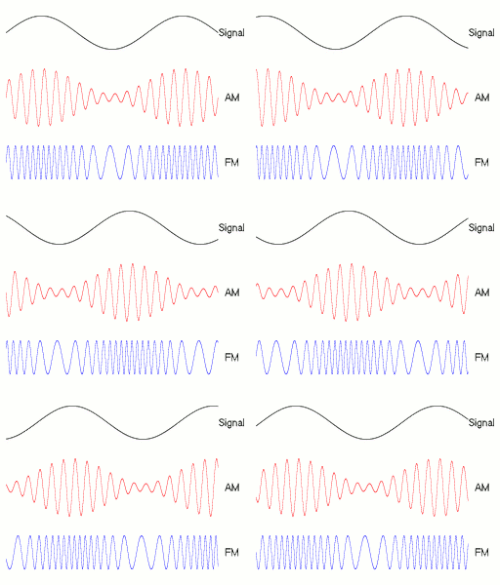
In 1933, FM radio was patented by inventor Edwin H. Armstrong. In 1937, W1XOJ, the first experimental FM radio station after Armstrong's W2XMN in Alpine, New Jersey, was granted a construction permit by the US Federal Communications Commission (FCC).
Image source: FM broadcasting
1946 - 1948
% complete
After early service in St. Louis in 1946, AT&T then introduced Mobile Telephone Service to one hundred towns and highway corridors by 1948. It was expensive, costing US$15 per month plus $0.30–0.40 per local call, equivalent to about $176 per month and $3.50–4.75 per call in 2012 dollars.
1953
% complete
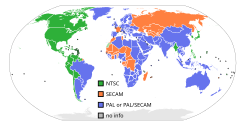
1953: NTSC compatible color television introduced in the US. By 1963, color television was being broadcast commercially (though not all broadcasts or programs were in color).
Image source: NTSC
1954 - 1957
% complete
In 1954, the Regency company introduced a pocket transistor radio, the TR-1, powered by a 'standard 22.5 V Battery.' In 1955, the newly formed Sony company introduced its first transistorized radio, the TR-55. In 1957, Sony introduced the TR-63, the first mass-produced transistor radio, leading to mass-market penetration of transistor radios.
Image source: Transistor radio
1962 - 1963
% complete
1962: Telstar 1, the first communications satellite, relayed the first publicly available live transatlantic television signal. By 1963, the first (radio) communication satellite, Telstar, had been launched.
Image source: Telstar 1
1965
% complete
Frequencies specified in number of cycles per second (kilocycles, megacycles) were replaced by the more specific designation of hertz (cycles per second) about 1965.
Image source: Hertz
1966
% complete
The first integrated circuit (IC) radio, P1740 by General Electric, became available in 1966.
Image source: Integrated circuit
1987
% complete
One of the first developments in the early 20th century was that aircraft used commercial AM radio stations for navigation, AM stations are still marked on U.S. aviation charts. In 1987, the Global Positioning System (GPS) constellation of satellites was launched; it was followed by other GNSS systems like Glonass, BeiDou and Galileo.
Image source: Global Positioning System
Dec 24, 1906
% complete
According to some sources, notably Fessenden's wife Helen's biography, on Christmas Eve 1906, Reginald Fessenden used an Alexanderson alternator and rotary spark-gap transmitter to make the first radio audio broadcast, from Brant Rock, Massachusetts.
Image source: Reginald Fessenden
Feb 1907
% complete
In February 1907 he transmitted electronic telharmonium music from his laboratory station in New York City. In July 1907 he made ship-to-shore transmissions by radiotelephone—race reports for the Annual Inter-Lakes Yachting Association Regatta held on Lake Erie—sent from the steam yacht Thelma to his assistant Frank E. Butler.
Image source: Lee de Forest
1916 - 1917
% complete
Launched by Lee de Forest in the Highbridge section of New York City, station 2XG began daily broadcasts in 1916, but went off the air when the U.S. entered World War I in 1917, and did not return to the air.
1917 - 1922
% complete
Powered in Medford, Massachusetts, 1XE was an experimental station that started broadcasting in 1917. It had to go off the air during World War I, but started up again after the war, and began regular voice and music broadcasts in 1919. However, it did not receive its commercial license, becoming WGI, until 1922.
Image source: WGI (radio station)
Feb 17, 1919
% complete
On February 17, 1919, station 9XM at the University of Wisconsin in Madison broadcast human speech to the public at large. 9XM was first experimentally licensed in 1914, began regular Morse code transmissions in 1916, and its first music broadcast in 1917. Regularly scheduled broadcasts of voice and music began in January 1921.
Image source: WHA (AM)
Nov 6, 1919 - 1924
% complete
The Dutch company Nederlandsche Radio-Industrie and its owner-engineer Hanso Idzerda made its first regular entertainment radio broadcast over station PCGG from its workshop in The Hague on 6 November 1919. Its popular program was broadcast four nights per week using narrow-band FM transmissions on 670 metres (448 kHz), until 1924 when the company ran into financial trouble.
Image source: Hanso Idzerda
Nov 19, 1919
% complete
KQV, one of Pittsburgh's five original AM stations, signed on as amateur station '8ZAE' on November 19, 1919, but did not receive a commercial license until January 9, 1922.
Image source: KQV
Aug 27, 1920
% complete
At 9 pm on August 27, 1920, Sociedad Radio Argentina aired a live performance of Richard Wagner's opera Parsifal from the Coliseo Theater in downtown Buenos Aires.
Image source: LOR Radio Argentina
Aug 31, 1920
% complete
On 31 August 1920 the Detroit News began publicized daily news and entertainment 'Detroit News Radiophone' broadcasts, originally as licensed amateur station 8MK, then later as WBL and WWJ in Detroit, Michigan. It has carried a regular schedule of programming to the present and also broadcast the 1920 presidential election returns just as KDKA did.
Image source: WWJ (AM)
Oct 14, 1920
% complete
Union College in Schenectady, New York began broadcasting on October 14, 1920, over 2ADD, an amateur station licensed to Wendell King, an African-American student at the school.
Image source: Union College
Nov 2, 1920
% complete
It is commonly attributed to KDKA in Pittsburgh, Pennsylvania, which in October 1920 received its license and went on the air as the first US licensed commercial broadcasting station on November 2, 1920, with the presidential election results as its inaugural show, but was not broadcasting daily until 1921. Technically, KDKA was the first of several already-extant stations to receive a 'limited commercial' license.
Image source: KDKA (AM)
1922
% complete
In 1922 regular audio broadcasts for entertainment began in the UK from the Marconi Research Centre 2MT at Writtle near Chelmsford, England.
Or browse the full history timeline directory, with more than 2,000 topics.
This History of Radio timeline was generated with the help of AI, using information found on the internet.
We work hard to keep these timelines accurate, but mistakes do get through. If you spot one, email us at [email protected] and we'll fix it for future visitors.
Generate yours with AI or build it from scratch, for free.
Export your timeline, add your own events, edit or remove AI-generated events, and much more
No credit card required.
Cancel anytime.
Cancel anytime.
You can create an unlimited number of timelines with up to 10 events on each one, customize how they look, export them to PDF, PNG, PowerPoint, CSV, and Excel, and share them with a link. Paid plans raise the event limit and add features like spreadsheet imports and collaborators.
Yes. You can cancel your subscription from your account page at any time, and you will not be charged again. Your subscription stays active for the rest of the period you already paid for.
Yes. We will email you a reminder before the annual renewal, and we will also email you a receipt.
Yes. You can email us within 15 days of any payment, and we will issue you a full refund.
Check out our pricing docs or send us an email anytime: [email protected].