
-
Use Cases
-
Resources
-
Pricing
The history of Vermont spans thousands of years, beginning with Indigenous peoples such as the Abenaki. European exploration began in the 17th century when Samuel de Champlain arrived in 1609. The region was contested between France, Britain, New York, and New Hampshire, leading to the formation of the Vermont Republic by Ethan Allen and the Green Mountain Boys. Vermont became the 14th U.S. state on March 4, 1791, after being an independent republic for 14 years. In later centuries, Vermont developed a reputation for dairy farming, maple syrup production, granite quarrying, progressive politics, and environmental conservation. More Less
Jul 1609
% complete
French explorer Samuel de Champlain became the first European known to have visited the region when he arrived at the lake that now bears his name. His arrival marked the beginning of European interest in the area and initiated French claims to the territory.
Image source: Samuel de Champlain
1724
% complete
Massachusetts built Fort Dummer on the Connecticut River in 1724, making it the first permanent European settlement in what would become Vermont. The fort served as a defensive outpost during ongoing conflicts with Indigenous peoples and rival colonial powers.
Image source: Fort Dummer
1749
% complete
Benning Wentworth, governor of New Hampshire, began issuing land grants west of the Connecticut River, an area also claimed by New York. These 'New Hampshire Grants' led to decades of dispute between the two colonies over control of the territory.
Image source: New Hampshire Grants
Jan 3, 1749
% complete
Benning Wentworth chartered the town of Bennington, named after himself, as the first of the New Hampshire Grants. Settlers from Massachusetts and Connecticut soon followed, beginning the wave of New England migration into the region.
Image source: Bennington, Vermont
1770
% complete
Settler Ethan Allen organized the Green Mountain Boys, a militia formed to defend the rights of New Hampshire grant landholders against New York's attempts to assert authority over the region. Their resistance helped foster a distinct Vermont identity.
Image source: Green Mountain Boys
May 10, 1775
% complete
Ethan Allen and Benedict Arnold led a surprise dawn assault that captured Fort Ticonderoga from the British without a fight. The victory secured valuable artillery, including cannons later hauled to Boston to help force the British evacuation of that city.
Image source: Capture of Fort Ticonderoga
Jan 15, 1777
% complete
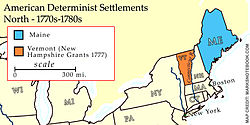
Delegates meeting at Westminster declared the region an independent state, initially called New Connecticut and renamed Vermont shortly afterward. For fourteen years, Vermont functioned as a sovereign republic with its own constitution, currency, and postal system.
Image source: Vermont Republic
Jul 8, 1777
% complete
The Vermont Republic's first constitution included a clause prohibiting slavery of adults, making Vermont one of the first jurisdictions in the world to formally outlaw the institution. This reflected the radical democratic ideals of the new republic.
Aug 16, 1777
% complete
American militia forces under John Stark decisively defeated a British raiding force near Bennington. The battle depleted General John Burgoyne's army ahead of his surrender at Saratoga and boosted American morale during the Revolutionary War.
Image source: Battle of Bennington
1781 - 1783
% complete
British officials in Canada conducted secret negotiations with Vermont's leaders, including Governor Thomas Chittenden and Ethan Allen, exploring the possibility of Vermont becoming a British province. The talks ended without result as the war concluded and Vermont's independence prospects improved.
Image source: Haldimand Affair
Mar 4, 1791
% complete
After resolving disputes with New York and New Hampshire, Vermont was admitted to the United States as its fourteenth state, the first to join after the original thirteen colonies. Statehood ended Vermont's fourteen-year existence as an independent republic.
Image source: Vermont
1805
% complete
Montpelier was designated the permanent state capital, replacing earlier rotating locations such as Windsor and Rutland. Its central location made it a practical choice for hosting the state legislature.
Image source: Montpelier, Vermont
1812 - 1814
% complete
Vermont played a significant role in the War of 1812, particularly through naval actions on Lake Champlain. The decisive American victory at the Battle of Plattsburgh in September 1814 helped secure the northern frontier and strengthen America's position at peace negotiations.
Image source: Battle of Plattsburgh
1823
% complete
The opening of the Champlain Canal linked Lake Champlain to the Hudson River and New York City, transforming Vermont's economy by enabling cheap shipment of timber, wool, and agricultural products to distant markets.
Image source: Champlain Canal
1826 - 1833
% complete
Following the mysterious disappearance of William Morgan in western New York, anti-Masonic sentiment spread rapidly into Vermont, where the Anti-Masonic Party became a powerful political force, winning elections and reshaping the state's political landscape.
Image source: Anti-Masonic Party
1830 - 1861
% complete
Vermont became a hotbed of abolitionism, with towns hosting antislavery societies, speakers like Frederick Douglass visiting the state, and many communities participating in the Underground Railroad to help enslaved people escape to Canada.
Image source: Abolitionism in the United States
1848 - 1853
% complete
Railroad construction transformed Vermont in the mid-nineteenth century, connecting its towns to Boston, Montreal, and New York. Railways spurred industrial growth, tourism, and the movement of dairy products and granite from Vermont quarries.
1861 - 1865
% complete
Vermont sent roughly 34,000 men to serve in the Union Army, suffering among the highest per capita casualty rates in the nation. Green Mountain soldiers fought in nearly every major eastern battle, including Gettysburg, where the 1st Vermont Cavalry participated in Pickett's Charge defense.
Image source: Vermont in the American Civil War
Oct 19, 1864
% complete
Confederate soldiers based in Canada raided St. Albans, robbing three banks of over $200,000 and attempting to burn the town before escaping back across the border. It remains the northernmost Confederate action of the Civil War.
Image source: St. Albans Raid
1870
% complete
As competition from western farms made sheep farming unprofitable, Vermont agriculture shifted decisively toward dairy production. Butter and later cheese and fluid milk became the backbone of the rural economy, a legacy that persists today.
Image source: Vermont
1880
% complete
Italian immigrant stonecutters helped make Barre the granite capital of the world, with quarries producing stone for monuments and buildings nationwide. The industry drew waves of immigrants who diversified Vermont's population and labor movement.
Image source: Barre (city), Vermont
Nov 3, 1927 - Nov 7, 1927
% complete
Torrential rainfall caused catastrophic flooding across Vermont, killing dozens of people and causing millions of dollars in damage. The disaster destroyed bridges, roads, and railroad lines, prompting major flood-control projects and highway reconstruction in subsequent years.
Image source: Great Vermont Flood of 1927
Jan 7, 1937 - Jan 9, 1941
% complete
Governor George Aiken modernized Vermont government, expanding services while preserving fiscal conservatism. He later served as a long-serving U.S. senator and became an influential moderate Republican voice, famously advising the nation to declare victory in Vietnam.
Image source: George Aiken
Sep 21, 1938
% complete
The powerful New England Hurricane of 1938 swept through Vermont, flattening millions of trees and damaging homes, farms, and infrastructure. The storm accelerated the decline of marginal hill farms and reshaped forest composition across the state.
Image source: 1938 New England hurricane
1950
% complete
Postwar investment in ski resorts such as Mount Snow, Killington, and Sugarbush turned skiing into a pillar of Vermont's economy. The industry brought tourism revenue, new residents, and cultural change to rural mountain towns.
Image source: Vermont Ski and Snowboard Museum
1956 - 1978
% complete
Construction of Interstates 89 and 91, completed in the late 1970s, connected Vermont's cities to national networks, spurring suburban growth and commerce while raising concerns about sprawl and the loss of traditional village character.
Image source: Interstate 89
1970
% complete
Under governor Deane Davis, Vermont enacted Act 250, pioneering legislation requiring permits for large developments to protect air, water, soil, and scenic resources. The law became a nationally recognized model of environmental planning and land use regulation.
Jan 10, 1985 - Jan 10, 1991
% complete
Madeleine Kunin served three terms as Vermont's first female governor, championing education funding reform, environmental protection, and children's programs. She became a prominent figure in national Democratic politics and women's political leadership.
Image source: Madeleine Kunin
Aug 1991 - Jan 8, 2003
% complete
Howard Dean took office during a recession and guided Vermont through budget cuts before presiding over recovery and expansions in health care coverage. He gained national attention for supporting civil unions and later ran for president in 2004.
Image source: Howard Dean
Dec 20, 1999
% complete
In response to the Baker v. Vermont court decision, the legislature passed the nation's first civil union law granting same-sex couples legal recognition equivalent to marriage at the state level. Vermont thus became a pioneer in LGBTQ rights.
Apr 1, 2009
% complete
Vermont became the first state to legalize same-sex marriage through legislative action rather than court order, overriding a gubernatorial veto. The landmark law cemented Vermont's reputation as a leader in progressive social policy.
2011 - 2014
% complete
Governor Peter Shumlin pursued an ambitious plan to establish a statewide single-payer health care system, Green Mountain Care. The plan was ultimately abandoned in 2014 due to cost concerns, but it kept Vermont at the forefront of health policy debates.
Image source: Peter Shumlin
Aug 28, 2011 - Aug 29, 2011
% complete
Tropical Storm Irene dumped torrential rain on Vermont, destroying hundreds of roads and bridges, isolating numerous towns, and causing over $700 million in damage. The disaster prompted extensive rebuilding and renewed attention to climate resilience.
Image source: Hurricane Irene
Apr 30, 2015 - Jul 26, 2016
% complete
Vermont Senator Bernie Sanders mounted a surprisingly competitive campaign for the Democratic presidential nomination, energizing young voters and shifting national debate on inequality, health care, and campaign finance while drawing attention to his home state.
Image source: Bernie Sanders 2016 presidential campaign
Or browse the full history timeline directory, with more than 2,000 topics.
This History of Vermont timeline was generated with the help of AI, using information found on the internet.
We work hard to keep these timelines accurate, but mistakes do get through. If you spot one, email us at [email protected] and we'll fix it for future visitors.
Generate yours with AI or build it from scratch, for free.
Export your timeline, add your own events, edit or remove AI-generated events, and much more
No credit card required.
Cancel anytime.
Cancel anytime.
You can create an unlimited number of timelines with up to 10 events on each one, customize how they look, export them to PDF, PNG, PowerPoint, CSV, and Excel, and share them with a link. Paid plans raise the event limit and add features like spreadsheet imports and collaborators.
Yes. You can cancel your subscription from your account page at any time, and you will not be charged again. Your subscription stays active for the rest of the period you already paid for.
Yes. We will email you a reminder before the annual renewal, and we will also email you a receipt.
Yes. You can email us within 15 days of any payment, and we will issue you a full refund.
Check out our pricing docs or send us an email anytime: [email protected].