-
Use Cases
-
Resources
-
Pricing
Yellowstone National Park, established in 1872 as the world's first national park, spans Wyoming, Montana, and Idaho. Its history includes massive prehistoric volcanic eruptions that formed the Yellowstone Caldera, thousands of years of habitation by Native American tribes, early exploration by fur trappers and the 1869-1870 expeditions, its designation as a protected park by President Ulysses S. Grant, the creation of the National Park Service in 1916, ecological restoration efforts such as the 1995 reintroduction of gray wolves, and its continued role as a center of conservation and geothermal wonder. More Less
1000 - 1879
% complete
The Sheepeater band of the Eastern Shoshone (the Tukudika) lived year-round in the mountainous areas around Yellowstone, hunting bighorn sheep and fishing the region's rivers until they were removed to reservations in the late 1870s.
Image source: Tukudeka
Aug 1877
% complete
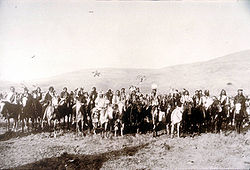
During their flight toward Canada, roughly 800 Nez Perce under Chief Joseph crossed Yellowstone National Park, encountering tourists in several incidents. The episode underscored that Native peoples still traveled traditional routes through the region.
Image source: Nez Perce War
1807 - 1808
% complete
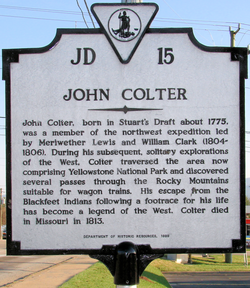
Fur trapper John Colter, a veteran of the Lewis and Clark Expedition, became the first known European American to enter the Yellowstone region. His accounts of steaming geysers and boiling springs were so fantastic that skeptics mockingly called it 'Colter's Hell.'
Image source: John Colter
1836
% complete
Mountain man Osborne Russell kept detailed journals of his trapping expeditions in the Yellowstone country during the 1830s, providing some of the earliest written descriptions of the region's geysers, lakes, and abundant wildlife.
1859 - 1860
% complete
Captain William F. Raynolds led an Army survey intended to explore the Yellowstone region, but deep snow in the passes prevented his party from entering the plateau itself. The expedition nonetheless mapped much of the surrounding territory.
Image source: Raynolds Expedition
Sep 1869
% complete
A small private party of three explorers from Montana ventured into Yellowstone, reaching Yellowstone Lake and documenting the geyser basins. Their published account helped inspire larger official expeditions to follow.
Image source: Cook–Folsom–Peterson Expedition
Aug 22, 1870
% complete
Led by Surveyor General Henry D. Washburn and including Nathaniel P. Langford, this expedition spent over a month exploring Yellowstone, naming features such as Old Faithful and Mount Washburn. Members discussed the idea that the land should be preserved rather than privately exploited.
Image source: Washburn–Langford–Doane Expedition
1871
% complete
Geologist Ferdinand Vandeveer Hayden led a comprehensive government-sponsored scientific expedition through Yellowstone with photographer William Henry Jackson and painter Thomas Moran. Their stunning images and reports convinced Congress of the region's extraordinary value.
Image source: Hayden Geological Survey of 1871
1872 - 1877
% complete
Langford was appointed unpaid superintendent but visited the park only twice, leaving it largely unprotected from poachers and vandals. His tenure highlighted the need for real enforcement and funding in the new park.
Image source: Nathaniel P. Langford
Mar 1, 1872
% complete
President Ulysses S. Grant signed the Act of Dedication, establishing Yellowstone as the first national park in the United States and the world, setting aside more than two million acres 'for the benefit and enjoyment of the people.'
Image source: Yellowstone National Park
1877 - 1882
% complete
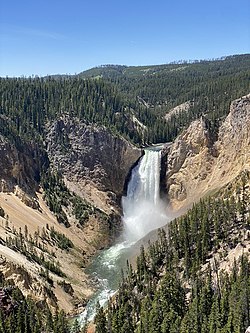
Norris aggressively explored and mapped the park, built its first road network, and secured congressional funding and paid staff, dramatically improving administration though poaching continued unchecked on park borders.
Image source: Philetus Norris
1886 - 1918
% complete
After civilian management failed to stop poaching and vandalism, the US Army established Fort Yellowstone at Mammoth Hot Springs. Soldiers patrolled the park for three decades, dramatically reducing lawlessness and developing management practices later adopted by the National Park Service.
Image source: Fort Yellowstone
1891
% complete
The Army constructed permanent facilities at Mammoth Hot Springs, including barracks and administrative buildings. This historic district later served as park headquarters and is now a National Historic Landmark District.
1894
% complete
By the early 1890s, rampant market hunting had reduced Yellowstone's once-vast bison herds to fewer than fifty animals, prompting urgent protection efforts that eventually enabled the species' remarkable recovery within the park.
Image source: Yellowstone bison herd
1894
% complete
Army scout Burgess caught poacher Ed Howell slaughtering bison in the park, and the national outrage prompted Congress to pass legislation strengthening legal protection of Yellowstone's wildlife, a precursor to broader federal conservation laws.
Image source: Lacey Act of 1900
Jun 14, 1988 - Sep 11, 1988
% complete
The largest wildfire complex in Yellowstone's recorded history scorched nearly 800,000 acres, about 36 percent of the park. The fires transformed forest policy nationwide and demonstrated the resilience of lodgepole pine ecosystems, which regenerated vigorously in the following decades.
Image source: Yellowstone fires of 1988
Jan 12, 1995
% complete
After a seventy-year absence, gray wolves were captured in Canada and released into Yellowstone, restoring a keystone predator. The reintroduction triggered trophic cascades that reshaped elk behavior, willow growth, and river ecology, becoming one of conservation's most celebrated success stories.
Image source: History of wolves in Yellowstone
2000
% complete
Federal and state agencies adopted a bison management plan addressing brucellosis transmission concerns, leading to controversial hazing and culling of bison migrating out of the park. Debates continue over expanding tribal and public hunting opportunities outside park boundaries.
Image source: American bison hunting
2007
% complete
The Greater Yellowstone grizzly population, which had dwindled to about 136 bears when listed in 1975, recovered sufficiently for federal delisting. Subsequent legal challenges caused relisting and delisting cycles, reflecting ongoing debates about managing the recovering population.
Image source: Grizzly bear
1903 - 1904
% complete
Architect Robert Reamer designed the massive log hotel near Old Faithful Geyser, creating an icon of rustic 'parkitecture.' The seven-story structure remains one of the largest log buildings in the world and a National Historic Landmark.
Image source: Old Faithful Inn
1905
% complete
Engineers completed the figure-eight Grand Loop Road, linking all major attractions—geysers, canyons, lakes, and wildlife valleys—and establishing the circulation pattern visitors still use today across the vast park.
Image source: Grand Loop Road
Jul 31, 1915
% complete
After decades of horse-drawn stagecoaches, the park opened its roads to automobiles. The change transformed tourism, rapidly increasing visitation and requiring major road improvements throughout the following decades.
Aug 25, 1916
% complete
Congress established the National Park Service under Secretary of the Interior to provide unified management of national parks and monuments. The following year the NPS took over Yellowstone from the US Army, professionalizing park stewardship nationwide.
Image source: National Park Service
1959
% complete
The magnitude 7.2 Hebgen Lake earthquake just west of the park triggered landslides, killed 28 people, formed Quake Lake, and altered geyser activity throughout Yellowstone, reminding scientists of the region's intense geological dynamism.
Image source: 1959 Hebgen Lake earthquake
1965
% complete
Scientists recognized that Yellowstone sits atop an enormous volcanic hotspot with three cataclysmic eruptions over the past two million years. Ongoing monitoring by the Yellowstone Volcano Observatory tracks seismicity, ground deformation, and hydrothermal changes.
Image source: Yellowstone Caldera
1976
% complete
UNESCO designated Yellowstone a Biosphere Reserve, recognizing the Greater Yellowstone Ecosystem as one of the world's most intact temperate ecosystems and encouraging international cooperation in its scientific study and preservation.
Image source: World Network of Biosphere Reserves
1978
% complete
Yellowstone was among the first sites inscribed on the UNESCO World Heritage List, acknowledged for its exceptional geothermal features, wildlife, and role as the prototype of the global national park movement.
Image source: List of World Heritage Sites in the United States
1990
% complete
Rising winter snowmobile visitation sparked decades of litigation and rule changes over air pollution, noise, and wildlife impacts, ultimately resulting in restrictions favoring guided snowcoach access and cleaner technology.
Image source: Yellowstone National Park
Or browse the full history timeline directory, with more than 2,000 topics.
This History of Yellowstone timeline was generated with the help of AI, using information found on the internet.
We work hard to keep these timelines accurate, but mistakes do get through. If you spot one, email us at [email protected] and we'll fix it for future visitors.
Generate yours with AI or build it from scratch, for free.
Export your timeline, add your own events, edit or remove AI-generated events, and much more
No credit card required.
Cancel anytime.
Cancel anytime.
You can create an unlimited number of timelines with up to 10 events on each one, customize how they look, export them to PDF, PNG, PowerPoint, CSV, and Excel, and share them with a link. Paid plans raise the event limit and add features like spreadsheet imports and collaborators.
Yes. You can cancel your subscription from your account page at any time, and you will not be charged again. Your subscription stays active for the rest of the period you already paid for.
Yes. We will email you a reminder before the annual renewal, and we will also email you a receipt.
Yes. You can email us within 15 days of any payment, and we will issue you a full refund.
Check out our pricing docs or send us an email anytime: [email protected].