-
Use Cases
-
Resources
-
Pricing
Impressionism was a revolutionary 19th-century art movement that originated in France, characterized by small, visible brushstrokes, an emphasis on light and its changing qualities, ordinary subject matter, and depictions of everyday life. Artists such as Claude Monet, Pierre-Auguste Renoir, Edgar Degas, and Camille Pissarro broke away from academic traditions, exhibiting independently after being rejected by the official Salon. The movement paved the way for modern art movements such as Post-Impressionism, Fauvism, and Cubism. More Less
1850
% complete
In the middle of the 19th century—a time of rapid industrialisation and unsettling social change in France, as Emperor Napoleon III rebuilt Paris and waged war—the Académie des Beaux-Arts dominated French art with its traditional standards of subject matter and technique.
Image source: Impressionism
1850
% complete
Many vivid synthetic pigments became commercially available to artists for the first time during the 19th century, enabling painters to work with brighter, more saturated colours than ever before.
1850
% complete
Impressionists took advantage of the mid-century introduction of premixed paints in tin tubes (resembling modern toothpaste tubes), which allowed artists to work more spontaneously, both outdoors and indoors.
1855
% complete
Following a practice pioneered by artists such as the Englishman John Constable that had become increasingly popular by mid-century, artists often ventured into the countryside together to paint in the open air.
1860
% complete
By painting in sunlight directly from nature, and making bold use of vivid synthetic pigments available since the beginning of the century, artists began to develop a lighter and brighter manner of painting that extended further the Realism of Courbet and the Barbizon school.
1863
% complete
In 1863, the Salon jury rejected Manet's Le déjeuner sur l'herbe ('The Luncheon on the Grass'), primarily because it depicted a nude woman with two clothed men at a picnic, scandalising the art establishment.
Image source: Le Déjeuner sur l'herbe
1863
% complete
After Emperor Napoleon III saw the rejected works of 1863, he decreed that the public be allowed to judge the works themselves, and the Salon des Refusés ('Salon of the Refused') was organised.
Image source: Salon des Refusés
1867 - 1872
% complete
Artists' petitions requesting a new Salon des Refusés in 1867, and again in 1872, were denied, pushing independent-minded painters toward organising their own exhibitions.
1861
% complete
Manet continued to submit his works to the Salon, where his painting Spanish Singer had won a 2nd class medal in 1861, and he urged others to do likewise, arguing that 'the Salon is the real field of battle' where a reputation could be made.
Image source: Édouard Manet
1867
% complete
An example of new influences is Monet's Jardin à Sainte-Adresse (1867), with its bold blocks of colour and composition on a strong diagonal slant showing the influence of Japanese prints.
Image source: Garden at Sainte-Adresse
1870
% complete
Bazille, a promising young painter associated with the future Impressionists, died in the Franco-Prussian War in 1870, cutting short a career that had shown great potential.
Image source: Frédéric Bazille
1874
% complete
Degas's The Dance Class (La classe de danse) of 1874 shows both the influence of Japanese prints and modern life in its asymmetrical composition, exemplifying the movement's unusual visual angles.
Image source: The Ballet Class (Degas, Musée d'Orsay)
1877
% complete
Caillebotte's Paris Street; Rainy Day (1877) strikes a modern note by emphasising the isolation of individuals amid the outsized buildings and spaces of the urban environment.
Image source: Paris Street; Rainy Day
1879
% complete
Renoir had a great Salon success in 1879, demonstrating that recognition from the official establishment was still possible even while participating in the independent Impressionist exhibitions.
Image source: Pierre-Auguste Renoir
1881
% complete
Only one of Degas's sculptures, Little Dancer of Fourteen Years, was exhibited in his lifetime, displayed at the Sixth Impressionist Exhibition in 1881 to mixed reactions from critics and the public.
Image source: Little Dancer of Fourteen Years
1899
% complete
Although Sisley died in poverty in 1899, his fellow Impressionist Renoir had achieved great Salon success in 1879, illustrating the divergent fortunes of the movement's members.
Image source: Alfred Sisley
1917
% complete
Following Degas's death in 1917, his heirs authorised bronze castings from 73 of the artist's sculptures, preserving his sculptural legacy for posterity.
Image source: Edgar Degas
Dec 1873
% complete
In December 1873, Monet, Renoir, Pissarro, Sisley, Cézanne, Berthe Morisot, Edgar Degas and several other artists founded the Société anonyme des artistes peintres, sculpteurs, graveurs, etc. to exhibit their artworks independently of the official Salon.
Image source: Modern art
1874
% complete
The name of the style derives from the title of Claude Monet's work Impression, Sunrise, which provoked the critic Louis Leroy to coin the term in a satirical 1874 review of the First Impressionist Exhibition published in the Parisian newspaper Le Charivari.
Image source: Louis Leroy
1874 - 1886
% complete
The Impressionists exhibited together regardless of shifting membership eight times between 1874 and 1886. Participation varied: Morisot participated in seven exhibitions, Cassatt in four, Bracquemond in three, and Gonzalès did not participate.
1874
% complete
Giuseppe De Nittis, an Italian artist living in Paris, participated in the first Impressionist exhibit at the invitation of Degas, although the other Impressionists disparaged his work.
Image source: Giuseppe De Nittis
Apr 1874
% complete
In total, thirty artists participated in their first exhibition, held in April 1874 at the studio of the photographer Nadar in Paris, marking the public debut of the Impressionist movement.
Image source: First Impressionist Exhibition
1876
% complete
In 1876, the poet and critic Stéphane Mallarmé said of the new style: 'The represented subject, being composed of a harmony of reflected and ever-changing lights, cannot be supposed always to look the same but palpitates with movement, light, and life'.
Image source: Stéphane Mallarmé
1879 - 1886
% complete
Among the close associates of the Impressionists, Jean-Louis Forain participated in Impressionist exhibitions in 1879, 1880, 1881 and 1886, contributing to the group's shifting membership over the years.
Image source: Jean-Louis Forain
1879
% complete
Degas invited Mary Cassatt to display her work in the 1879 exhibition, but also insisted on the inclusion of Jean-François Raffaëlli, Ludovic Lepic, and other realists who did not represent Impressionist practices.
Image source: Mary Cassatt
1880
% complete
Degas's insistence on including realists caused Monet in 1880 to accuse the Impressionists of 'opening doors to first-come daubers', revealing tensions within the group over artistic standards.
Image source: Claude Monet
1882
% complete
The seventh Paris Impressionist exhibition in 1882 was the most selective of all, including the works of only nine 'true' impressionists: Gustave Caillebotte, Paul Gauguin, Armand Guillaumin, Claude Monet, Berthe Morisot, Camille Pissarro, Pierre-Auguste Renoir, Alfred Sisley, and Victor Vignon.
1882
% complete
Among the close associates of the Impressionists, Victor Vignon is the only artist outside the group of prominent names who participated in the most exclusive Seventh Paris Impressionist Exhibition in 1882, a rejection of the previous less restricted exhibitions chiefly organised by Degas.
Image source: Victor Vignon
1886
% complete
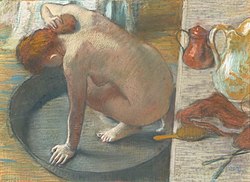
The group divided again over the invitations to Paul Signac and Georges Seurat to exhibit with them at the 8th Impressionist exhibition in 1886, reflecting the rise of Neo-Impressionism.
Image source: The Tub
1890 - 1950
% complete
Musical Impressionism is the name given to a movement in European classical music that arose in the late 19th century and continued into the middle of the 20th century, extending Impressionist aesthetics beyond painting.
1904
% complete
In 1904, the artist and writer Wynford Dewhurst wrote the first important study of the French painters published in English, Impressionist Painting: its genesis and development, which did much to popularise Impressionism in Great Britain.
Image source: Wynford Dewhurst
1919 - 1929
% complete
French Impressionist Cinema is a term applied to a loosely defined group of films and filmmakers in France from 1919 to 1929, although these years are debatable, showing Impressionism's influence on film aesthetics.
Image source: French impressionist cinema
1945
% complete
René Huyghe and Georges Salles in the summer of 1945 celebrated Impressionism as French art and exhibited the paintings of the core group artists alongside historic French master painters, drawing a straight aesthetic line connecting French art schools through history.
Image source: René Huyghe
1955
% complete
For example, Impressionism by Jean Leymarie, published in 1955 included no information on any women Impressionists, reflecting a long-standing omission of female artists from the movement's historiography.
Or browse the full history timeline directory, with more than 2,000 topics.
This Impressionism timeline was generated with the help of AI, using information found on the internet.
We work hard to keep these timelines accurate, but mistakes do get through. If you spot one, email us at [email protected] and we'll fix it for future visitors.
Generate yours with AI or build it from scratch, for free.
Export your timeline, add your own events, edit or remove AI-generated events, and much more
No credit card required.
Cancel anytime.
Cancel anytime.
You can create an unlimited number of timelines with up to 10 events on each one, customize how they look, export them to PDF, PNG, PowerPoint, CSV, and Excel, and share them with a link. Paid plans raise the event limit and add features like spreadsheet imports and collaborators.
Yes. You can cancel your subscription from your account page at any time, and you will not be charged again. Your subscription stays active for the rest of the period you already paid for.
Yes. We will email you a reminder before the annual renewal, and we will also email you a receipt.
Yes. You can email us within 15 days of any payment, and we will issue you a full refund.
Check out our pricing docs or send us an email anytime: [email protected].