-
Use Cases
-
Resources
-
Pricing
The Iraq War was a protracted armed conflict that began in March 2003 when a U.S.-led coalition invaded Iraq and toppled the regime of Saddam Hussein, based on claims of weapons of mass destruction that were later proven false. The invasion led to years of insurgency, sectarian violence, political instability, and a major U.S. troop surge before coalition forces withdrew in December 2011, leaving lasting consequences for Iraq and the Middle East. More Less
Dec 16, 1998
% complete
United Nations Special Commission (UNSCOM) weapons inspectors withdrew from Iraq ahead of Operation Desert Fox, a four-day US-British bombing campaign. Iraq had repeatedly obstructed inspections, leaving questions about its banned weapons programs unresolved for years.
Sep 11, 2001
% complete
Al-Qaeda's September 11 attacks killed nearly 3,000 people in the United States. Although no operational link between Iraq and the attacks was established, the Bush administration's war on terror framework soon turned attention toward Saddam Hussein's alleged weapons of mass destruction and ties to terrorism.
Image source: September 11 attacks
Jan 29, 2002
% complete
President George W. Bush's State of the Union address labeled Iraq, Iran, and North Korea an 'axis of evil,' signaling that regime change in Baghdad was becoming a central goal of US foreign policy.
Image source: Axis of evil
Sep 12, 2002
% complete
President Bush addressed the United Nations General Assembly, warning that Iraq posed a grave danger and demanding renewed weapons inspections and compliance with prior resolutions, setting the stage for diplomatic confrontation over Iraq's disarmament.
Image source: Iraq disarmament crisis
Oct 11, 2002
% complete
The US Congress passed the Iraq Resolution, granting President Bush authority to use military force against Iraq to enforce UN Security Council resolutions and defend against the threat posed by Saddam Hussein's regime.
Image source: Authorization for Use of Military Force Against Iraq Resolution of 2002
Nov 8, 2002
% complete
The UN Security Council unanimously adopted Resolution 1441, giving Iraq a final opportunity to comply with disarmament obligations or face 'serious consequences.' UNMOVIC inspectors subsequently returned to Iraq to search for weapons of mass destruction.
Image source: United Nations Security Council Resolution 1441
Jan 27, 2003
% complete
Chief UN weapons inspector Hans Blix reported to the Security Council that Iraq was not providing full cooperation with inspections. The report intensified debate among Security Council members over whether to authorize military action.
Image source: Hans Blix
Feb 5, 2003
% complete
US Secretary of State Colin Powell presented intelligence, later largely discredited, alleging that Iraq possessed weapons of mass destruction and maintained ties to terrorists. The presentation aimed to win international support for military action.
Image source: Colin Powell's presentation to the United Nations Security Council
Mar 16, 2003
% complete
President Bush met with British Prime Minister Tony Blair and leaders of Spain and Portugal in the Azores, declaring March 17 as a deadline for diplomacy and signaling that war would follow if Saddam Hussein did not disarm or leave power.
Image source: Azores Summit
Mar 17, 2003
% complete
With UN authorization unattainable, President Bush delivered a televised address giving Saddam Hussein and his sons 48 hours to leave Iraq or face military conflict. Weapons inspectors began evacuating the country.
Image source: Iraq War
Mar 20, 2003
% complete
Coalition forces led by the United States and United Kingdom launched Operation Iraqi Freedom with airstrikes on Baghdad targeting Saddam Hussein and senior leadership, followed by a massive ground invasion from Kuwait by US, British, Australian, and Polish forces.
Image source: 2003 invasion of Iraq
Mar 21, 2003 - Mar 25, 2003
% complete
British and US Marines captured the strategic port city of Umm Qasr after several days of fighting, opening a vital supply route for humanitarian aid and military logistics during the invasion.
Image source: Battle of Umm Qasr
Mar 23, 2003 - Mar 29, 2003
% complete
US Marines fought fierce battles around Nasiriyah, encountering determined resistance from Iraqi forces and Fedayeen Saddam. The fighting included the ambush of the 507th Maintenance Company and secured crossings over the Euphrates River.
Image source: Battle of Nasiriyah
Apr 9, 2003
% complete
US forces entered central Baghdad, and crowds aided by American troops pulled down a statue of Saddam Hussein in Firdos Square. The iconic images symbolized the fall of the regime, though widespread looting followed across the capital.
Image source: Saddam Hussein statue destruction
Apr 10, 2003
% complete
Kurdish Peshmerga fighters supported by US special forces seized Kirkuk, a major oil-producing city in northern Iraq, accelerating the collapse of Iraqi government control in the north.
Image source: Kirkuk
Apr 13, 2003
% complete
US Marines captured Tikrit, Saddam Hussein's hometown and one of the last strongholds of organized resistance, effectively concluding major combat operations of the invasion phase.
Image source: First Battle of Tikrit
May 1, 2003
% complete
President Bush declared the end of major combat operations aboard the USS Abraham Lincoln beneath a 'Mission Accomplished' banner. In retrospect, the speech marked the start of a prolonged and deadly occupation rather than the war's conclusion.
Image source: Mission Accomplished speech
May 12, 2003 - Jun 28, 2004
% complete
Ambassador L. Paul Bremer III became head of the Coalition Provisional Authority, which governed occupied Iraq. His decisions, including de-Ba'athification and dissolving the Iraqi army, left hundreds of thousands armed men unemployed and fueled the insurgency.
Image source: Coalition Provisional Authority
Jul 22, 2003
% complete
US forces killed Saddam Hussein's sons Uday and Qusay during a firefight in Mosul, removing two of the most feared figures of the former regime from the equation.
Image source: Killing of Qusay and Uday Hussein
Aug 19, 2003
% complete
A suicide truck bomb destroyed part of the Canal Hotel housing UN headquarters in Baghdad, killing 22 people including envoy Sérgio Vieira de Mello. The attack drove most international organizations out of Iraq and marked the insurgency's escalation.
Image source: Canal Hotel bombing
Dec 13, 2003
% complete
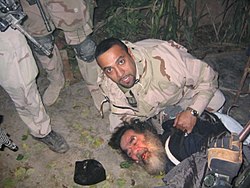
Operation Red Dawn culminated in the capture of Saddam Hussein, found hiding in a spider hole near Tikrit. His capture was a major symbolic victory for the coalition, though violence continued to intensify afterward.
Image source: Capture of Saddam Hussein
Jan 1, 2004 - Dec 31, 2004
% complete
Throughout 2004, insurgent groups including al-Qaeda in Iraq, led by Abu Musab al-Zarqawi, waged increasingly lethal campaigns of bombings, beheadings, and ambushes against coalition forces, Iraqi security personnel, and civilians.
Image source: Iraqi insurgency (2003–2011)
Apr 4, 2004 - Apr 9, 2004
% complete
Following the murder of four American contractors in Fallujah, US Marines launched Operation Vigilant Resolve to retake the city. Facing political pressure and heavy resistance, the assault was halted and security handed to an Iraqi force that failed to control the city.
Image source: First Battle of Fallujah
Apr 4, 2004 - Aug 30, 2004
% complete
Shia cleric Muqtada al-Sadr launched an uprising with his Mahdi Army militia, fighting US and coalition forces in Baghdad, Najaf, Karbala, and other cities. The revolt revealed a second front beyond the Sunni insurgency before ceasefires ended major clashes.
Image source: Iraqi conflict
Nov 7, 2004 - Dec 23, 2004
% complete
Operation Phantom Fury, the bloodiest battle of the Iraq War, saw US and Iraqi forces retake Fallujah from insurgents in intense urban combat. The victory came at high cost and displaced much of the city's civilian population.
Image source: Second Battle of Fallujah
Jan 30, 2005
% complete
Despite insurgent threats, millions of Iraqis voted in the country's first free multiparty elections in decades. A Shia-led coalition won a majority, beginning a new political order that deepened sectarian divisions among Sunnis who largely boycotted the vote.
Image source: January 2005 Iraqi parliamentary election
Feb 22, 2006
% complete
The bombing of the golden-domed al-Askari Shrine in Samarra, revered by Shia Muslims, ignited waves of sectarian retaliation. Death squads and militias plunged Iraq into full-scale civil war, with thousands killed monthly at the height of the bloodshed.
Image source: 2006 al-Askari mosque bombing
Dec 30, 2006
% complete
After trial by the Iraqi High Tribunal for crimes against humanity stemming from the Dujail massacre, Saddam Hussein was hanged in Baghdad. The execution closed a chapter on the former dictator amid ongoing sectarian violence.
Image source: Execution of Saddam Hussein
Sep 6, 2006 - Dec 31, 2007
% complete
Sunni tribes in Anbar province, alienated by al-Qaeda in Iraq's brutality, allied with US forces through the Awakening movement. Combined with the surge, this shift dramatically reduced violence across western Iraq by late 2007.
Image source: Sons of Iraq
Jan 10, 2007
% complete
President Bush announced a surge of more than 20,000 additional US troops to secure Baghdad and Anbar province under General David Petraeus's counterinsurgency doctrine, aiming to reverse the deteriorating security situation.
Image source: Iraq War troop surge of 2007
Jan 1, 2008 - Dec 31, 2008
% complete
By 2008, civilian and military casualties had fallen dramatically from their 2006–2007 peaks due to the surge, the Awakening councils, ceasefires by militias including the Mahdi Army, and improved Iraqi security forces.
Nov 17, 2008
% complete
Iraq and the United States signed an agreement requiring all American combat troops to withdraw from Iraqi cities by June 2009 and to leave Iraq entirely by the end of 2011, establishing a timetable for the war's conclusion.
Feb 27, 2009
% complete
President Barack Obama announced that US combat operations in Iraq would end by August 31, 2010, reaffirming the commitment to remove all American troops by the end of 2011 as negotiations with Iraq proceeded.
Image source: Withdrawal of United States troops from Iraq (2007–2011)
Jun 30, 2009
% complete
Under the Status of Forces Agreement, American combat units withdrew from all Iraqi cities, transferring security responsibilities to Iraqi forces in what the US called Operation New Dawn's precursor milestone.
Aug 31, 2010
% complete
President Obama formally declared the end of US combat operations in Iraq, renaming the mission Operation New Dawn. Remaining American troops shifted to advising and assisting Iraqi security forces.
Dec 18, 2011
% complete
The final American soldiers crossed into Kuwait, ending nearly nine years of US military presence in Iraq. Negotiations over a residual force failed over immunity issues, leaving Iraq to manage its own security.
Or browse the full history timeline directory, with more than 2,000 topics.
This Iraq War timeline was generated with the help of AI, using information found on the internet.
We work hard to keep these timelines accurate, but mistakes do get through. If you spot one, email us at [email protected] and we'll fix it for future visitors.
Generate yours with AI or build it from scratch, for free.
Export your timeline, add your own events, edit or remove AI-generated events, and much more
No credit card required.
Cancel anytime.
Cancel anytime.
You can create an unlimited number of timelines with up to 10 events on each one, customize how they look, export them to PDF, PNG, PowerPoint, CSV, and Excel, and share them with a link. Paid plans raise the event limit and add features like spreadsheet imports and collaborators.
Yes. You can cancel your subscription from your account page at any time, and you will not be charged again. Your subscription stays active for the rest of the period you already paid for.
Yes. We will email you a reminder before the annual renewal, and we will also email you a receipt.
Yes. You can email us within 15 days of any payment, and we will issue you a full refund.
Check out our pricing docs or send us an email anytime: [email protected].