-
Use Cases
-
Resources
-
Pricing
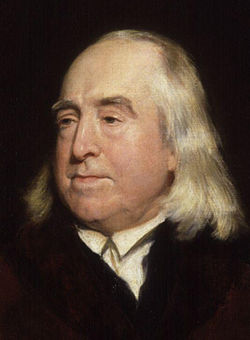
Jeremy Bentham (1748–1832) was an English philosopher, jurist, and social reformer best known as the father of utilitarianism. He argued that the moral worth of actions is determined by their contribution to overall happiness or pleasure, formulating the principle of the greatest happiness for the greatest number. Bentham's influential works on law, ethics, and political reform helped shape modern legal systems and social policy. More Less
Feb 4, 1748
% complete
Jeremy Bentham was born on 15 February 1748 (N.S.) in Houndsditch, London, to attorney Jeremiah Bentham and Alicia Woodward, widow of a Mr Whitehorne and daughter of mercer Thomas Grove of Andover. He would grow up to become an English philosopher, jurist, and social reformer regarded as the founder of modern utilitarianism.
Image source: Jeremy Bentham
1759
% complete
Bentham said that it was the placing of women in a legally inferior position that made him choose in 1759, at the age of eleven, the career of a reformist. This early commitment to justice and legal equality foreshadowed his lifelong advocacy of social and institutional reform.
1760
% complete
Having attended Westminster School, Bentham was sent by his father in 1760, at age 12, to The Queen's College, Oxford, where he completed his bachelor's degree in 1764, receiving the title of MA in 1767.
Image source: The Queen's College, Oxford
1769
% complete
Bentham trained as a lawyer and, though he never practised, was called to the bar in 1769. That same year, at age 21, he made a will leaving his body for dissection to family friend George Fordyce, the physician and chemist whose daughter Maria Sophia married Jeremy's brother Samuel.
1786 - 1787
% complete
In 1786 and 1787, Bentham travelled to Krichev in White Russia (now Belarus) to visit his brother Samuel, who was engaged in managing various industrial and other projects for Prince Potemkin.
Image source: Krychaw
1802
% complete
In an 1802 letter to Lord Pelham, Bentham described the Aboriginal people in New South Wales in derogatory terms, calling them 'brutes in human shape' and 'a set of living nuisances', views reflecting the prejudices of his era regarding colonisation.
Image source: Indigenous Australians
1808 - 1810
% complete
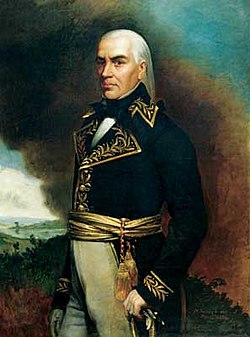
Between 1808 and 1810, Bentham held a personal friendship with Latin American revolutionary Francisco de Miranda and paid visits to Miranda's Grafton Way house in London, engaging with the cause of Latin American independence.
Image source: Francisco de Miranda
1817
% complete
By the end of his life, Bentham was a strong admirer of the United States, describing himself in an 1817 letter to John Adams Smith as a 'Philo-Yankee'. Writing to Andrew Jackson in 1830, he called himself 'at heart more of a United-States-man than an Englishman'.
Image source: United States

1825 - 1827
% complete
Though Bentham claimed the placing of women in a legally inferior position drove him toward reform from age eleven, American critic John Neal claimed to have convinced Bentham to take up women's rights issues during their association between 1825 and 1827.
Image source: John Neal
Jun 6, 1832
% complete
Bentham died on 6 June 1832, aged 84, at his residence in Queen Square Place in Westminster, London. As instructed, his body was dissected and preserved as an auto-icon, which remains his memorial today.
1776
% complete
Bentham published A Fragment on Government in 1776, a critical attack on Sir William Blackstone's legal doctrine. The 'Fragment' was only a small part of his larger Commentary on the Commentaries, which remained unpublished until the twentieth century.
Image source: Jeremy Bentham
1776
% complete
When the American colonies published their Declaration of Independence in July 1776, the British government did not issue any official response but instead secretly commissioned London lawyer and pamphleteer John Lind to publish a rebuttal, to which Bentham contributed the Short Review of the Declaration (1776).
Image source: United States Declaration of Independence
1780
% complete
In 1780, alluding to the limited degree of legal protection afforded to slaves in the French West Indies by the Code Noir, Bentham wrote that the greater part of the species had been treated by law exactly upon the same footing as, in England, the inferior races of animals were still treated.
Image source: Code Noir
1785
% complete
Bentham's c. 1785 essay 'Paederasty (Offences Against One's Self)' argued for the liberalisation of laws prohibiting homosexual sex. It was not published until 1978, when the Journal of Homosexuality described it as the first known argument for homosexual law reform in England.
Image source: Exoletus
1786 - 1789
% complete
Between 1786 and 1789, Bentham wrote A Plan for an Universal and Perpetual Peace, which forms part IV of his Principles of International Law. It includes such interesting writings on international relations and was included in Bowring's standard edition of Bentham's works.
Image source: Nuremberg principles
1787
% complete
Bentham wrote a series of thirteen 'Letters' addressed to Adam Smith, published in 1787 as Defence of Usury. The work attacked restrictions on lending money at interest; repeal of these restrictions was achieved in stages and fully achieved in England in 1854.
Image source: Usury
1789
% complete
Bentham's most famous book, An Introduction to the Principles of Morals and Legislation (1789), presents his theory of utilitarianism and is regarded as the first major book on the topic, establishing him as the founder of modern utilitarianism.
Image source: An Introduction to the Principles of Morals and Legislation
1796
% complete
In Anarchical Fallacies: Being an Examination of the Declarations of Rights Issued During the French Revolution (written around 1796), Bentham was an outspoken critic of the revolutionary discourse of natural rights and of the violence that arose after the Jacobins took power in 1792.
1817 - 1818
% complete
Swear Not At All was printed in 1817 by Effingham Wilson and published in 1818, one of Bentham's works attacking oaths and religious tests, reflecting his radical critique of established institutions.
Aug 1831
% complete
In August 1831, Bentham drafted an unpublished work entitled 'Colonization Company Proposal', his commentary upon the National Colonization Society's 'Proposal' approved on 3 August 1831 to establish a free colony on the south coast of Australia funded by the sale of appropriated colonial lands.
1978
% complete
Some of Bentham's writings on 'sexual non-conformity' were first published in 1931, but Paederasty was not published until 1978 in the Journal of Homosexuality, where it was described as the first known argument for homosexual law reform in England.
1787
% complete
In 1787, Bentham published Panopticon; or, the Inspection-House, proposing a circular prison design allowing constant observation of inmates. Twentieth-century French philosopher Michel Foucault later argued that the panopticon was paradigmatic of several 19th-century 'disciplinary' institutions.
1793
% complete
Bentham's 1793 pamphlet Emancipate Your Colonies! critiqued French colonialism, addressed to the National Convention of France. He was an outspoken critic of colonial exploitation throughout his career.
Image source: Colonialism
1794
% complete
Bentham was eventually successful in winning over Pitt and his advisors, and in 1794 was paid £2,000 for preliminary work on the panopticon prison project.
Nov 1799
% complete
Using government money, Bentham bought land on behalf of the Crown for £12,000 in November 1799. The intended site was one authorised under the Appropriation Act 1799, intended for the panopticon prison project.
Image source: Millbank Prison
1800
% complete
Bentham's proposals contributed to the Depredations on the Thames Act 1800 (39 & 40 Geo. 3), which addressed theft and damage on the River Thames, demonstrating his influence on practical legislative reform.
Image source: Depredations on the Thames Act 1800
1801 - 1803
% complete
Negotiations continued, but in 1801 Pitt resigned from office, and in 1803 the new Addington administration decided not to proceed with the panopticon project, a bitter disappointment for Bentham after years of effort.
Image source: Panopticon
1811
% complete
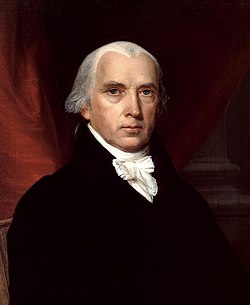
Bentham lobbied hard for the formation of codification commissions in both England and the United States, and went so far as to write to President James Madison in 1811 to volunteer to write a complete legal code for the young country.
Image source: James Madison
1811 - 1812
% complete
A few years later, the government revived the idea of a National Penitentiary, and in 1811 and 1812 returned specifically to the idea of a panopticon, though Bentham ultimately did not secure its adoption.
1821
% complete
In 1821, John Cartwright proposed to Bentham that they serve as 'Guardians of Constitutional Reform', seven 'wise men' whose reports and observations would 'concern the entire Democracy or Commons of the United Kingdom'.
Image source: John Cartwright (political reformer)
1823
% complete
In 1823, Bentham co-founded The Westminster Review with James Mill as a journal for the 'Philosophical Radicals'—a group of younger disciples through whom Bentham exerted considerable influence in British public life.
Image source: The Westminster Review
1826
% complete
Bentham is widely associated with the foundation in 1826 of London University (which became University College London in 1836), though he was 78 years old when the university opened and played only an indirect role in its establishment.
Image source: University College London
1829
% complete
Bentham failed in his efforts to see his disciple John Bowring appointed professor of English or History at London University, but he did oversee the appointment of another pupil, John Austin, as the first professor of Jurisprudence in 1829.
Image source: John Austin (legal philosopher)
May 30, 1832
% complete
A paper written in 1830, instructing Thomas Southwood Smith to create the auto-icon, was attached to Bentham's last will, dated 30 May 1832 – Queen's Square Place, Westminster. On his death, Bentham left instructions for his body to be dissected and then permanently preserved as an 'auto-icon', or self-image.
Jun 9, 1832
% complete
On 8 June 1832, two days after his death, invitations were distributed to a select group of friends, and on the following day at 3 p.m., Southwood Smith delivered a lengthy oration over Bentham's remains in the Webb Street School of Anatomy & Medicine in Southwark, London.
Image source: Thomas Southwood Smith
1838 - 1843
% complete
Bentham's writings appeared in 11 volumes in 1838–1843 under the editorship of John Bowring. Bowring's remained the standard edition of most of Bentham's writings for over a century and is still only partially superseded.
Image source: John Bowring
1849
% complete
The more direct associations between Bentham and UCL postdate his death: the majority of his surviving papers were donated to the college in 1849, followed by the auto-icon in 1850.
Mar 1850
% complete
After standing in Southwood Smith's Finsbury Square consulting rooms from 1833 and then painter Margaret Gillies's studio at 36 Percy Street, Southwood Smith offered the auto-icon to Henry Brougham in March 1850, who readily accepted it for UCL, where it has been displayed ever since.
1952 - 1954
% complete
In 1952–1954, Werner Stark published a three-volume set, Jeremy Bentham's Economic Writings, in which he attempted to bring together all of Bentham's writings on economic matters, including both published and unpublished material.
1959
% complete
Since 1959, when the Bentham Committee was first established under the auspices of University College London, UCL has hosted the Bentham Project, which is progressively publishing a definitive edition of Bentham's writings, The Collected Works of Jeremy Bentham.
1968
% complete
The Bentham Project set up to produce a definitive edition published the first volume of The Collected Works of Jeremy Bentham in 1968. Of Laws in General (1970) was found to contain many errors and was replaced by Of the Limits of the Penal Branch of Jurisprudence (2010).
Sep 2010
% complete
Launched in September 2010, the Transcribe Bentham initiative makes freely available digital images of UCL's vast Bentham Papers collection—which runs to some 60,000 manuscript folios—to engage the public and recruit volunteers to help transcribe the material.
Image source: Transcribe Bentham
2013
% complete
Upon the retirement of Sir Malcolm Grant as provost of UCL in 2013, Bentham's body was present at Grant's final council meeting—the only time the body has been taken to a UCL council meeting. That same year, on 28 November, IMF Limited adopted Bentham's name to become Bentham IMF Limited in recognition of Bentham being among the first to support the utility of litigation funding.
2020
% complete
Previously displayed at the end of the South Cloisters in UCL's main building, the auto-icon was put into a new glass display case in 2020 and moved to the entrance of UCL's new Student Centre on Gordon Square.
Or browse the full history timeline directory, with more than 2,000 topics.
This Jeremy Bentham timeline was generated with the help of AI, using information found on the internet.
We work hard to keep these timelines accurate, but mistakes do get through. If you spot one, email us at [email protected] and we'll fix it for future visitors.
Generate yours with AI or build it from scratch, for free.
Export your timeline, add your own events, edit or remove AI-generated events, and much more
No credit card required.
Cancel anytime.
Cancel anytime.
You can create an unlimited number of timelines with up to 10 events on each one, customize how they look, export them to PDF, PNG, PowerPoint, CSV, and Excel, and share them with a link. Paid plans raise the event limit and add features like spreadsheet imports and collaborators.
Yes. You can cancel your subscription from your account page at any time, and you will not be charged again. Your subscription stays active for the rest of the period you already paid for.
Yes. We will email you a reminder before the annual renewal, and we will also email you a receipt.
Yes. You can email us within 15 days of any payment, and we will issue you a full refund.
Check out our pricing docs or send us an email anytime: [email protected].