
-
Use Cases
-
Resources
-
Pricing
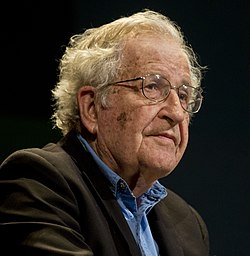
Noam Chomsky (born 1928) is an American linguist, philosopher, cognitive scientist, historian, and social critic, widely regarded as the father of modern linguistics. He revolutionized the field with his theory of generative grammar and universal grammar, while also becoming one of the world's most prominent public intellectuals through his critiques of politics, media, and power. More Less
Dec 7, 1928
% complete
Avram Noam Chomsky was born on December 7, 1928, in Philadelphia to William Chomsky, a Hebrew scholar from Ukraine, and Elsie Chomsky, a teacher. Growing up in a Jewish household steeped in intellectualism and Zionist politics, young Chomsky developed an early interest in politics, language, and ideas.
Image source: Noam Chomsky
1939
% complete
At the age of ten, following the fall of Barcelona in the Spanish Civil War, Chomsky wrote his first political article for his school newspaper about the threat of fascism spreading across Europe. This early engagement with world events foreshadowed his lifelong commitment to political commentary.
1945 - 1955
% complete
Chomsky began studying at the University of Pennsylvania at age 16, earning a BA in 1949, an MA in 1951, and a PhD in linguistics in 1955. He was mentored by Zellig Harris, whose work in structural linguistics profoundly influenced Chomsky's approach to the study of language.
Image source: University of Pennsylvania
Dec 24, 1949
% complete
Chomsky married Carol Schatz, a fellow student whom he had known since childhood. Their marriage lasted until her death in 2008, and they raised three children together while both pursued distinguished academic careers.
1955
% complete
Chomsky completed his doctoral dissertation, Transformational Analysis, under the supervision of Zellig Harris, receiving his PhD from the University of Pennsylvania. His dissertation laid out many of the core ideas that he would develop into transformational grammar.
1955
% complete
Chomsky joined the Massachusetts Institute of Technology as an assistant professor in 1955, initially working on machine translation projects. He would spend his entire academic career at MIT, becoming Institute Professor Emeritus and transforming the field of linguistics.
Image source: Massachusetts Institute of Technology

1957
% complete
The publication of Syntactic Structures in 1957 revolutionized linguistics by introducing transformational-generative grammar and arguing that language has a formal mathematical structure. The slim book is widely credited with triggering the cognitive revolution in psychology and establishing Chomsky's reputation.
Image source: Syntactic Structures
1959
% complete
Chomsky's scathing review of B.F. Skinner's Verbal Behavior demolished the behaviorist account of language learning and is often cited as a turning point in psychology's shift toward cognitive science. The review argued that complex language behavior could not be explained by conditioning.
Image source: Verbal Behavior
1961
% complete
Chomsky was promoted to full professor of foreign languages and linguistics at MIT in 1961, cementing his position as a leading figure in the emerging field of modern linguistics and attracting graduate students from around the world.
1965
% complete
In Aspects of the Theory of Syntax, Chomsky elaborated his theory of generative grammar and introduced the distinction between linguistic competence and performance. The work became one of the most influential texts in theoretical linguistics.
Image source: Aspects of the Theory of Syntax
1965
% complete
Chomsky argued that humans possess an innate capacity for language, proposing that children acquire language through an inborn 'language acquisition device' rather than mere imitation or reinforcement. This nativist view challenged behaviorist psychology and reshaped debates about human cognition.
Image source: Universal grammar
1966
% complete
Chomsky traced the intellectual history of his ideas to seventeenth-century rationalist thinkers such as Descartes and Port-Royal grammarians, arguing that the creative use of language was central to understanding the human mind.
Image source: Cartesian Linguistics
1981
% complete
Chomsky's Pisa lectures presented the government-and-binding framework, a major revision of transformational grammar that dominated syntactic theory throughout the 1980s and influenced generations of linguists.
1993
% complete
Beginning with A Minimalist Program for Linguistic Theory, Chomsky proposed radically simplifying the apparatus of syntax, seeking principles of economy and optimality in grammatical design. The minimalist program has guided theoretical linguistics research ever since.
1964 - 1975
% complete
Chomsky became one of the most prominent opponents of the Vietnam War, speaking at demonstrations, participating in civil disobedience including sit-ins at draft offices, and writing extensively about U.S. imperialism in Southeast Asia.
Image source: Opposition to United States involvement in the Vietnam War
Feb 23, 1966
% complete
Published in The New York Review of Books after being delivered at Harvard Hillel, Chomsky's essay 'The Responsibility of Intellectuals' became a defining manifesto of the New Left, urging intellectuals to speak truth to power rather than serve the state.
Oct 1967
% complete
Chomsky participated in the March on the Pentagon in October 1967 and was arrested during civil disobedience actions against the war. These experiences deepened his public identification with the radical wing of the anti-war movement.
1969
% complete
Chomsky's first major political book criticized American involvement in Vietnam and the role of intellectuals in justifying state power. It established him as one of the leading voices of the anti-war movement.
Image source: American Power and the New Mandarins
Oct 1971
% complete
Chomsky engaged in a famous televised debate with French philosopher Michel Foucault in Amsterdam, discussing human nature, power, and justice. The exchange highlighted their contrasting views on whether human nature provides a basis for social justice.
Image source: Chomsky–Foucault debate
1988
% complete
Manufacturing Consent: The Political Economy of the Mass Media introduced the propaganda model of media criticism, arguing that corporate ownership and advertising incentives shape news coverage to favor elite interests. It remains one of the most influential works of media studies.
Image source: Manufacturing Consent
1999
% complete
Chomsky critiqued neoliberalism and globalization in Profit Over People, arguing that free trade agreements and international financial institutions primarily serve corporate interests at the expense of democratic governance and ordinary citizens.
Image source: Profit over People
Sep 11, 2001
% complete
Following the September 11 attacks, Chomsky published 9-11, which analyzed U.S. foreign policy and argued that America itself had committed acts comparable to terrorism. The book became an unlikely international bestseller, topping lists in several countries.
Image source: September 11 attacks
2003
% complete
Hegemony or Survival examined American imperial ambitions and warned of the dangers of U.S. unilateralism. Former Venezuelan president Hugo Chávez famously recommended the book at the United Nations General Assembly in 2006, bringing it renewed attention worldwide.
Image source: Hegemony or Survival
1980
% complete
Scholars noted that Chomsky ranked among the most cited authors in academic literature overall, placing alongside Marx, Lenin, Shakespeare, Aristotle, Plato, and Freud — making him the eighth most cited source overall and the most cited living author.
1992
% complete
Canadian filmmakers Mark Achbar and Peter Wintonick released a documentary about Chomsky's life and media analysis, which became one of the most commercially successful documentaries in Canadian film history and broadened his popular reach.
Image source: Manufacturing Consent (film)
2002
% complete
Chomsky retired from regular teaching duties at MIT in 2002 but continued his research, writing, and lecturing prolifically, holding the title of Institute Professor Emeritus and remaining one of the university's most celebrated scholars.
Dec 19, 2008
% complete
Carol Chomsky, a renowned Harvard linguist known for her research on child language development, passed away after a long battle with cancer after nearly six decades of marriage. Noam later remarried Valeria Wasserman in 2014.
2016
% complete
In Who Rules the World?, Chomsky surveyed American power in global affairs, addressing topics from nuclear policy and climate change to interventionism. Written in his late eighties, it demonstrated his enduring productivity as a public intellectual.
Image source: Who Rules the World (TV series)
Aug 2017
% complete
Chomsky accepted a dual appointment at the University of Arizona as laureate professor of linguistics and Agnese Nelms Haury Chair in the Program in Social Justice, Human Rights, and Environmental Sustainability, extending his teaching career into his late eighties.
Image source: University of Arizona
Dec 2017
% complete
Global Discontents: Conversations on the Rising Threats to Democracy collected interviews conducted between 2013 and 2016, in which Chomsky addressed rising authoritarianism, economic inequality, climate change, and the threats facing democracy worldwide.
Or browse the full history timeline directory, with more than 2,000 topics.
This Noam Chomsky timeline was generated with the help of AI, using information found on the internet.
We work hard to keep these timelines accurate, but mistakes do get through. If you spot one, email us at [email protected] and we'll fix it for future visitors.
Generate yours with AI or build it from scratch, for free.
Export your timeline, add your own events, edit or remove AI-generated events, and much more
No credit card required.
Cancel anytime.
Cancel anytime.
You can create an unlimited number of timelines with up to 10 events on each one, customize how they look, export them to PDF, PNG, PowerPoint, CSV, and Excel, and share them with a link. Paid plans raise the event limit and add features like spreadsheet imports and collaborators.
Yes. You can cancel your subscription from your account page at any time, and you will not be charged again. Your subscription stays active for the rest of the period you already paid for.
Yes. We will email you a reminder before the annual renewal, and we will also email you a receipt.
Yes. You can email us within 15 days of any payment, and we will issue you a full refund.
Check out our pricing docs or send us an email anytime: [email protected].