-
Use Cases
-
Resources
-
Pricing
May 5, 1818
% complete
Karl Heinrich Marx was born in Trier, then part of the Prussian Rhineland, to a middle-class Jewish family. His father, Heinrich Marx, was a lawyer who converted to Lutheranism, a decision that shaped Karl's upbringing in an increasingly assimilated household.
Image source: Karl Marx
1824
% complete
At the age of six, Karl Marx was baptized along with his siblings into the Evangelical Established Church of Prussia, following his father's conversion. This gave him formal membership in the state church and access to education that might otherwise have been restricted.
1835
% complete
Marx completed his secondary schooling at the Trier Gymnasium at age seventeen. In his graduation essay, 'Reflections of a Young Man on the Choice of a Profession,' he expressed idealistic ambitions to work for the welfare of humanity.
Oct 1835 - 1836
% complete
Marx began studying law at the University of Bonn at his father's insistence. He spent much of his time socializing, drinking, and dueling, and his father grew increasingly concerned about his son's unruly behavior.
Image source: University of Bonn
Oct 1836 - 1841
% complete
Marx transferred to the University of Berlin, where he immersed himself in philosophy, particularly the works of G.W.F. Hegel. He joined the Young Hegelians, a group of radical thinkers who applied Hegel's dialectical methods to critique religion and Prussian politics.
Image source: Humboldt University of Berlin
Apr 1841
% complete
Marx submitted his dissertation comparing the natural philosophies of Democritus and Epicurus to the University of Jena, which awarded him a doctorate. The work showed his early materialist leanings and his engagement with ancient Greek thought.
Image source: The Difference Between the Democritean and Epicurean Philosophy of Nature
1836 - Jun 19, 1843
% complete
Marx became secretly engaged to Jenny von Westphalen, daughter of Baron Ludwig von Westphalen, a Prussian nobleman seven years his senior. Despite her aristocratic family's reservations about the penniless young radical, they married in June 1843.
Image source: Jenny von Westphalen
Jun 19, 1843
% complete
Karl and Jenny married in Kreuznach after a seven-year engagement. Jenny remained Marx's devoted companion, secretary, and intellectual partner throughout his turbulent life despite poverty, exile, and repeated personal tragedies.
Dec 2, 1881
% complete
Jenny Marx died of cancer at the age of sixty-seven after decades of hardship alongside her husband. Her death devastated Marx, whose own health declined rapidly afterward as he suffered bronchitis and abscesses.
Jan 9, 1883
% complete
Marx's eldest daughter Jenny died of cancer of the bladder just weeks before her father's death, compounding his grief. Marx never recovered emotionally from the loss of his beloved daughter.
Image source: Jenny Longuet
Mar 14, 1883
% complete
Karl Marx died peacefully in his armchair at his home in Hampstead, London, aged sixty-four, having succumbed to bronchitis and pleurisy. He was buried three days later at Highgate Cemetery beside his wife.
Mar 17, 1883
% complete
Only eleven mourners attended Marx's funeral at Highgate Cemetery, where Engels delivered a eulogy declaring that Marx's name and work would endure through the ages. The modest graveside gathering belied the enormous future influence of his ideas.
Image source: Highgate Cemetery
Oct 1842 - Mar 18, 1843
% complete
Marx became editor-in-chief of the liberal Cologne newspaper Rheinische Zeitung, where he published critiques of censorship, Prussian absolutism, and the economic condition of the Moselle peasantry. The paper was suppressed by Prussian authorities in 1843.
Image source: Rheinische Zeitung
Oct 1843 - 1844
% complete
After the suppression of the Rheinische Zeitung, Marx moved to Paris with his new wife to co-edit the Deutsch-Französische Jahrbücher with Arnold Ruge. Only one double issue appeared before the partnership collapsed over ideological differences.
Image source: Deutsch–Französische Jahrbücher
Aug 28, 1844
% complete
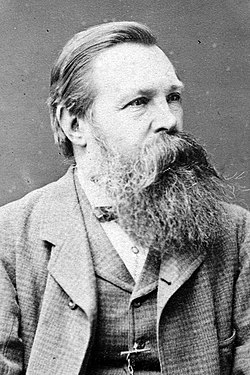
Marx met Friedrich Engels at the Café de la Régence in Paris, beginning one of history's most consequential intellectual partnerships. They discovered they shared identical views and embarked on nearly four decades of collaboration.
Image source: Friedrich Engels
Feb 1845
% complete
Prussian pressure led French authorities to expel Marx in early 1845. He relocated to Brussels with Jenny and their young daughter, renouncing his Prussian citizenship and settling into a period of intense theoretical work.
Feb 1846
% complete
Marx and Engels established the Communist Correspondence Committee in Brussels to link socialist groups across Europe. This network helped lay the organizational groundwork for the Communist League founded the following year.
Image source: Communist League
Jun 1847
% complete
The League of the Just merged with Marx's correspondence committee network to form the Communist League. At its London congresses, the League adopted Marx's motto 'Workers of the world, unite!' and commissioned him and Engels to write its manifesto.
Apr 1848 - Aug 1849
% complete
With revolution sweeping Europe, Marx returned to Cologne and edited the Neue Rheinische Zeitung, a radical daily advocating democratic revolution and unification of Germany. The paper's final issue, printed in red, appeared after Marx was ordered expelled again.
Image source: Neue Rheinische Zeitung
Aug 1849 - 1883
% complete
After brief stops in Paris, Marx settled permanently in London, where he lived the rest of his life in exile. He endured severe poverty, the deaths of several children, and dependence on Engels' financial support while developing his economic theories.
1843
% complete
In this essay, Marx critiqued Bruno Bauer's views on political emancipation and argued that true human emancipation required more than religious or civil liberty. The work marked an important stage in Marx's break from Young Hegelian idealism.
Image source: On the Jewish Question
1844
% complete
Known as the Paris Manuscripts, these notebooks introduced Marx's theory of alienated labor under capitalism. Unpublished during his lifetime, they became hugely influential among twentieth-century humanist interpreters of Marxism.
Image source: Economic and Philosophic Manuscripts of 1844
Feb 1845
% complete
Co-authored with Engels, this book attacked the Young Hegelians, particularly Bruno Bauer, and signaled Marx's decisive turn toward historical materialism and the central role of the working class in revolutionary change.
Image source: The Holy Family (book)
Apr 1845 - 1846
% complete
In Brussels, Marx composed the famous Theses on Feuerbach and, with Engels, wrote The German Ideology, which first systematically expounded the materialist conception of history: that economic conditions shape society, politics, and ideas.
Image source: The German Ideology
Feb 21, 1848
% complete
Written by Marx and Engels for the Communist League, this pamphlet declared that all history is the history of class struggles and called for proletarian revolution. It appeared just days before the outbreak of revolutions across Europe and became one of the most influential political texts ever written.
Image source: The Communist Manifesto
1850 - 1852
% complete
Analyzing the failed Revolution of 1848 and Napoleon III's coup, Marx developed influential concepts about class politics, the state, and Bonapartism. The Eighteenth Brumaire famously observed that history repeats itself, 'the first time as tragedy, the second as farce.'
Image source: The Eighteenth Brumaire of Louis Bonaparte
1850 - 1867
% complete
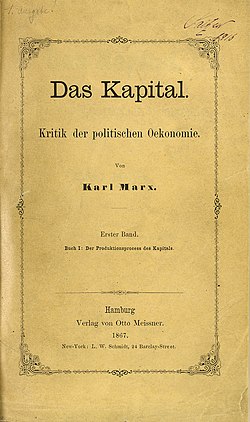
Marx spent years conducting exhaustive research in economics at the British Museum, studying classical economists, factory reports, and statistics. This research formed the basis of Das Kapital, his monumental critique of capitalist production.
Image source: Das Kapital
Or browse the full history timeline directory, with more than 2,000 topics.
This Karl Marx timeline was generated with the help of AI, using information found on the internet.
We work hard to keep these timelines accurate, but mistakes do get through. If you spot one, email us at [email protected] and we'll fix it for future visitors.
Generate yours with AI or build it from scratch, for free.
Export your timeline, add your own events, edit or remove AI-generated events, and much more
No credit card required.
Cancel anytime.
Cancel anytime.
You can create an unlimited number of timelines with up to 10 events on each one, customize how they look, export them to PDF, PNG, PowerPoint, CSV, and Excel, and share them with a link. Paid plans raise the event limit and add features like spreadsheet imports and collaborators.
Yes. You can cancel your subscription from your account page at any time, and you will not be charged again. Your subscription stays active for the rest of the period you already paid for.
Yes. We will email you a reminder before the annual renewal, and we will also email you a receipt.
Yes. You can email us within 15 days of any payment, and we will issue you a full refund.
Check out our pricing docs or send us an email anytime: [email protected].