-
Use Cases
-
Resources
-
Pricing
The Korean War (1950–1953) was a conflict between communist North Korea, supported by China and the Soviet Union, and South Korea, backed by United Nations forces led primarily by the United States. The war began when North Korean forces invaded South Korea and ended in an armistice, leaving the peninsula divided near the 38th parallel. It was one of the deadliest conflicts of the Cold War era and technically remains unresolved, as no formal peace treaty was ever signed. More Less
Aug 8, 1945 - Sep 2, 1945
% complete
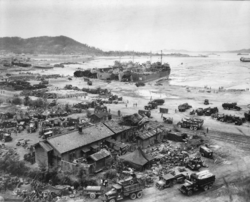
The Soviet Union declared war on Japan and rapidly overran Japanese forces in Manchuria and northern Korea, ending 35 years of Japanese colonial rule over the Korean peninsula and setting the stage for the division of Korea between occupying powers.
Image source: Soviet invasion of Manchuria
Sep 8, 1945
% complete
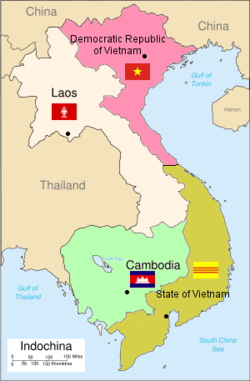
US and Soviet forces occupied Korea north and south of the 38th parallel as a temporary measure. The division, intended to be provisional, hardened into a permanent split as Cold War tensions grew between the two occupying powers.
Image source: Division of Korea
Dec 27, 1945
% complete
The foreign ministers of the United States, Soviet Union, and Britain agreed that Korea would be placed under a four-power trusteeship for up to five years before independence. The plan was deeply unpopular among Korean nationalists and was never implemented.
Image source: Moscow Conference (1945)
Aug 15, 1948
% complete
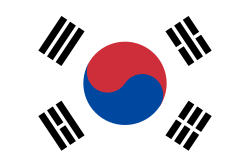
Syngman Rhee was inaugurated as the first president of the Republic of Korea in Seoul, backed by the United States. The new government was fiercely anti-communist and claimed sovereignty over the entire Korean peninsula.
Image source: South Korea
Sep 9, 1948
% complete
Kim Il Sung proclaimed the Democratic People's Republic of Korea in Pyongyang with Soviet backing. The creation of two rival Korean states, each claiming to be the legitimate government of the entire peninsula, set the stage for conflict.
Image source: North Korea
Dec 1948 - Jun 1949
% complete
Soviet forces withdrew from North Korea in late 1948, and American forces completed their withdrawal from South Korea by June 1949, leaving behind military advisory groups. Border clashes along the 38th parallel intensified throughout 1949.
Image source: United States Army Military Government in Korea
Jan 12, 1950
% complete
US Secretary of State Dean Acheson delivered a speech outlining America's defensive perimeter in the Pacific that notably excluded Korea. Some historians argue this signaled to North Korea and the Soviet Union that the US might not defend South Korea.
Image source: Dean Acheson
Jun 25, 1950
% complete
North Korean forces crossed the 38th parallel and invaded South Korea, launching a surprise assault with Soviet-supplied tanks and artillery. Seoul fell within three days, and the United Nations Security Council condemned the invasion.
Image source: Korean War
Jun 27, 1950
% complete
With the Soviet Union boycotting the Security Council over the exclusion of the People's Republic of China, the council passed Resolution 83 recommending member states assist South Korea, paving the way for the UN Command under US leadership.
Image source: United Nations Security Council Resolution 83
Jul 5, 1950
% complete
Task Force Smith, the first American ground unit committed to the war, was defeated by North Korean forces at Osan. The rout exposed the weakness of early US deployments and the strength of the North Korean People's Army.
Image source: Battle of Osan
Aug 4, 1950 - Sep 18, 1950
% complete
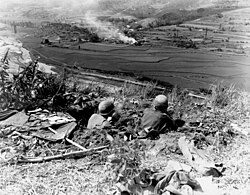
UN and South Korean forces were pushed into a defensive perimeter around the port city of Busan in southeastern Korea. Despite repeated North Korean assaults, the defenders held the line, buying time for reinforcements and supplies to arrive.
Image source: Battle of the Pusan Perimeter
Sep 15, 1950 - Sep 19, 1950
% complete
General Douglas MacArthur led a daring amphibious landing at Incheon, deep behind North Korean lines. The operation, considered highly risky due to extreme tides, succeeded brilliantly and cut off North Korean forces fighting in the south.
Image source: Battle of Inchon
Sep 22, 1950 - Sep 28, 1950
% complete
Following the Incheon landing, UN forces fought through urban resistance to retake Seoul from North Korean occupation. Combined with the breakout from the Pusan Perimeter, the recapture shattered North Korea's offensive capability.
Image source: Third Battle of Seoul
Oct 7, 1950
% complete
The UN General Assembly passed a resolution endorsing actions to establish a unified, independent Korea, effectively authorizing UN forces to cross the 38th parallel and pursue the enemy into North Korea.
Image source: United Nations Security Council Resolution 84
Oct 19, 1950
% complete
UN and South Korean forces captured Pyongyang, the North Korean capital. With North Korean forces in disarray, optimism grew in Washington that the war could be won and Korea unified by force before the end of the year.
Image source: Pyongyang
Oct 2, 1950
% complete
Chinese premier Zhou Enlai warned through Indian ambassador K. M. Panikkar that China would intervene in the war if UN forces crossed the 38th parallel. The warning was dismissed in Washington as a bluff.
Oct 25, 1950 - Nov 1, 1950
% complete
Chinese People's Volunteer Army units secretly crossed the Yalu River and engaged South Korean and UN forces near Onjong and Unsan, inflicting the first serious defeat on American troops and revealing China's entry into the war.
Image source: Battle of Onjong
Nov 25, 1950 - Dec 24, 1950
% complete
Massive Chinese forces launched a surprise offensive in brutal winter conditions against overextended UN lines. The attack shattered the UN advance, forcing the longest retreat in US military history and destroying hopes of a quick victory.
Image source: People's Volunteer Army
Nov 27, 1950 - Dec 13, 1950
% complete
In temperatures far below zero, the US X Corps fought its way out of encirclement by Chinese forces near the Chosin Reservoir. The fighting withdrawal, remembered as the 'Frozen Chosin,' became legendary for the endurance of American Marines.
Jan 4, 1951
% complete
Chinese and North Korean forces recaptured Seoul for the second time in the war. The fall of the capital prompted consideration among UN commanders of evacuating the peninsula entirely.
Mar 7, 1951 - Mar 21, 1951
% complete
UN forces under General Matthew Ridgway launched Operation Ripper, driving Chinese forces north and recapturing Seoul on March 14-15. Ridgway's aggressive tactics restored UN momentum after the winter defeats.
Image source: Operation Ripper
Apr 11, 1951
% complete
President Harry Truman dismissed General Douglas MacArthur after the general publicly advocated expanding the war into China, possibly with nuclear weapons. The dismissal affirmed civilian control of the military and sparked a major political controversy.
Image source: Relief of Douglas MacArthur
Jul 10, 1951
% complete
Truce talks opened at Kaesong, later moving to Panmunjom. Negotiations stalled repeatedly over issues including the demarcation line and, most intractably, the voluntary repatriation of prisoners of war, dragging on for two years while fighting continued.
Image source: Korean Armistice Agreement
Sep 13, 1951 - Oct 15, 1951
% complete
US and French forces fought a bloody month-long battle to seize a ridge complex north of the Punchbowl. The costly victory, gained through relentless frontal assaults, exemplified the grinding attritional warfare that characterized the war's later phase.
Image source: Battle of Heartbreak Ridge
Jun 26, 1952 - Aug 4, 1952
% complete
Hill 266, known as Old Baldy, changed hands repeatedly in fierce fighting between UN and Chinese forces. The prolonged struggle for a single hill illustrated the static, trench-warfare nature of the war's middle period.
Image source: Battle of Old Baldy
Nov 4, 1952
% complete
Dwight Eisenhower won the US presidential election after pledging to go to Korea to seek an end to the stalemated war. His election signaled a shift in American policy toward seeking a negotiated settlement.
Image source: 1952 United States presidential election
Mar 23, 1953 - Jul 16, 1953
% complete
UN and Chinese forces waged a series of brutal battles over Hill 255, nicknamed Pork Chop Hill. The high casualties for limited strategic value led the US to eventually abandon the position, symbolizing the futility of the stalemate's final months.
Image source: Battle of Pork Chop Hill
Mar 5, 1953
% complete
The death of Soviet leader Joseph Stalin removed the chief obstacle to a negotiated peace. The new Soviet leadership pressed China and North Korea to compromise on prisoner repatriation, accelerating progress toward an armistice.
Image source: Death and state funeral of Joseph Stalin
Jul 27, 1953
% complete
UN Commander Mark W. Clark, North Korean leader Kim Il Sung, and Chinese commander Peng Dehuai signed the armistice, ending hostilities. The agreement created the Korean Demilitarized Zone and mandated the exchange of prisoners, but no formal peace treaty was ever signed.
Aug 5, 1953 - Sep 6, 1953
% complete
The final and largest exchange of prisoners of war took place under the armistice terms, with tens of thousands of UN, South Korean, Chinese, and North Korean prisoners returned. Many Chinese and North Korean prisoners chose not to return home.
Image source: Operation Big Switch
Apr 26, 1954 - Jul 20, 1954
% complete
Representatives of both Korean states and the major powers met in Geneva to discuss a peaceful settlement and reunification of Korea. The conference ended in failure, leaving the peninsula divided along the Demilitarized Zone, a division that persists to this day.
Image source: 1954 Geneva Conference
Or browse the full history timeline directory, with more than 2,000 topics.
This Korean War timeline was generated with the help of AI, using information found on the internet.
We work hard to keep these timelines accurate, but mistakes do get through. If you spot one, email us at [email protected] and we'll fix it for future visitors.
Generate yours with AI or build it from scratch, for free.
Export your timeline, add your own events, edit or remove AI-generated events, and much more
No credit card required.
Cancel anytime.
Cancel anytime.
You can create an unlimited number of timelines with up to 10 events on each one, customize how they look, export them to PDF, PNG, PowerPoint, CSV, and Excel, and share them with a link. Paid plans raise the event limit and add features like spreadsheet imports and collaborators.
Yes. You can cancel your subscription from your account page at any time, and you will not be charged again. Your subscription stays active for the rest of the period you already paid for.
Yes. We will email you a reminder before the annual renewal, and we will also email you a receipt.
Yes. You can email us within 15 days of any payment, and we will issue you a full refund.
Check out our pricing docs or send us an email anytime: [email protected].