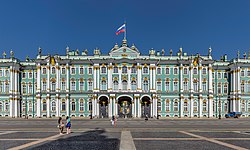
-
Use Cases
-
Resources
-
Pricing
The Kremlin is a fortified complex in the center of Moscow, Russia, serving as the official residence of the President of Russia and historically the seat of power for tsars, Soviet leaders, and modern Russian presidents. Comprising palaces, cathedrals, towers, and walls dating from the 15th century, it is a UNESCO World Heritage Site and a enduring symbol of Russian political authority. More Less
1000 - 1099
% complete
The Slavs occupied the south-western portion of Borovitsky Hill as early as the 11th century, a fact evidenced by a metropolitan seal from the 1090s unearthed by Soviet archaeologists in the area.
Image source: Kremlin
1156
% complete
The grad, known up to the 14th century simply as the 'grad of Moscow', was greatly extended by Prince Yuri Dolgorukiy in 1156, marking the site's emergence as a fortified stronghold.
Image source: Yuri Dolgorukiy
1331
% complete
The word 'Kremlin' was first recorded in 1331, though etymologist Max Vasmer mentions an earlier appearance in 1320.
1237
% complete
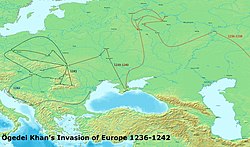
The grad was destroyed by the Mongols during their devastating invasion of the Russian principalities.
Image source: Mongol invasion of Kievan Rus'
1339
% complete
Following the Mongol destruction of 1237, Ivan I Kalita rebuilt the grad in oak, restoring Moscow's principal fortress.
Image source: Ivan I of Moscow
1365
% complete
Dmitri Donskoi's tutor, Metropolitan Alexis, founded the Chudov Monastery within the Kremlin. His widow, Eudoxia, later established the Ascension Convent in 1397.
Image source: Chudov Monastery
1366 - 1368
% complete
Dmitri Donskoi replaced the oak palisade with a strong citadel of white limestone in 1366–1368 on the basic foundations of the current walls; this fortification withstood a siege by Khan Tokhtamysh.
Image source: Dmitry Donskoy
1406
% complete
The newly built Cathedral of the Annunciation was painted by the great masters Theophanes the Greek, Andrei Rublev, and Prokhor.
Image source: Cathedral of the Annunciation, Moscow
1479
% complete
The Cathedral of the Dormition was completed in 1479 to serve as the main church of Moscow and the site where all the Tsars were crowned.
Image source: Dormition Cathedral, Moscow
1484 - 1488
% complete
One of two domestic churches of the Metropolitans and Patriarchs of Moscow, the one-domed Church of the Deposition of the Virgin's Robe was built by Pskov artisans from 1484 to 1488 and features icons and frescoes from 1627 and 1644.
Image source: Church of the Deposition of the Robe
1485 - 1495
% complete
The existing Kremlin Wall and Kremlin towers were built by Italian masters from 1485 to 1495, giving the fortress its present-day appearance.
Image source: Moscow Kremlin Wall
1489
% complete
The gilded, three-domed Cathedral of the Annunciation was completed in 1489, only to be reconstructed to a nine-domed design a century later.
1491
% complete
The oldest secular structure still standing in the Kremlin is Ivan III's Palace of Facets (1491), which holds the imperial thrones.
Image source: Palace of Facets
1505 - 1508
% complete
The highest building of the city and Muscovite Russia, the Ivan the Great Bell Tower, was built between 1505 and 1508.
Image source: Ivan the Great Bell Tower
1508
% complete
John the Precursor was built by Aloisio the New in 1508 in place of the first church constructed in Moscow.
1508
% complete
On the south-east of the square stands the much larger Cathedral of the Archangel Michael, where almost all the Muscovite monarchs from Ivan Kalita to Ivan V of Russia are interred.
Image source: Cathedral of the Archangel
1600 - 1699
% complete
Originally there were eighteen Kremlin towers, but their number increased to twenty in the 17th century, when most of the existing Terem Palace was also built.
Image source: List of Moscow Kremlin towers
1600
% complete
The Ivan the Great Bell Tower was augmented to its present height in 1600, reaching 81 metres (266 feet), making it the tallest structure in the city.
Sep 21, 1610 - Oct 26, 1612
% complete
During the Time of Troubles, the Kremlin was held by Polish forces for two years, from 21 September 1610 until its recapture on 26 October 1612.
Image source: Time of Troubles
1653 - 1656
% complete
One of the two domestic churches of the Metropolitans and Patriarchs of Moscow, the Church of the Twelve Apostles, was constructed between 1653 and 1656.
Image source: Church of the Twelve Apostles
1682
% complete
After the death of Alexis's son Feodor and the Moscow Uprising of 1682, Tsar Peter escaped with much difficulty from the Kremlin and as a result developed a dislike for it.
Image source: Peter the Great
1701
% complete
The northern corner of the Kremlin is occupied by the Arsenal, which was built for Peter the Great beginning in 1701.
Image source: Kremlin Arsenal
1703
% complete
Three decades after escaping the Kremlin, Peter abandoned the residence of his forefathers for his new capital, Saint Petersburg, founded in 1703.
Image source: Saint Petersburg
1752
% complete
The Golden Hall, a throne room with murals painted probably after 1547, was destroyed to make place for the Kremlin Palace commissioned by Elizabeth of Russia and designed by Italian architect Francesco Bartolomeo Rastrelli.
Image source: Grand Kremlin Palace
1773
% complete
Although still used for coronation ceremonies, the Kremlin had been neglected until 1773, when Catherine the Great engaged Vasili Bazhenov to build her new residence there.
Image source: Vasily Bazhenov
Sep 2, 1812 - Oct 11, 1812
% complete
French forces under Napoleon occupied the Kremlin from 2 September to 11 October 1812, following the French invasion of Russia.
Image source: French invasion of Russia
Oct 21, 1812 - Oct 23, 1812
% complete
Explosions continued for three days, from 21 to 23 October 1812, damaging the Kremlin; the upper part of the Ivan the Great Bell Tower was destroyed and later rebuilt.
1816 - 1819
% complete
Restoration works were undertaken in 1816–1819 under the supervision of architect Osip Bove to repair the war damage inflicted on the Kremlin.
Image source: Joseph Bové
1838
% complete
The Terem Palace, commissioned by Nicholas I in 1838, contains reception halls, a ceremonial red staircase, private apartments of the tsars, and the lower story of the Resurrection of Lazarus church (1393), the oldest extant structure in the Kremlin and all of Moscow.
Image source: Terem Palace
1839 - 1849
% complete
Commissioned by Nicholas I, the palace was constructed in 1839–1849, followed by the rebuilding of the Kremlin Armoury in 1851.
1851
% complete
Built in 1851 to a Renaissance Revival design, the Kremlin Armoury is currently a museum housing the Russian state Regalia and Diamond Fund.
Image source: Kremlin Armoury
1905
% complete
A stone cross was erected marking the spot where in 1905 Grand Duke Sergei Alexandrovich of Russia was assassinated by Ivan Kalyayev; it was one of the few monuments added after 1851, before being destroyed by the Bolsheviks in 1918.
Image source: Grand Duke Sergei Alexandrovich of Russia
1918
% complete
The Monument to Alexander II and the stone cross marking the assassination spot of Grand Duke Sergei Alexandrovich were destroyed by the Bolsheviks in 1918.
Mar 12, 1918
% complete
The Soviet government moved from Petrograd (present-day Saint Petersburg) to Moscow on 12 March 1918, making the Kremlin once again the seat of power.
1920 - 1955
% complete
The residence of the Soviet government was closed to tourists until 1955, keeping the Kremlin off-limits to visitors for decades.
1920
% complete
The Chudov Monastery and Ascension Convent, with their 16th-century cathedrals, were demolished to make room for the military school.
1947 - 1991
% complete
During the Cold War, the term 'the Kremlin' meant the Government of the Soviet Union, and 'Kremlinology' meant the study of the decisions of the Soviet leaders and of Russian and Soviet politics.
1959 - 1961
% complete
The State Kremlin Palace, alias the Kremlin Palace of Congresses, was commissioned by Nikita Khrushchev as a modern arena for Communist Party meetings and was built within the Kremlin walls between 1959 and 1961.
Image source: State Kremlin Palace
1961
% complete
The Kremlin Museums were established in 1961, opening the historic complex to greater public access.
Image source: Kremlin
1990
% complete
The Kremlin complex was among the first Soviet patrimonies inscribed on the World Heritage List in 1990.
Image source: World Heritage Site
May 2013
% complete
A helipad was completed in May 2013 within the Kremlin grounds, allowing the president to travel without convoys disrupting traffic in central Moscow.
Or browse the full history timeline directory, with more than 2,000 topics.
This Kremlin timeline was generated with the help of AI, using information found on the internet.
We work hard to keep these timelines accurate, but mistakes do get through. If you spot one, email us at [email protected] and we'll fix it for future visitors.
Generate yours with AI or build it from scratch, for free.
Export your timeline, add your own events, edit or remove AI-generated events, and much more
No credit card required.
Cancel anytime.
Cancel anytime.
You can create an unlimited number of timelines with up to 10 events on each one, customize how they look, export them to PDF, PNG, PowerPoint, CSV, and Excel, and share them with a link. Paid plans raise the event limit and add features like spreadsheet imports and collaborators.
Yes. You can cancel your subscription from your account page at any time, and you will not be charged again. Your subscription stays active for the rest of the period you already paid for.
Yes. We will email you a reminder before the annual renewal, and we will also email you a receipt.
Yes. You can email us within 15 days of any payment, and we will issue you a full refund.
Check out our pricing docs or send us an email anytime: [email protected].