-
Use Cases
-
Resources
-
Pricing
Mao Zedong (1893–1976) was a Chinese revolutionary, politician, and founding father of the People's Republic of China. As leader of the Chinese Communist Party from 1935 until his death, he shaped modern Chinese history through events such as the Long March, the establishment of communist rule in 1949, the Great Leap Forward, and the Cultural Revolution. More Less
Dec 26, 1893
% complete
Mao Zedong was born into a relatively prosperous peasant family in the village of Shaoshan in Hunan Province, China. His father was a strict grain dealer and farmer, and Mao's early years working in the fields shaped his later views on rural life and the peasantry.
Image source: Mao Zedong
1913 - 1918
% complete
Mao studied at Changsha's Hunan First Normal University, where he was exposed to progressive ideas, developed his political philosophy, and co-founded the New People's Study Society with friends like Cai Hesen, laying the groundwork for his revolutionary career.
Image source: Hunan Normal University
May 4, 1919
% complete
The May Fourth Movement erupted in Beijing in response to the Treaty of Versailles. Mao became actively involved in nationalist activities in Changsha, editing the student journal Xiang River Review, which helped establish his reputation as a political writer and organizer.
Image source: May Fourth Movement
Jul 23, 1921
% complete
Mao attended the First Congress of the Chinese Communist Party in Shanghai as one of twelve delegates, becoming one of the founding members of the party that he would eventually lead for decades.
Image source: 100th Anniversary of the Chinese Communist Party
1923 - 1927
% complete
The CCP allied with Sun Yat-sen's Kuomintang under Comintern guidance. Mao joined the KMT and worked in its peasant movement apparatus, organizing rural farmers in Hunan and gaining experience that informed his later emphasis on peasant revolution.
Image source: First United Front
Dec 1, 1925
% complete
Mao published this influential essay analyzing the social classes of China, arguing that the poor peasants would be the key force in revolution, an idea that distinguished his approach from orthodox Marxism focused on urban workers.
Image source: Lumpenproletariat
Sep 7, 1927
% complete
Following the KMT's violent purge of communists, Mao led the Autumn Harvest Uprising in Hunan. Though the revolt failed militarily, it marked Mao's turn toward independent armed struggle and led him to retreat to the Jinggang Mountains with his remaining forces.
Image source: Autumn Harvest Uprising
Nov 1931
% complete
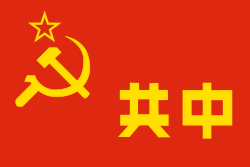
Mao helped establish the Chinese Soviet Republic in Jiangxi Province, serving as its chairman. This rural base area demonstrated his strategy of surrounding the cities from the countryside and implementing land reform policies.
Image source: Jiangxi Soviet
Oct 16, 1934
% complete
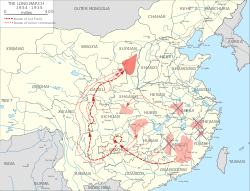
Facing encirclement by Kuomintang forces, the Red Army broke out of the Jiangxi Soviet and began the Long March, a grueling retreat of thousands of miles across western China that became legendary in Communist history.
Image source: Long March
Jan 15, 1935
% complete
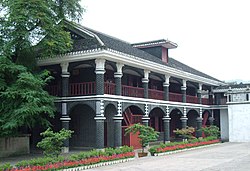
At a meeting during the Long March in Zunyi, Guizhou, Mao gained effective control of the Red Army and the party leadership, marking a decisive turning point in his rise to power within the Chinese Communist Party.
Image source: Zunyi Conference
Oct 20, 1935
% complete
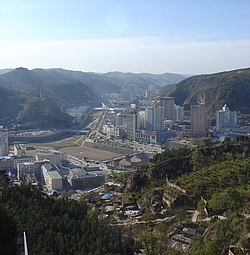
The remnants of the Red Army arrived in northern Shaanxi, establishing Yan'an as their base. Over the next decade, Mao consolidated his ideological authority, writing major theoretical works and developing Sinified Marxism.
Image source: Yan'an
1937
% complete
Mao published his treatise on guerrilla strategy, articulating how a mobile, peasant-based army could defeat stronger conventional foes, ideas that influenced insurgent movements worldwide throughout the twentieth century.
Image source: Guerrilla warfare
Sep 22, 1937 - 1941
% complete
After Japan's full-scale invasion of China, the CCP and Kuomintang formed a nominal alliance to resist Japanese aggression. During this period, the Communists expanded their forces through guerrilla warfare behind enemy lines.
Image source: Second Sino-Japanese War
Aug 29, 1945 - Oct 10, 1945
% complete
Following Japan's surrender, Mao traveled to Chongqing to negotiate directly with Chiang Kai-shek about China's future, producing the Double Tenth Agreement that briefly delayed but failed to prevent full civil war.
Image source: Chongqing Negotiations
1946 - 1949
% complete
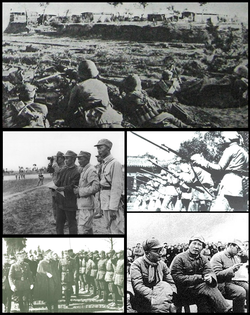
Fighting resumed between the Communists and Nationalists. Despite initially superior numbers and American support for Chiang Kai-shek, the KMT collapsed amid corruption and inflation, while Mao's forces won decisive campaigns like Liaoshen, Huaihai, and Pingjin.
Image source: Chinese Civil War
1942 - 1945
% complete
Mao launched a campaign to purge party members of dissent and enforce ideological conformity, consolidating his personal dominance over the CCP and establishing methods of thought reform that foreshadowed later campaigns.
Image source: Yan'an Rectification Movement
Apr 23, 1945 - Jun 11, 1945
% complete
The Seventh Congress enshrined Maoism (Mao Zedong Thought) in the party constitution as guiding ideology and elected Mao as Chairman of the Central Committee, formalizing his position as the party's paramount leader.
Image source: 7th National Congress of the Chinese Communist Party
1950 - 1953
% complete
The new government redistributed land from landlords to peasants across China, mobilizing mass struggle sessions in which hundreds of thousands of landlords were persecuted or killed, fundamentally transforming rural society.
Image source: Land Reform Movement
Mar 1951 - 1952
% complete
Mao directed a nationwide campaign to eliminate alleged enemies of the new regime, including former KMT agents, bandits, and religious sects, resulting in hundreds of thousands of executions and arrests.
Image source: Campaign to Suppress Counterrevolutionaries
1953 - 1957
% complete
Modeled on Soviet planning, the First Five-Year Plan prioritized heavy industry and collectivized agriculture, laying foundations for state socialism while achieving significant industrial growth with Soviet assistance.
May 1956 - Jun 1957
% complete
Mao encouraged intellectuals to voice criticism of the party under the slogan 'let a hundred flowers bloom.' When criticism proved sharper than expected, the campaign abruptly ended and set the stage for repression.
Image source: Hundred Flowers Campaign
Jun 1957 - 1958
% complete
Retaliating against Hundred Flowers critics, the party purged over half a million people labeled 'rightists,' many of whom were sent to labor camps, devastating China's intellectual community and silencing dissent for decades.
Image source: Anti-Rightist Campaign
1958 - 1962
% complete
Mao launched a campaign to rapidly industrialize and collectivize China through people's communes and backyard steel furnaces. The disastrous policies disrupted agriculture and contributed to the Great Chinese Famine, killing tens of millions.
Image source: Great Leap Forward
Jul 2, 1959 - Aug 1, 1959
% complete
When Defense Minister Peng Dehuai criticized the Great Leap Forward, Mao treated it as an attack on his leadership and crushed the opposition, deepening radical policies and removing a key military figure.
Image source: Lushan Conference
Oct 1, 1949
% complete
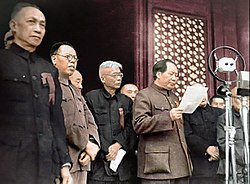
Standing atop Tiananmen Gate in Beijing, Mao proclaimed the founding of the People's Republic of China, declaring that 'the Chinese people have stood up' and establishing communist rule over mainland China.
Image source: Proclamation of the People's Republic of China
Dec 16, 1949 - Feb 14, 1950
% complete
Mao made his first trip abroad to negotiate with Stalin, resulting in a treaty of alliance with the Soviet Union that brought Soviet economic and technical aid to the new People's Republic.
Image source: Sino-Soviet Treaty of Friendship and Alliance
Oct 19, 1950 - Jul 27, 1953
% complete
After UN forces approached the Yalu River, Mao ordered Chinese 'People's Volunteers' into Korea to defend North Korea, fighting US-led forces to a stalemate and greatly elevating China's international standing at enormous human cost.
Image source: Korean War
1960 - 1963
% complete
Ideological disputes with Nikita Khrushchev over de-Stalinization and peaceful coexistence ruptured the Sino-Soviet alliance, with the withdrawal of Soviet experts in 1960 and public polemics by 1963 reshaping the Cold War.
Image source: Sino-Soviet split
Oct 16, 1964
% complete
China successfully detonated its first nuclear weapon at Lop Nur, becoming the fifth nuclear power and fulfilling Mao's goal of strategic independence despite the loss of Soviet assistance.
Image source: Project 596
1964
% complete
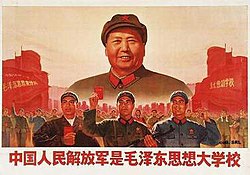
The 'Little Red Book' of Mao's sayings became one of the most printed books in history, carried by billions of copies worldwide and serving as a central text of the personality cult during the Cultural Revolution.
Image source: Quotations from Chairman Mao Tse-tung
Jul 16, 1966
% complete
The 72-year-old chairman's celebrated swim in the Yangtze signaled his return to active political leadership and publicly launched his campaign to retake control of the party, preceding the Cultural Revolution.
Image source: Baiji
Aug 8, 1966 - 1976
% complete
Mao launched the Great Proletarian Cultural Revolution to purge 'bourgeois' elements and reassert his dominance, unleashing Red Guards and factional violence that plunged China into a decade of chaos and persecution.
Image source: Cultural Revolution
Feb 21, 1972 - Feb 28, 1972
% complete
US President Richard Nixon met with Mao in Beijing, opening diplomatic relations between the two countries and dramatically realigning the Cold War balance following years of Sino-Soviet hostility.
Image source: 1972 visit by Richard Nixon to China
Sep 9, 1976
% complete
Mao died in Beijing at age 82 after a long illness. His death ended the Cultural Revolution era, triggered a power struggle won by Deng Xiaoping's reformers, and prompted official reassessment of his mixed legacy.
Image source: Death and state funeral of Mao Zedong
Jun 27, 1981
% complete
The party adopted a landmark resolution declaring Mao's legacy '70 percent right, 30 percent wrong,' acknowledging grave errors including the Cultural Revolution while preserving his status as a founding revolutionary leader.
Image source: Resolution on Certain Questions in the History of Our Party since the Founding of the People's Republic of China
Or browse the full history timeline directory, with more than 2,000 topics.
This Mao Zedong timeline was generated with the help of AI, using information found on the internet.
We work hard to keep these timelines accurate, but mistakes do get through. If you spot one, email us at [email protected] and we'll fix it for future visitors.
Generate yours with AI or build it from scratch, for free.
Export your timeline, add your own events, edit or remove AI-generated events, and much more
No credit card required.
Cancel anytime.
Cancel anytime.
You can create an unlimited number of timelines with up to 10 events on each one, customize how they look, export them to PDF, PNG, PowerPoint, CSV, and Excel, and share them with a link. Paid plans raise the event limit and add features like spreadsheet imports and collaborators.
Yes. You can cancel your subscription from your account page at any time, and you will not be charged again. Your subscription stays active for the rest of the period you already paid for.
Yes. We will email you a reminder before the annual renewal, and we will also email you a receipt.
Yes. You can email us within 15 days of any payment, and we will issue you a full refund.
Check out our pricing docs or send us an email anytime: [email protected].