-
Use Cases
-
Resources
-
Pricing
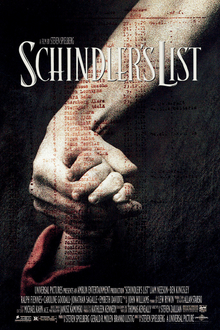
Oskar Schindler was a German businessman and member of the Nazi Party who is credited with saving the lives of approximately 1,200 Jews during the Holocaust by employing them in his enamelware and munitions factories. His story, popularized by Thomas Keneally's novel 'Schindler's Ark' and Steven Spielberg's film 'Schindler's List,' transformed him from a war profiteer into one of history's most recognized rescuers of Holocaust victims. More Less
Apr 28, 1908
% complete
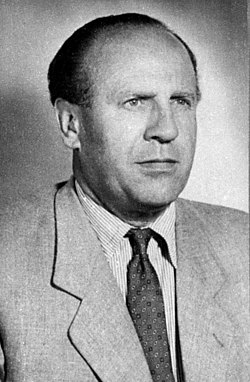
Oskar Schindler was born on 28 April 1908 into a Sudeten German family in the city of Zwittau, then part of the Margraviate of Moravia within Austria-Hungary. He would grow up to become a German industrialist and humanitarian credited with saving the lives of 1,200 Jews during the Holocaust.
1915
% complete
Schindler's sister, Elfriede, was born in 1915. The two siblings grew up together in Zwittau, Moravia, during a period of significant political upheaval in Central Europe.
Image source: Oskar Schindler
1924
% complete
After attending primary and secondary school, Schindler enrolled in a technical school, from which he was expelled in 1924 for forging his report card. He then worked in several trades before entering military intelligence.
Mar 6, 1928
% complete
On 6 March 1928, Schindler married Emilie Pelzl, daughter of a prosperous Sudeten German farmer from Maletein. Emilie would later play an important role in supporting his efforts to protect Jewish workers during the war.
Image source: Emilie Schindler
1931 - 1938
% complete
Schindler took a job with Jaroslav Šimek Bank of Prague in 1931, where he worked until 1938. During this period he was arrested several times in 1931 and 1932 for public drunkenness.
1933 - 1935
% complete
Oskar and Emilie Schindler had a daughter, Emily, in 1933, and a son, Oskar Jr., in 1935. Also in 1935, Schindler's father, an alcoholic, abandoned his wife.
1935
% complete
In 1935, Schindler joined the separatist Sudeten German Party, a political movement advocating for the Sudeten Germans of Czechoslovakia. This marked an early step in his alignment with German nationalist causes.
Image source: Sudeten German Party
1936
% complete
Although a citizen of Czechoslovakia, Schindler became a spy for the Abwehr, the military intelligence service of Nazi Germany, in 1936. Before the German occupation of Czechoslovakia in 1938, he collected information on railways and troop movements for the German government.
Image source: Abwehr
Jul 18, 1938 - Oct 1, 1938
% complete
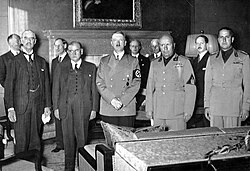
Schindler was arrested by the Czech government for espionage on 18 July 1938 and immediately imprisoned. He was released as a political prisoner under the terms of the Munich Agreement, under which the Czech Sudetenland was annexed by Germany on 1 October 1938.
Image source: Munich Agreement
1939
% complete
Schindler joined the Nazi Party in 1939, further cementing his position within the German apparatus. Decades later, he would become the only former member of the Nazi Party to be buried on Mount Zion in Jerusalem.
Image source: Nazi Party
Jan 1939
% complete
After some time off to recover in Zwittau, Schindler was promoted to second in command of his Abwehr unit and relocated with his wife to Ostrava on the Czech-Polish border in January 1939. He continued collecting information for the Nazis in Poland before the invasion of Poland.
Oct 1939
% complete
Schindler first arrived in Kraków (Krakau) in October 1939 on Abwehr business and took an apartment the following month. In November 1939, he contacted interior decorator Mila Pfefferberg to decorate his new apartment.
Image source: Kraków
Nov 13, 1939
% complete
With the financial backing of several Jewish investors, including one of the owners, Abraham Bankier, Schindler signed an informal lease agreement on the factory on 13 November 1939 and formalised the arrangement on 15 January 1940. At its peak in 1944, the business employed around 1,750 workers, a thousand of whom were Jews.
Image source: Oskar Schindler's Enamel Factory
Aug 1, 1940 - Mar 1941
% complete
On 1 August 1940, Governor-General Hans Frank issued a decree requiring all Kraków Jews to leave the city within two weeks. Of the 60,000 to 80,000 Jews then living in the city, only 15,000 remained by March 1941.
Image source: Kraków Ghetto
1941
% complete
Emilie Schindler visited Kraków for a few months in 1940 and moved there to live with Oskar in 1941. She would later assist him in caring for and protecting the Jewish workers at his factory.
Oct 1, 1941 - Dec 31, 1941
% complete
The first of Schindler's arrests, in late 1941, led to him being kept overnight. He would be arrested several more times over the course of the war, largely due to his dealings with and protection of Jewish workers.
Apr 29, 1942
% complete
Schindler's second arrest, on 29 April 1942, was the result of his kissing a Jewish girl on the cheek at his birthday party at the factory the previous day. Such acts violated Nazi racial laws and put him at serious risk.
1943
% complete
In 1943, Schindler was contacted by Zionist leaders in Budapest via members of the Jewish resistance movement. This contact reflected his growing reputation among Jewish organizations as someone willing to help persecuted Jews.
Mar 13, 1943
% complete
On 13 March 1943 the Kraków ghetto was liquidated, and those still fit for work were sent to the new concentration camp at Płaszów. The Płaszów camp opened that same month about 2.5 kilometres from Schindler's DEF factory.
Jul 1944
% complete
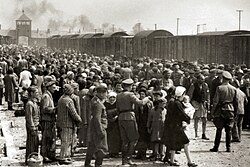
As the Red Army drew nearer in July 1944, Germany was losing the war; the SS began closing down the easternmost concentration camps and evacuating the remaining prisoners westward to Auschwitz and Gross-Rosen concentration camp.
Image source: The Holocaust
Sep 13, 1944
% complete
Amon Göth, the commandant of the Płaszów concentration camp, was arrested on 13 September 1944 for corruption and other abuses of power. Schindler's subsequent arrest was part of the ongoing investigation into Göth's activities.
Image source: Amon Göth
Oct 1944
% complete
In October 1944 Schindler was arrested again, accused of black marketeering and bribing Göth and others to improve the conditions of the Jewish workers. His connections allowed him to avoid prosecution despite these charges.
Oct 1944
% complete
Using names provided by Jewish Ghetto Police officer Marcel Goldberg, Göth's secretary Mietek Pemper compiled and typed the list of 1,200 Jews—1,000 of Schindler's workers and 200 inmates from Julius Madritsch's textiles factory—who were sent to Brünnlitz in October 1944.
Image source: Schindler's List
Oct 15, 1944
% complete
On 15 October 1944, a train carrying 700 men on Schindler's list was initially sent to the concentration camp at Gross-Rosen, where the men spent about a week before being rerouted to the factory in Brünnlitz in the Protectorate of Bohemia and Moravia.
Image source: Brünnlitz labor camp
Jan 1945
% complete
In January 1945, a trainload of 250 Jews who had been rejected as workers at a German mine in Goleschau in occupied Poland arrived at Brünnlitz. Schindler accepted them into his factory, saving them from almost certain death.
May 7, 1945
% complete
On 7 May 1945 Schindler and his workers gathered on the factory floor to listen to British Prime Minister Winston Churchill announce over the radio that Germany had surrendered and that the war in Europe was over. Until this point, Schindler had continued bribing SS officials to prevent his workers' execution, spending his entire fortune on bribes and black market purchases of supplies.
Image source: Victory in Europe Day
Oct 1, 1945 - Dec 31, 1945
% complete
After the war, Schindler and his wife moved to Bavaria in Germany in late 1945. As a former Nazi Party member, he faced an uncertain future and struggled financially in the postwar years.
Image source: Bavaria
1948
% complete
In 1948, Schindler presented a claim for reimbursement of his wartime expenses to the American Jewish Joint Distribution Committee and received US$15,000. This helped offset some of the fortune he had spent protecting his workers.
Image source: American Jewish Joint Distribution Committee
1949 - 1958
% complete
In 1949, Schindler emigrated to Argentina, where he tried raising chickens and then nutria (coypu), a small animal raised for its fur. When the business went bankrupt in 1958, he left his wife and returned to Germany.
Image source: Argentina
1963 - 1964
% complete
Back in Germany, Schindler had a series of unsuccessful business ventures, including a cement factory. He declared bankruptcy in 1963 and suffered a heart attack the next year, which led to a month-long hospital stay. He relied on financial support from the Schindlerjuden—the people whose lives he had saved.
May 8, 1962
% complete
For his work during the war, on 8 May 1962, Yad Vashem invited Schindler to a ceremony in which a carob tree was planted in his honour on the Avenue of the Righteous. This marked early official recognition of his rescue efforts.
Image source: Yad Vashem
1966
% complete
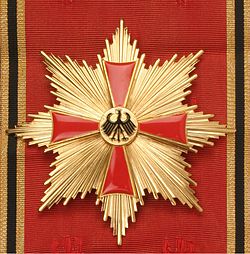
Schindler received awards for his wartime efforts, including the German Order of Merit in 1966. Alongside earlier recognition from Yad Vashem, these honours acknowledged his role in saving Jewish lives during the Holocaust.
Image source: Order of Merit of the Federal Republic of Germany
Oct 9, 1974
% complete
Schindler died of liver failure on 9 October 1974 in Hildesheim, Germany. He was buried in Jerusalem on Mount Zion, the only former member of the Nazi Party to be honoured in this way.
Image source: Mount Zion
1993
% complete
Thomas Keneally's 1982 historical novel Schindler's Ark, written after Pfefferberg told Keneally Schindler's story in 1980, was adapted as the 1993 movie Schindler's List by American film director Steven Spielberg. The film brought Schindler's story to a worldwide audience.
Jun 24, 1993
% complete
On 24 June 1993, Oskar and Emilie Schindler were named Righteous Among the Nations by Yad Vashem, an award the State of Israel bestows on non-Jews who took an active role in rescuing Jews during the Holocaust.
Image source: Righteous Among the Nations
1997 - Dec 1999
% complete
In 1997, a suitcase belonging to Schindler containing historic photographs and documents was discovered in the attic of the apartment of Ami and Heinrich Staehr in Hildesheim. After examination in 1999 by Stuttgarter Zeitung editor Wolfgang Borgmann, the documents and suitcase were sent to the Holocaust museum at Yad Vashem in Israel for safekeeping in December 1999.
Apr 2009
% complete
In early April 2009, a carbon copy of one version of the list was discovered at the State Library of New South Wales by workers combing through boxes of materials collected by Thomas Keneally. The document contains 801 names, is dated 18 April 1945, and lists Pfefferberg as worker number 173.
Jul 19, 2013
% complete
One of four existing copies of the list was offered at a ten-day auction starting on 19 July 2013 on eBay at a reserve price of US$3 million. That August, a one-page letter signed by Schindler on 22 August 1944 sold in an online auction for US$59,135.
May 2025
% complete
Attempts to convert the factory site in Brněnec to a museum initially failed due to a lack of financial support, though it was proclaimed a protected memorial site in November 2016. After receiving additional funds from the regional government and the European Union, the site opened as a museum in May 2025 on the 80th anniversary of VE day.
Image source: Brněnec
Or browse the full history timeline directory, with more than 2,000 topics.
This Oskar Schindler timeline was generated with the help of AI, using information found on the internet.
We work hard to keep these timelines accurate, but mistakes do get through. If you spot one, email us at [email protected] and we'll fix it for future visitors.
Generate yours with AI or build it from scratch, for free.
Export your timeline, add your own events, edit or remove AI-generated events, and much more
No credit card required.
Cancel anytime.
Cancel anytime.
You can create an unlimited number of timelines with up to 10 events on each one, customize how they look, export them to PDF, PNG, PowerPoint, CSV, and Excel, and share them with a link. Paid plans raise the event limit and add features like spreadsheet imports and collaborators.
Yes. You can cancel your subscription from your account page at any time, and you will not be charged again. Your subscription stays active for the rest of the period you already paid for.
Yes. We will email you a reminder before the annual renewal, and we will also email you a receipt.
Yes. You can email us within 15 days of any payment, and we will issue you a full refund.
Check out our pricing docs or send us an email anytime: [email protected].