-
Use Cases
-
Resources
-
Pricing
Ramses II, also known as Ramesses the Great, was the third pharaoh of the Nineteenth Dynasty of Egypt. He reigned for 66 years (1279–1213 BC), one of the longest reigns in Egyptian history. Renowned for his military campaigns, especially the Battle of Kadesh against the Hittites, he is equally famous for his extensive building program, which included Abu Simbel, Pi-Ramesses, and additions to Karnak and Luxor. More Less
1303 BC
% complete
Ramesses II was born around 1303 BC. He would go on to become commonly known as Ramesses the Great, the third pharaoh of the Nineteenth Dynasty of Egypt.
Image source: Ramesses II
May 31, 1279 BC
% complete
Ramesses's date of accession to the throne is recorded as III Shemu (11th month), day 27, which most Egyptologists believe to be 31 May 1279 BC. He became the third pharaoh of the Nineteenth Dynasty of Egypt.
May 1, 1274 BC
% complete
After advancing through Canaan for exactly a month, according to the Egyptian sources, Ramesses arrived at Kadesh on 1 May 1274 BC, leading to the famous Battle of Kadesh against the Hittites.
Apr 1272 BC - May 1272 BC
% complete
Late in the seventh year of his reign (April/May 1272 BC), Ramesses II returned to Syria again to continue his military campaigns in the region.
Nov 1272 BC
% complete
By November 1272 BC, Ramesses was back in Egypt, at Heliopolis, after his Syrian campaign late in his seventh year of reign.
1269 BC
% complete
A mostly illegible stele at the Dog River near Beirut, Lebanon, which appears to be dated to the king's second year, was probably set up there in his tenth year (1269 BC).
Jan 19, 1261 BC
% complete
In year eighteen of his reign, Ramesses erected a stele at Beth Shean on 19 January 1261 BC, marking Egyptian presence in the region.
1259 BC
% complete
Eventually, in the twenty-first year of his reign (1259 BC), Ramesses concluded an agreement at Kadesh to end the conflict with the Hittites, one of the earliest known international peace treaties.
Nov 10, 1259 BC
% complete
The Egyptian account records Ramesses II's receipt of the Hittite peace treaty tablets on I Peret 21 of Year 21, corresponding to 10 November 1259 BC, according to the standard 'Low Chronology' used by Egyptologists.
1255 BC
% complete
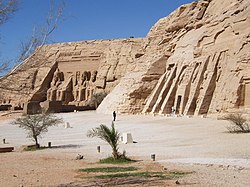
In 1255 BC, Ramesses and his queen Nefertari traveled into Nubia to inaugurate a new temple, Abu Simbel, one of the most magnificent monuments of ancient Egypt.
Image source: Abu Simbel
1250 BC
% complete
During Ramesses II's long reign, his country was more prosperous and powerful than it had been in nearly a century, reflecting the stability and strength of his rule.
1213 BC
% complete
Upon his death, Ramesses II was buried in a tomb (KV7) in the Valley of the Kings. His body was later moved to the Royal Cache for safekeeping.
Image source: KV7
Aug 13, 1213 BC
% complete
Ramesses II died on 13 August 1213 BC (Year 67, II Akhet day 6), after reigning 66 years and 74 days. This falls within the calculations of Jürgen von Beckerath, who placed Ramesses' death on either late July or early August 1213 BC. Classical authors including Manetho attributed him a reign of 66 years and 2 months.
1881
% complete
Ramesses II's mummy was eventually discovered in 1881 in TT320 inside a reused but ordinary wooden coffin. It is now in Cairo's National Museum of Egyptian Civilization.
1975
% complete
In 1975, Maurice Bucaille, a French doctor, examined the mummy at the Cairo Museum and found it in poor condition, prompting further scientific study and conservation efforts.
1976
% complete
The mummy was forensically tested in 1976 by Pierre-Fernand Ceccaldi, the chief forensic scientist at the Criminal Identification Laboratory of Paris, providing insights into the pharaoh's life and death.
Sep 1976
% complete
In September 1976, the mummy was greeted at Paris–Le Bourget Airport with full military honours befitting a king, then taken to a laboratory at the Musée de l'Homme for study.
May 1977
% complete
After being irradiated in an attempt to eliminate fungi and insects, the mummy was returned from Paris to Egypt in May 1977.
2004
% complete
A 2004 study excluded ankylosing spondylitis as a possible cause of Ramesses II's ailments and proposed diffuse idiopathic skeletal hyperostosis as a possible alternative, which was confirmed by more recent work.
2006
% complete
In 2006, French police arrested a man who tried to sell several tufts of Ramesses' hair on the Internet, highlighting ongoing concerns about the protection of royal remains.
2020
% complete
Ali Gomaa announced in 2020 that when tests were run on the body of Ramesses, the reason of death was found to be suffocation.
Apr 3, 2021
% complete
In April 2021, his mummy was moved from the old Egyptian Museum to the new National Museum of Egyptian Civilization along with those of 17 other kings and 4 queens in an event termed the Pharaohs' Golden Parade.
Image source: Pharaohs' Golden Parade
900
% complete
In the 10th century AD, the Bible exegete Rabbi Saadia Gaon believed that the biblical site of Ramesses had to be identified with Ain Shams.
Image source: Pi-Ramesses
1900
% complete
For a time, during the early 20th century, the site of Pi-Ramesses was misidentified as Tanis due to the amount of statuary found there, but it is now recognized that the real Pi-Ramesses lies about 30 km south, near modern Qantir.
1944
% complete
Ramesses II is cast in the role of the Pharaoh of the Exodus in the 1944 novella The Tables of the Law by Thomas Mann, part of a long tradition associating him with the Exodus narrative.
Image source: Twelve Tables
1956
% complete
In Cecil B. DeMille's 1956 film The Ten Commandments, Ramesses is played by Yul Brynner, portrayed as a vengeful tyrant as well as the main antagonist of the film, ever scornful of his father's preference for Moses over 'the son of [his] body'.
Image source: The Ten Commandments (1956 film)
1968
% complete
The East Village underground rock band The Fugs released their song 'Ramses II Is Dead, My Love' on their 1968 album It Crawled into My Hand, Honest.
Image source: The Fugs
1989
% complete
The Anne Rice book The Mummy, or Ramses the Damned (1989) features Ramesses as the main character, adding to the many fictional representations inspired by his life.
Image source: The Mummy, or Ramses the Damned
1998
% complete
The animated film The Prince of Egypt (1998) features a depiction of Ramesses voiced by Ralph Fiennes, portrayed as Moses' adoptive brother and ultimately the film's villain.
Image source: The Prince of Egypt
2008
% complete
Ramesses II is a main character in the fiction book The Heretic Queen by Michelle Moran, published in 2008, continuing the tradition of historical novels about his life.
Image source: Michelle Moran
2013
% complete
In the 2013 miniseries The Bible, Ramesses is portrayed by Stewart Scudamore, continuing his association with the Exodus story in popular media.
Image source: The Bible (miniseries)
2014
% complete
Joel Edgerton played Ramesses in the 2014 film Exodus: Gods and Kings, another major cinematic portrayal of the pharaoh in the Exodus narrative.
Image source: Exodus: Gods and Kings
2015 - 2016
% complete
Sérgio Marone plays Ramesses in the 2015–2016 Brazilian telenovela series Os Dez Mandamentos ('The Ten Commandments'), bringing the pharaoh's story to television audiences.
Image source: Os Dez Mandamentos
2023
% complete
In 2023, Mostafa Waziry, then secretary-general of Egypt's Supreme Council of Antiquities, said there is no archaeological or historical evidence in Egyptian antiquities indicating Ramesses II is the Pharaoh of the Exodus, noting the Hyksos were the ruling power at the time.
1800
% complete
The temple complex built by Ramesses II between Qurna and the desert has been known as the Ramesseum since the 19th century, serving as his mortuary temple and inspiration for Shelley's 'Ozymandias'.
Image source: Ramesseum
1813
% complete
The temple at Abu Simbel was discovered in 1813 by the Swiss Orientalist and traveler Johann Ludwig Burckhardt, bringing renewed attention to Ramesses II's monumental architecture.
Aug 4, 1817
% complete
The Paduan explorer Giovanni Battista Belzoni reached the interior of the Abu Simbel temple on 4 August 1817, after Burckhardt's initial discovery.
Image source: Giovanni Belzoni
1904
% complete
The tomb of Nefertari, the most important consort of Ramesses, was discovered by Ernesto Schiaparelli in 1904, revealing stunning wall paintings considered among the finest of Egyptian art.
Image source: Tomb of Nefertari
1955
% complete
A colossal statue of Ramesses II weighing some 83 tonnes was transported, reconstructed, and erected in Ramesses Square in Cairo in 1955.
1995
% complete
In 1995, Professor Kent Weeks, head of the Theban Mapping Project, rediscovered Tomb KV5, believed to be the burial place of the sons of Ramesses II.
Image source: KV5
Aug 2006
% complete
In August 2006, contractors relocated the colossal statue of Ramesses II to save it from exhaust fumes that were causing it to deteriorate at its previous location in Cairo.
2018
% complete
In 2018, a group of archaeologists in Cairo's Matariya neighborhood discovered pieces of a booth with a seat that, based on its structure and age, may have been used by Ramesses.
Dec 2019
% complete
In December 2019, a red granite royal bust of Ramesses II was unearthed by an Egyptian archaeological mission in the village of Mit Rahina in Giza.
May 2023
% complete
In May 2023, French archaeologists from the Sorbonne University in Paris identified part of the original granite sarcophagus of Ramesses II. The fragment had been reused by a high priest of the 21st Dynasty named Menkheperre around 1000 BC, but Frédéric Payraudeau's careful analysis discovered the cartouche of Ramesses II on it.
Sep 2024
% complete
In September 2024, it was published that during an archaeological excavation of a 3,200-year-old fort along the Nile, researchers found a golden sword with Ramses II's signature on it.
Or browse the full history timeline directory, with more than 2,000 topics.
This Ramses II timeline was generated with the help of AI, using information found on the internet.
We work hard to keep these timelines accurate, but mistakes do get through. If you spot one, email us at [email protected] and we'll fix it for future visitors.
Generate yours with AI or build it from scratch, for free.
Export your timeline, add your own events, edit or remove AI-generated events, and much more
No credit card required.
Cancel anytime.
Cancel anytime.
You can create an unlimited number of timelines with up to 10 events on each one, customize how they look, export them to PDF, PNG, PowerPoint, CSV, and Excel, and share them with a link. Paid plans raise the event limit and add features like spreadsheet imports and collaborators.
Yes. You can cancel your subscription from your account page at any time, and you will not be charged again. Your subscription stays active for the rest of the period you already paid for.
Yes. We will email you a reminder before the annual renewal, and we will also email you a receipt.
Yes. You can email us within 15 days of any payment, and we will issue you a full refund.
Check out our pricing docs or send us an email anytime: [email protected].