-
Use Cases
-
Resources
-
Pricing
The Pacific War was the theater of World War II fought between the Allied powers—primarily the United States—and the Empire of Japan across the Pacific Ocean and East Asia. It began with Japan's attack on Pearl Harbor in December 1941 and ended with Japan's surrender in August 1945 following the atomic bombings of Hiroshima and Nagasaki. The conflict involved massive naval battles, island-hopping campaigns, and immense casualties on all sides. More Less
Jul 7, 1937 - Sep 9, 1945
% complete
The Second Sino-Japanese War began with the Marco Polo Bridge Incident, when Japanese and Chinese forces clashed near Beijing. Japan launched a full-scale invasion of China, capturing major cities including Shanghai, Nanjing, and Wuhan. The conflict became a central front of the Pacific War, causing enormous casualties among Chinese soldiers and civilians.
Image source: Second Sino-Japanese War
Dec 1, 1937 - Dec 13, 1937
% complete
Japanese forces captured Nanjing, then the capital of the Republic of China, after intense fighting. The fall of the city was followed by the Nanjing Massacre, in which Japanese troops committed widespread atrocities against Chinese civilians and disarmed soldiers over several weeks.
Image source: Battle of Nanking
May 11, 1939 - Sep 16, 1939
% complete
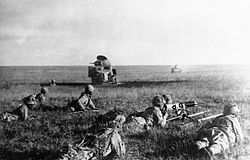
Soviet forces under Georgy Zhukov decisively defeated Japanese troops along the Mongolian-Manchurian border. The defeat discouraged Japan from attacking the Soviet Union and contributed to its decision to strike southward instead, shaping the strategic direction of the Pacific War.
Image source: Battles of Khalkhin Gol
Sep 22, 1940
% complete
Japanese forces entered northern French Indochina to secure bases and cut supply routes to China. The move provoked the United States to impose embargoes on scrap metal and later oil, escalating tensions that would lead directly to war in the Pacific.
Image source: Japanese invasion of French Indochina
Sep 27, 1940
% complete
Germany, Italy, and Japan signed a mutual defense agreement in Berlin. The pact formalized the alliance between the European Axis powers and Japan, linking the conflicts in Europe and Asia into a single global struggle.
Image source: Tripartite Pact
Dec 7, 1941
% complete
Japanese carrier aircraft launched a surprise strike on the United States Pacific Fleet at Pearl Harbor, Hawaii, sinking or damaging numerous battleships and killing over 2,400 Americans. The attack prompted the United States to declare war on Japan the next day, bringing America fully into World War II.
Image source: Attack on Pearl Harbor
Dec 8, 1941 - Jan 31, 1942
% complete
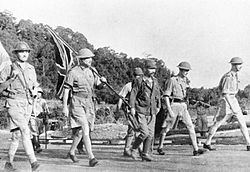
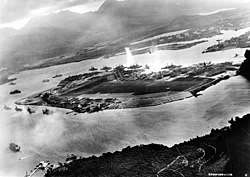
Hours before or simultaneous with Pearl Harbor, Japanese forces landed on the Malay Peninsula and advanced rapidly down its length. Their superior tactics and air support overwhelmed British Commonwealth defenses, culminating in one of Britain's worst military defeats.
Image source: Malayan campaign
Dec 8, 1941 - Dec 25, 1941
% complete
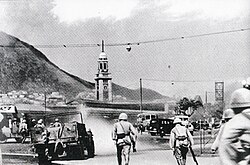
Japanese forces attacked the British colony of Hong Kong on the same day as Pearl Harbor. After eighteen days of fierce resistance by British, Canadian, Indian, and local troops, the garrison surrendered on Christmas Day, beginning a harsh Japanese occupation.
Image source: Battle of Hong Kong
Dec 8, 1941 - May 6, 1942
% complete
Japan invaded the American-held Philippines within hours of Pearl Harbor. Despite determined resistance by Filipino and American forces under General Douglas MacArthur, the defenders retreated to Bataan and Corregidor, where they ultimately surrendered after months of siege.
Image source: Philippines campaign (1941–1942)
Dec 10, 1941
% complete
Japanese land-based aircraft sank two major British warships off the coast of Malaya. The disaster demonstrated the vulnerability of capital ships without air cover and crippled British naval power in the Far East at the outset of the Pacific War.
Image source: Sinking of Prince of Wales and Repulse
Dec 11, 1941 - Dec 23, 1941
% complete
The small American garrison on Wake Island repulsed an initial Japanese landing attempt but succumbed to a reinforced second assault. The island's capture gave Japan an important outpost in the Central Pacific.
Image source: Battle of Wake Island
Feb 8, 1942 - Feb 15, 1942
% complete
Japanese forces crossed into Singapore island and overwhelmed its British-led defenders despite their numerical superiority. The surrender of approximately 80,000 Allied troops was described by Winston Churchill as the 'worst disaster' in British military history.
Image source: Fall of Singapore
Feb 19, 1942
% complete
Japanese carrier-based aircraft launched the largest attack ever mounted against Australia, striking the port of Darwin. The raid destroyed ships, aircraft, and infrastructure, bringing the war directly to Australian soil and heightening fears of invasion.
Image source: Bombing of Darwin
Apr 9, 1942
% complete
After the surrender of American and Filipino forces on Bataan, tens of thousands of prisoners were force-marched northward in brutal heat with little food or water. Thousands died from exhaustion, abuse, and executions, becoming one of the war's most notorious atrocities.
Apr 18, 1942
% complete
Sixteen American B-25 bombers led by James Doolittle took off from the carrier USS Hornet to strike Tokyo and other Japanese cities. Though damage was modest, the daring raid boosted American morale and shocked Japanese leadership, contributing to their decision to attack Midway.
Image source: Doolittle Raid
May 4, 1942 - May 8, 1942
% complete
The first naval battle fought entirely between carrier aircraft, with opposing fleets never sighting each other. The Allies thwarted Japan's attempt to seize Port Moresby, halting a planned thrust toward Australia and costing Japan the services of two carriers for the coming battle at Midway.
Image source: Battle of the Coral Sea
Jun 4, 1942 - Jun 7, 1942
% complete
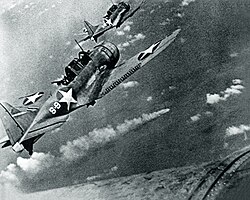
American codebreakers enabled US Navy carriers to ambush the Japanese fleet near Midway Atoll. In a decisive engagement, American dive bombers sank four Japanese fleet carriers while losing only one of their own, shifting the strategic balance of the Pacific War permanently in favor of the Allies.
Image source: Battle of Midway
Jun 30, 1943 - Aug 31, 1944
% complete
A major Allied strategy aimed at neutralizing the great Japanese base at Rabaul through a double envelopment by General MacArthur's Southwest Pacific forces and Admiral Halsey's South Pacific forces. Rather than assaulting Rabaul directly, the Allies bypassed and isolated it, exemplifying the island-hopping approach.
Image source: Operation Cartwheel
Nov 20, 1943 - Nov 23, 1943
% complete
US Marines stormed heavily fortified Betio Island in the Gilbert Islands against fanatical Japanese resistance. The bloody victory came at a high cost and taught American planners vital lessons about amphibious assaults that shaped subsequent island-hopping operations.
Image source: Battle of Tarawa
Oct 20, 1944 - Oct 26, 1944
% complete
Following MacArthur's return to Philippine soil at Leyte, Japanese naval forces made their last major sortie, engaging in a series of massive sea battles. The Imperial Japanese Navy was shattered, and Japan first employed kamikaze suicide attacks on a large scale during this campaign.
Image source: Battle of Leyte Gulf
Jul 21, 1942 - Nov 16, 1942
% complete
Australian troops fought a grueling series of battles along the Kokoda Trail in New Guinea's rugged jungle mountains, halting the Japanese advance toward Port Moresby. The campaign became legendary in Australia and marked a key check on Japan's southward expansion.
Image source: Kokoda Track campaign
Aug 7, 1942 - Feb 9, 1943
% complete
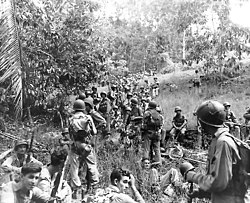
US Marines landed on Guadalcanal in the Solomon Islands, initiating the first major Allied offensive against Japan. Six months of savage fighting on land, sea, and air ended with Japanese evacuation, giving the Allies a strategic foothold and momentum for future offensives.
Image source: Guadalcanal campaign
Aug 8, 1942 - Aug 9, 1942
% complete
A Japanese cruiser force surprised Allied naval units guarding the Guadalcanal landing area at night, sinking four heavy cruisers in one of the worst defeats in US Navy history. The loss left American ground troops temporarily unsupported and began months of naval duels around the island.
Image source: Battle of Savo Island
Oct 25, 1942 - Oct 27, 1942
% complete
Carrier forces of the United States and Japan clashed again near Guadalcanal. Tactically a Japanese victory that sank the USS Hornet, the battle cost Japan so many experienced aircrew that it could not sustain its carrier operations, a strategic blow it never recovered from.
Image source: Battle of the Santa Cruz Islands
Jun 15, 1944 - Jul 9, 1944
% complete
American forces captured Saipan after weeks of ferocious combat marked by mass Japanese banzai charges and civilian suicides. The fall of Saipan placed Tokyo within range of new B-29 bombers and triggered the collapse of Japan's Tojo government.
Image source: Battle of Saipan
Jun 19, 1944 - Jun 20, 1944
% complete
In the largest carrier battle in history, overwhelming numbers of Japanese aircraft were shot down by American pilots and anti-aircraft fire, with losses so lopsided that American airmen called it the Great Marianas Turkey Shoot. Japan's naval aviation was effectively destroyed as a fighting force.
Image source: Battle of the Philippine Sea
Feb 19, 1945 - Mar 26, 1945
% complete
US Marines assaulted the volcanic island of Iwo Jima in one of the bloodiest battles of the war. Nearly all of the roughly 21,000 Japanese defenders died resisting from elaborate cave networks. The iconic flag-raising on Mount Suribachi symbolized the Marines' costly sacrifice.
Image source: Battle of Iwo Jima
Apr 1, 1945 - Jun 22, 1945
% complete
The last major amphibious campaign of the war saw American forces invade Okinawa, meeting desperate resistance and waves of kamikaze attacks. Massive casualties on both sides, along with enormous civilian deaths, foreshadowed the potential human cost of invading Japan itself.
Image source: Battle of Okinawa
Aug 6, 1945 - Aug 9, 1945
% complete
The United States dropped atomic bombs on the Japanese cities of Hiroshima and Nagasaki three days apart. The unprecedented destruction, killing well over 100,000 people, shocked Japan's leadership and played a decisive role in the decision to surrender.
Image source: Atomic bombings of Hiroshima and Nagasaki
Aug 8, 1945 - Sep 2, 1945
% complete
The Soviet Union declared war on Japan and launched a massive offensive through Manchuria, swiftly overrunning Japanese Kwantung Army positions. The rapid Soviet success eliminated any hope Japan had of negotiating through Moscow and accelerated the move toward surrender.
Image source: Soviet invasion of Manchuria
Aug 15, 1945
% complete
Emperor Hirohito announced Japan's acceptance of the Potsdam terms in a radio broadcast, the first time most Japanese had heard his voice. The announcement ended hostilities across the Pacific and Asia, though formal surrender documents were still to come.
Image source: Hirohito surrender broadcast
Sep 2, 1945
% complete
Japanese officials signed the Instrument of Surrender aboard the battleship USS Missouri in Tokyo Bay, formally ending World War II. The ceremony marked the close of the Pacific War and the beginning of the American occupation of Japan.
Image source: Surrender of Japan
Or browse the full history timeline directory, with more than 2,000 topics.
This Pacific War timeline was generated with the help of AI, using information found on the internet.
We work hard to keep these timelines accurate, but mistakes do get through. If you spot one, email us at [email protected] and we'll fix it for future visitors.
Generate yours with AI or build it from scratch, for free.
Export your timeline, add your own events, edit or remove AI-generated events, and much more
No credit card required.
Cancel anytime.
Cancel anytime.
You can create an unlimited number of timelines with up to 10 events on each one, customize how they look, export them to PDF, PNG, PowerPoint, CSV, and Excel, and share them with a link. Paid plans raise the event limit and add features like spreadsheet imports and collaborators.
Yes. You can cancel your subscription from your account page at any time, and you will not be charged again. Your subscription stays active for the rest of the period you already paid for.
Yes. We will email you a reminder before the annual renewal, and we will also email you a receipt.
Yes. You can email us within 15 days of any payment, and we will issue you a full refund.
Check out our pricing docs or send us an email anytime: [email protected].