-
Use Cases
-
Resources
-
Pricing
Oct 16, 1905 - Dec 12, 1911
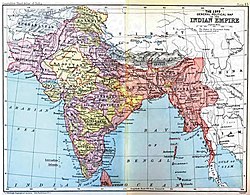
The British partitioned Bengal, officially for administrative reasons but widely understood as an effort to weaken nationalist politics by separating predominantly Muslim eastern areas from predominantly Hindu western areas. The decision intensified political mobilization and communal representation debates, and it was reversed in 1911.
Image source: Partition of Bengal (1905)
Dec 30, 1906
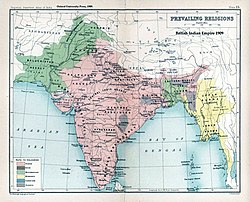
Muslim political leaders founded the All-India Muslim League at Dacca, later Dhaka, to represent Muslim interests in British India. The organization eventually became the principal political vehicle for the demand for Pakistan.
Image source: All-India Muslim League
Dec 1916
The Indian National Congress and the Muslim League reached the Lucknow Pact, agreeing on constitutional reforms and separate electorates. The temporary Congress–League cooperation demonstrated that Hindu–Muslim political unity remained possible, although separate communal representation was also entrenched.
Dec 23, 1919
The Government of India Act 1919 introduced dyarchy in the provinces and expanded limited electoral participation. Its communal electorates and restricted franchise shaped later negotiations over minority safeguards and political power.
Aug 10, 1928
A committee chaired by Motilal Nehru proposed a constitutional framework for self-governing India, including joint electorates with minority protections. Muhammad Ali Jinnah rejected the proposal as inadequate, contributing to a widening Congress–League divide.
Mar 28, 1929
Muhammad Ali Jinnah presented fourteen constitutional demands calling for provincial autonomy, safeguards for Muslim representation, and limits on central power. The points became an important statement of Muslim League constitutional expectations.
Dec 29, 1930
In his presidential address to the Muslim League, Muhammad Iqbal argued for a consolidated Muslim-majority region in northwestern India within a broader federal arrangement. The speech later became associated with intellectual precedents for Pakistan, though its precise constitutional meaning remains debated.
Aug 16, 1932
British Prime Minister Ramsay MacDonald announced separate electorates and reserved representation for several communities. The award reinforced communal political categories and influenced the constitutional framework later enacted under the Government of India Act 1935.
Aug 2, 1935
The act created provincial autonomy, expanded the electorate, and proposed a federation that never fully came into operation. Provincial elections under this framework gave Congress and the Muslim League competing opportunities to build mass political support.
Image source: Government of India Act 1935
Jul 1937 - Nov 1939
After the 1937 provincial elections, Congress formed ministries in several provinces. The Muslim League performed unevenly and later argued that Congress rule failed to protect Muslim political and cultural interests, claims that helped the League expand its support.
Image source: 1937 Indian provincial elections
Nov 1939
Congress ministries resigned after Britain declared India at war with Germany without consulting Indian leaders. Muhammad Ali Jinnah called for a Day of Deliverance, deepening the political separation between Congress and the Muslim League.
Mar 23, 1940
The Muslim League adopted the Lahore Resolution, calling for geographically contiguous Muslim-majority areas to be grouped into independent states with autonomous and sovereign units. Although it did not initially use the word Pakistan, it became the foundational political demand of the Pakistan movement.
Image source: Lahore Resolution
Dec 1945 - Mar 1946
Elections to central and provincial legislatures showed Congress dominance in general constituencies and overwhelming Muslim League success in Muslim-reserved constituencies. The results strengthened the League's claim to speak for most politically organized Indian Muslims.
Nov 12, 1930 - Dec 24, 1932
Three conferences in London brought British officials and representatives of Indian political and communal groups together to discuss constitutional reform. Disagreement over representation, federalism, and minority safeguards prevented a comprehensive settlement.
Image source: Round Table Conferences (India)
Mar 22, 1942 - Apr 12, 1942
Stafford Cripps offered a postwar constitutional settlement including dominion status and the possibility for provinces to opt out of a future Indian union. Congress rejected the proposal as too delayed and weak, while the League objected that it did not clearly establish Pakistan.
Image source: Cripps Mission
Aug 8, 1942 - Sep 21, 1942
Congress launched the Quit India Movement demanding an immediate end to British rule. The British imprisoned major Congress leaders and suppressed the movement, while the Muslim League used the political opening to strengthen its organization during the final years of the Raj.
Image source: Quit India Movement
Sep 9, 1944 - Sep 27, 1944
Mahatma Gandhi and Muhammad Ali Jinnah met in Bombay to discuss a possible agreement on independence and partition. Their negotiations failed, particularly over whether Pakistan should be conceded before or after independence and how territories would be determined.
Image source: C. R. formula
Jun 25, 1945 - Jul 14, 1945
Viceroy Lord Wavell proposed reconstructing the Executive Council with greater Indian participation. The conference collapsed when Congress and the Muslim League disagreed over whether the League alone could nominate Muslim representatives.
Image source: Simla Conference
Mar 24, 1946 - Jun 16, 1946
The British Cabinet Mission proposed a loose Indian union handling defense, foreign affairs, and communications, with provinces grouped into sections and substantial autonomy. Congress and the League initially accepted elements of the plan but later disagreed over the meaning and permanence of provincial groupings.
Sep 2, 1946 - Aug 15, 1947
An interim government was formed under the Viceroy with Jawaharlal Nehru as vice president of the Executive Council. The Muslim League joined later, but persistent rivalry within the administration made a united constitutional future increasingly difficult.
Image source: Interim Government of India
Feb 20, 1947
British Prime Minister Clement Attlee announced that Britain would transfer power in India by June 1948 at the latest. The declaration accelerated negotiations and increased pressure on Indian leaders to reach an agreement before authority collapsed.
Mar 24, 1947 - Aug 15, 1947
Lord Louis Mountbatten replaced Lord Wavell as viceroy and was charged with overseeing the transfer of power. He quickly concluded that Congress–League cooperation was unlikely and moved toward a partition settlement on an accelerated timetable.
Image source: Louis Mountbatten, 1st Earl Mountbatten of Burma
Jun 3, 1947
Mountbatten announced the plan for partitioning British India into two dominions, India and Pakistan. It provided for votes and legislative decisions in Punjab and Bengal, a referendum in the North-West Frontier Province, and the partition of Assam's Sylhet district.
Jun 30, 1947 - Aug 17, 1947
Sir Cyril Radcliffe chaired commissions tasked with drawing the borders of Punjab and Bengal. The commissions relied on religious majorities, administrative units, communications, and other factors, but their decisions left villages, property, irrigation systems, and communities divided.
Image source: Radcliffe Line
Jul 18, 1947
The British Parliament passed the Indian Independence Act, legally creating the dominions of India and Pakistan and ending British sovereignty. The act authorized the division of Punjab and Bengal and dissolved the authority of the British Crown over the new states.
Aug 14, 1947
Pakistan became an independent dominion, initially comprising West Pakistan and East Bengal, later East Pakistan. Muhammad Ali Jinnah became its first governor-general, while the new state faced immediate challenges involving refugees, administration, finances, and security.
Image source: Pakistan Movement
Aug 15, 1947
India became an independent dominion at midnight on 15 August, ending nearly two centuries of British colonial rule. Jawaharlal Nehru became the first prime minister, while the new government confronted mass displacement, communal violence, and the integration of princely states.
Image source: Indian independence movement
Aug 16, 1946 - Aug 21, 1946
The Muslim League called for demonstrations to press its demand for Pakistan after constitutional negotiations broke down. Massive communal violence erupted in Calcutta, killing thousands and triggering retaliatory violence in other parts of Bengal and Bihar.
Image source: Direct Action Day
Oct 10, 1946 - Nov 1946
Communal attacks in Noakhali and nearby districts of eastern Bengal targeted Hindu communities, producing killings, forced conversions, sexual violence, and displacement. Gandhi traveled through the area in an effort to promote reconciliation and restore confidence.
Image source: Noakhali riots
Oct 30, 1946 - Nov 1946
Retaliatory violence against Muslims spread through parts of Bihar after the Noakhali attacks. Large numbers of people were killed or displaced, demonstrating how rapidly local violence could become part of a wider cycle of communal retaliation.
Mar 5, 1947 - Mar 22, 1947
Communal violence in the Rawalpindi district of Punjab killed and displaced large numbers of Sikhs and Hindus, with attacks also affecting Muslims. The massacres intensified fears that Punjab could not remain peacefully united.
Aug 1947 - Dec 1950
An estimated 10 to 20 million people crossed the new borders, making the partition one of the largest forced migrations in modern history. Muslims moved toward Pakistan, while many Hindus and Sikhs moved toward India; trains, refugee columns, and cities were repeatedly attacked.
Aug 17, 1947
The Radcliffe Award divided Punjab between India and Pakistan, assigning Lahore to Pakistan and key eastern districts to India. The delayed publication of the boundary intensified uncertainty and coincided with some of the worst violence and displacement of the partition.
Aug 31, 1947 - Sep 4, 1947
Gandhi undertook a fast in Calcutta to stop communal violence. Local political and community leaders pledged peace, and the cessation of major attacks there was widely regarded as a notable, though temporary, success of his nonviolent intervention.
Image source: Mahatma Gandhi
Sep 1947 - Mar 1948
Delhi experienced killings, expulsions, and seizures of Muslim homes and businesses as Hindu and Sikh refugees arrived from West Punjab. Government relief and policing efforts gradually reduced the violence, but the city's demographic and political character changed profoundly.
Image source: Partition of India
Oct 22, 1947 - Jan 1, 1949
Tribal forces from Pakistan entered Jammu and Kashmir, prompting its ruler Hari Singh to sign an Instrument of Accession to India. India airlifted troops, Pakistan became involved, and the first Indo-Pakistani war ended with a United Nations-backed ceasefire that left the territory divided.
Image source: Indo-Pakistani War of 1947–1948
Jan 1948 - Apr 8, 1950
India and Pakistan negotiated over the protection of minorities, refugee property, and the return of abducted women and children. These efforts culminated in the Liaquat–Nehru Pact of April 1950, which committed both governments to safeguard minority rights.
Jan 30, 1948
A Hindu nationalist, Nathuram Godse, assassinated Mahatma Gandhi in New Delhi. Gandhi had advocated protection for Muslims and reconciliation after partition, and his death shocked both India and the wider world during the still-fragile post-partition period.
Image source: Assassination of Mahatma Gandhi
Jan 26, 1950
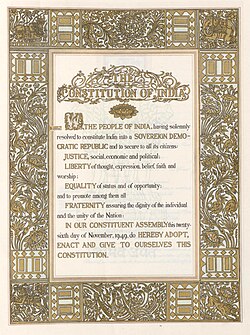
India became a republic under a constitution guaranteeing citizenship and fundamental rights without formally establishing a religious state. The constitutional settlement was shaped by the experience of partition and the need to protect a large and diverse population of minorities.
Image source: Constitution of India
Apr 8, 1950
The prime ministers of India and Pakistan agreed to protect religious minorities, address forced conversions and abductions, and facilitate the restoration of property. The pact sought to reduce continuing population flight and establish a framework for minority security.
Mar 23, 1956
Pakistan adopted its first constitution and became the Islamic Republic of Pakistan. The move reflected continuing debates over the relationship between Islam, citizenship, federalism, and the rights of religious and regional minorities after partition.
Image source: Constitution of Pakistan
Sep 19, 1960
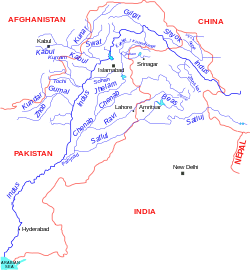
India and Pakistan signed the Indus Waters Treaty with World Bank assistance, allocating the eastern rivers primarily to India and the western rivers primarily to Pakistan. The agreement addressed one of the most consequential resource disputes created by partition.
Image source: Indus Waters Treaty
Or browse the full history timeline directory, with more than 2,500 topics.
This Partition of India timeline was generated with the help of AI, using information found on the internet.
We work hard to keep these timelines accurate, but mistakes do get through. If you spot one, email us at [email protected] and we'll fix it for future visitors.
Generate yours with AI or build it from scratch, for free.
Export your timeline, add your own events, edit or remove AI-generated events, and much more
No credit card required.
Cancel anytime.
Cancel anytime.
You can create an unlimited number of timelines with up to 10 events on each one, customize how they look, export them to PDF, PNG, PowerPoint, CSV, and Excel, and share them with a link. Paid plans raise the event limit and add features like spreadsheet imports and collaborators.
Yes. You can cancel your subscription from your account page at any time, and you will not be charged again. Your subscription stays active for the rest of the period you already paid for.
Yes. We will email you a reminder before the annual renewal, and we will also email you a receipt.
Yes. You can email us within 15 days of any payment, and we will issue you a full refund.
Check out our pricing docs or send us an email anytime: [email protected].