-
Use Cases
-
Resources
-
Pricing
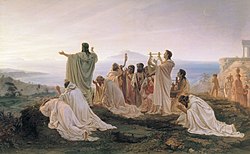
Pythagoras was an ancient Greek philosopher and mathematician born on the island of Samos around 570 BC. He is best known for the Pythagorean theorem, a fundamental principle in geometry relating to right-angled triangles. He founded a mystical school in Croton, southern Italy, that blended mathematics, philosophy, and religious teachings, influencing later thinkers such as Plato. His followers believed numbers were the essence of all things, shaping Western mathematical and philosophical thought for centuries. More Less
1800 BC
% complete
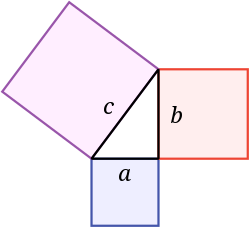
The Pythagorean theorem was known and used by the Babylonians and Indians centuries before Pythagoras. Walter Burkert rejects the suggestion that Pythagoras had anything to do with it, noting that Pythagoras was never credited with having proved any theorem in antiquity.
Image source: Pythagorean theorem
350 BC
% complete
In the fourth century BC, Aristippus of Cyrene explained Pythagoras's name by associating it with Pythian Apollo, saying, 'He spoke [agoreúō] the truth no less than did the Pythian [puthikós].'
Image source: Pythagoras
300 BC
% complete
By the third century BC, Pythagoras was also reported to have studied under the Jews, adding to the growing body of legendary claims about his travels and the foreign origins of his wisdom.
200 BC
% complete
Contradicting all reports of Pythagoras's travels and teachers, the novelist Antonius Diogenes, writing in the second century BC, reported that Pythagoras discovered all his doctrines himself by interpreting dreams.
150 BC
% complete
Apollonius Paradoxographus, a paradoxographer who may have lived in the second century BC, identified Pythagoras's thaumaturgic ideas as a result of Pherecydes's influence.
Image source: Pherecydes of Syros
250 AD
% complete
By the third century AD, Pythagoras was reported by Philostratus to have studied under sages or gymnosophists in India and, according to Iamblichus, also with the Celts and Iberians, expanding legends of his wanderings.
Image source: Gymnosophists
400 BC
% complete
By the end of the fifth century BC, the fact of Pythagoras's teachings and doctrines was universally accepted among Greek intellectuals, cementing his reputation as one of the foundational figures of Greek thought.
340 BC - 300 BC
% complete
In the fourth century BC, Aristotle's students Dicaearchus, Aristoxenus, and Heraclides Ponticus wrote earlier accounts of Pythagoras. Porphyry and Iamblichus later used this material, which, when it can be identified, is generally considered the most reliable.
Image source: Dicaearchus
80 AD
% complete
The later first-century Neopythagorean philosopher Moderatus of Gades expanded on Pythagorean number philosophy and probably understood the soul as a 'kind of mathematical harmony'.
80 AD
% complete
The first-century AD philosopher Apollonius of Tyana sought to emulate Pythagoras and live by Pythagorean teachings, adopting his ascetic lifestyle and philosophical ideals.
Image source: Apollonius of Tyana
270 AD
% complete
Porphyry wrote a biography of Pythagoras, drawing partly on reliable earlier material from Aristotle's students Dicaearchus, Aristoxenus, and Heraclides Ponticus, alongside more legendary accounts.
Image source: Porphyry (philosopher)
300 AD
% complete
Iamblichus composed his account of Pythagoras and the Pythagorean way of life, likewise incorporating material from fourth-century BC sources such as Aristoxenus and Dicaearchus while also reporting Pythagoras's alleged studies with the Celts and Iberians.
Image source: Iamblichus
400 BC - 350 BC
% complete
During the early fourth century BC, sizeable Pythagorean communities continued to exist in Magna Graecia, Phlius, and Thebes, preserving and transmitting the teachings attributed to Pythagoras after his death.
Image source: Pythagoreanism
100 BC
% complete
A major revival of Pythagoras's teachings occurred in the first century BC among Middle Platonists, coinciding with the rise of Neopythagoreanism and renewing interest in his philosophy.
Image source: Neopythagoreanism
50 BC
% complete
A revival of Pythagorean teachings occurred when Middle Platonist philosophers such as Eudorus and Philo of Alexandria hailed the rise of a 'new' Pythagoreanism in Alexandria.
1080 AD - 1160 AD
% complete
Byzantine scholarship of the eleventh and twelfth centuries led commentators active around 1080–1160 to declare that Plato was Pythagorean, reinforcing the deep association between the two thinkers.
Image source: Plato
1490 AD - 1522 AD
% complete
The German humanist scholar Johannes Reuchlin synthesized Pythagoreanism with Christian theology and Jewish Kabbalah, arguing that Kabbalah and Pythagoreanism were both inspired by Mosaic tradition and that Pythagoras was therefore a kabbalist.
Image source: Johann Reuchlin
1494 AD
% complete
In 1494, the Greek Neopythagorean scholar Constantine Lascaris published The Golden Verses of Pythagoras, translated into Latin, with a printed edition of his Grammatica, thereby bringing them to a widespread audience.
Image source: Golden Verses
1494 AD
% complete
In his dialogue De verbo mirifico (1494), Johannes Reuchlin compared the Pythagorean tetractys to the ineffable divine name YHWH, ascribing each of the four letters of the tetragrammaton a symbolic meaning according to Pythagorean mystical teachings.
Image source: Heinrich Cornelius Agrippa
1499 AD
% complete
In 1499, Constantine Lascaris published the first Renaissance biography of Pythagoras in his work Vitae illustrium philosophorum siculorum et calabrorum, issued in Messina.
1543 AD
% complete
In his preface to On the Revolution of the Heavenly Spheres (1543), Nicolaus Copernicus cited various Pythagoreans as the most important influences on his heliocentric model, deliberately omitting mention of Aristarchus of Samos, who had developed a fully heliocentric model in the fourth century BC, to portray his model as fundamentally Pythagorean.
Image source: De revolutionibus orbium coelestium
1567 AD
% complete
It was through Arthur Golding's 1567 English translation of Ovid's Metamorphoses, which includes a speech by Pythagoras, that Pythagoras was best known to English-speakers throughout the early modern period.
Image source: Arthur Golding
1600 AD - 1637 AD
% complete
Rosicrucianism used Pythagorean symbolism, as did Robert Fludd (1574–1637), who believed his own musical writings to have been inspired by Pythagoras.
Image source: Robert Fludd
1700 AD
% complete
John Dryden included a translation of the scene with Pythagoras from Ovid's Metamorphoses in his 1700 work Fables, Ancient and Modern, continuing the poem's influence on English literature.
1726 AD
% complete
John Gay's 1726 fable 'Pythagoras and the Countryman' reiterates the major themes of Ovid's Pythagoras scene, linking carnivorism with tyranny.
Image source: John Gay
Or browse the full history timeline directory, with more than 2,000 topics.
This Pythagoras timeline was generated with the help of AI, using information found on the internet.
We work hard to keep these timelines accurate, but mistakes do get through. If you spot one, email us at [email protected] and we'll fix it for future visitors.
Generate yours with AI or build it from scratch, for free.
Export your timeline, add your own events, edit or remove AI-generated events, and much more
No credit card required.
Cancel anytime.
Cancel anytime.
You can create an unlimited number of timelines with up to 10 events on each one, customize how they look, export them to PDF, PNG, PowerPoint, CSV, and Excel, and share them with a link. Paid plans raise the event limit and add features like spreadsheet imports and collaborators.
Yes. You can cancel your subscription from your account page at any time, and you will not be charged again. Your subscription stays active for the rest of the period you already paid for.
Yes. We will email you a reminder before the annual renewal, and we will also email you a receipt.
Yes. You can email us within 15 days of any payment, and we will issue you a full refund.
Check out our pricing docs or send us an email anytime: [email protected].