-
Use Cases
-
Resources
-
Pricing
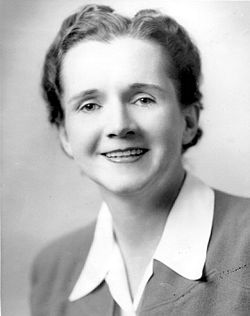
Rachel Carson (1907–1964) was an American marine biologist, author, and conservationist whose writings advanced the global environmental movement. Her landmark book Silent Spring (1962) exposed the dangers of pesticides like DDT and led to significant policy changes, including the eventual creation of the U.S. Environmental Protection Agency. More Less
May 27, 1907
% complete
Rachel Louise Carson was born on May 27, 1907, on a family farm near Springdale, Pennsylvania, located by the Allegheny River near Pittsburgh. She would grow up to become an American marine biologist, writer, and conservationist whose work advanced marine conservation and the global environmental movement.
Image source: Rachel Carson
1925
% complete
After attending Springdale's small school through tenth grade, Carson completed high school in nearby Parnassus, Pennsylvania, graduating in 1925 at the top of her class of 44 students.
Jan 1928
% complete
Carson gained admission to Pennsylvania College for Women, now Chatham University, in Pittsburgh, where she originally studied English but switched her major to biology in January 1928. She was admitted to graduate school at Johns Hopkins University but had to remain for her senior year due to financial difficulties.
Image source: Chatham University
1929
% complete
In 1929, Carson graduated magna cum laude from the Pennsylvania College for Women, setting the stage for her graduate studies in zoology.
Jun 1929
% complete
In the summer of 1929, Carson moved to Woods Hole, Massachusetts for a course at the Marine Biological Laboratory, deepening her experience with marine life that would shape her future writing.
Image source: Marine Biological Laboratory
Jun 1932
% complete
In June 1932, Carson earned a master's degree in zoology from Johns Hopkins University. She intended to continue for a doctorate, but in 1934 was forced to leave Johns Hopkins to search for a full-time teaching position to support her family during the Great Depression.
Image source: Johns Hopkins University
1935
% complete
In 1935, Carson's father died suddenly, worsening the family's already critical financial situation and leaving Carson to care for her aging mother.
1936
% complete
After sitting for the civil service exam and outscoring all other applicants, Carson became in 1936 the second woman hired by the Bureau of Fisheries for a full-time professional position, as a junior aquatic biologist.
Image source: United States Fish and Wildlife Service
Jan 1937
% complete
Carson's family responsibilities further increased in January 1937 when her older sister died, leaving Carson as the sole breadwinner for her mother and two nieces.
1949
% complete
In 1949, Carson was appointed chief editor of publications, which allowed her increased opportunities for fieldwork and freedom in choosing her writing projects, though it also entailed increasingly tedious administrative responsibilities.
Jan 1, 1957 - Mar 31, 1957
% complete
In early 1957, a family tragedy struck for the third time when one of her nieces died at the age of 31, leaving her 5-year-old son, Roger Christie, an orphan. Carson moved to Silver Spring, Maryland to care for Roger and spent much of 1957 studying specific environmental threats.
Image source: The Murder of Roger Ackroyd
Apr 14, 1964
% complete
Weakened from breast cancer and her treatment regimen, Carson became ill with a respiratory virus in January 1964. She died of a heart attack on April 14, 1964, in her home in Silver Spring, Maryland. In spring 1964, Dorothy received half of Rachel's ashes sent to her by Robert Carson.
Jul 1937
% complete
In July 1937, the Atlantic Monthly accepted a revised version of an essay, The World of Waters, that Carson originally wrote for her first fisheries bureau brochure, launching her literary career.
Image source: The Atlantic
1941
% complete
Several years of writing resulted in Under the Sea Wind (1941), which received excellent reviews but sold poorly. Its success came later after the republication prompted by Carson's later fame.
Image source: Under the Sea Wind
1948
% complete
By 1948, Carson was working on material for a second book and decided to begin a transition to writing full-time. Oxford University Press expressed interest in her book proposal for a life history of the ocean, spurring her to complete the manuscript by early 1950.
Jun 1951
% complete
Beginning in June 1951, nine chapters of The Sea Around Us were serialized in The New Yorker, building anticipation ahead of the book's publication.
Image source: The Sea Around Us
Jul 2, 1951
% complete
On July 2, 1951, The Sea Around Us was published by Oxford University Press. It remained on The New York Times Bestseller List for 86 weeks, was abridged by Reader's Digest, and won the 1952 National Book Award for Nonfiction and the John Burroughs Medal, earning Carson two honorary doctorates.
1952
% complete
With success came financial security; in 1952, Carson was able to give up her job in order to concentrate on writing full-time. That same year, Under the Sea Wind was republished and became a bestseller.
Jan 1, 1953 - Mar 31, 1953
% complete
Early in 1953, Carson began library and field research on the ecology and organisms of the Atlantic shore. In 1955, she completed the third volume of her sea trilogy, The Edge of the Sea, focusing on coastal ecosystems along the Eastern Seaboard — also a bestseller.
Image source: The Edge of the Sea
1953
% complete
Carson met Dorothy Freeman in the summer of 1953 on Southport Island, Maine, beginning a close and deeply meaningful friendship documented in their correspondence, later published in Always, Rachel (1995) by Beacon Press.
Image source: Rachel Carson
1945
% complete
In mid-1945, Carson first encountered DDT, a revolutionary new pesticide lauded as the 'insect bomb' after the atomic bombings of Hiroshima and Nagasaki, which was only beginning to undergo tests for safety and ecological effects. Editors found the subject unappealing, and she published nothing on DDT until 1962.
Image source: DDT
Oct 1, 1957 - Dec 31, 1957
% complete
By late 1957, Carson was closely following federal proposals for widespread pesticide spraying, including the USDA's plan to eradicate fire ants. The government's 1957 gypsy moth eradication program prompted her to devote her research and next book to pesticides and environmental poisons.
Image source: Silent Spring
1958
% complete
By 1958, Carson had arranged a book deal with plans to co-write with Newsweek science journalist Edwin Diamond. By 1959, the USDA responded to criticism from Carson and others with a public service film, Fire Ant on Trial, which she characterized as 'flagrant propaganda.'
1960
% complete
By 1960, Carson had more than enough research material, and the writing was progressing rapidly. Most of the research and writing was done by fall 1960, except for discussion of recent research on biological pest controls and investigations of new pesticides. Further health troubles slowed final revisions in 1961 and early 1962.
Aug 1961
% complete
By August 1961, Carson agreed to the suggestion of her literary agent Marie Rodell: Silent Spring would be a metaphorical title for the entire book, suggesting a bleak future for the whole natural world, rather than a single chapter title about the literal absence of birdsong.
May 1962
% complete
Carson attended the White House Conference on Conservation in May 1962; Houghton Mifflin distributed proof copies of Silent Spring to many of the delegates and promoted the upcoming New Yorker serialization.
Jun 16, 1962
% complete
Though Silent Spring had generated relatively high interest based on pre-publication promotion, this became much more intense with the serialization in The New Yorker, which began with the June 16, 1962 issue.
Sep 27, 1962
% complete
Silent Spring, Carson's most influential book, was published by Houghton Mifflin on September 27, 1962. It brought environmental concerns to an unprecedented share of the American people, despite strong opposition from the chemical industry in the weeks leading up to publication.
Apr 3, 1963
% complete
Pesticide use became a major public issue, especially after the CBS Reports TV special The Silent Spring of Rachel Carson aired on April 3, 1963, bringing Carson's arguments before a mass television audience.
Image source: Silent Spring
May 15, 1963
% complete
The President's Science Advisory Committee issued its report on May 15, 1963, largely backing Carson's scientific claims about the dangers of pesticides, a significant vindication of Silent Spring.
1967
% complete
Though environmental concerns about DDT had been considered by government agencies as early as Carson's testimony before the President's Science Advisory Committee, the 1967 formation of the Environmental Defense Fund was the first significant milestone in the campaign against DDT.
Image source: Environmental Defense Fund
1970
% complete
The creation of the Environmental Protection Agency (EPA) by the Nixon Administration in 1970 addressed another concern Carson had brought to light. One journalist later described the EPA as 'the extended shadow of Silent Spring.'
Image source: United States Environmental Protection Agency
1972
% complete
By 1972, the Environmental Defense Fund and other activist groups had succeeded in securing a phase-out of DDT use in the United States, except in emergency cases, a landmark outcome of the movement Carson helped spark.
Oct 1, 1963 - Dec 31, 1963
% complete
In late 1963, Carson received a flurry of awards and honors: the Audubon Medal from the National Audubon Society, the Cullum Geographical Medal from the American Geographical Society, and induction into the American Academy of Arts and Letters. Time magazine later chose Carson for its 1963 Woman of the Year cover in 2019.
1965
% complete
In 1965, Marie Rodell arranged for the publication of an essay Carson had intended to expand into a book: The Sense of Wonder, celebrating wonder at the natural world.
1969
% complete
In 1969, the Coastal Maine National Wildlife Refuge became the Rachel Carson National Wildlife Refuge; expansions will bring the size of the refuge to about 9,125 acres.
Image source: Rachel Carson National Wildlife Refuge
1973
% complete
In 1973, Carson was inducted into the National Women's Hall of Fame, recognizing her enduring contributions as a scientist, writer, and conservationist.
Image source: National Women's Hall of Fame
1975
% complete
Carson's birthplace and childhood home in Springdale, Pennsylvania, known as the Rachel Carson Homestead, became a National Register of Historic Places site, and the nonprofit Rachel Carson Homestead Association was created in 1975. Near Pittsburgh, the 46.1-mile Rachel Carson Trail was also dedicated to her in 1975.
Image source: Rachel Carson Homestead
Jun 9, 1980
% complete
Perhaps most significantly, on June 9, 1980, Carson was awarded the Presidential Medal of Freedom, the highest civilian honor in the United States.
Image source: Presidential Medal of Freedom
1985
% complete
In 1985, North Carolina renamed one of its estuarine reserves in honor of Carson, in Beaufort, recognizing her contributions to marine conservation.
Image source: Rachel Carson North Carolina National Estuarine Research Reserve
1991
% complete
Carson's home in Colesville, Maryland, where she wrote Silent Spring, was named a National Historic Landmark in 1991. That same year, the Rachel Carson Prize was founded in Stavanger, Norway, awarded to women who have contributed to environmental protection.
Image source: Rachel Carson House (Colesville, Maryland)
1995
% complete
Many of Carson's letters were published in 1995 as Always, Rachel: The Letters of Rachel Carson and Dorothy Freeman, 1952–1964, edited by Martha Freeman, Dorothy's granddaughter, offering an intimate portrait of their remarkable friendship.
1998
% complete
In addition to the letters in Always, Rachel, in 1998 a volume of Carson's previously unpublished work was published as Lost Woods: The Discovered Writing of Rachel Carson, edited by Linda Lear.
2007
% complete
The centennial of Carson's birth occurred in 2007. On May 27, 2007, the Rachel Carson Homestead Association held a birthday party and sustainable feast at her birthplace in Springdale, Pennsylvania, and the first Rachel Carson Legacy Conference in Pittsburgh. Also in 2007, American author Ginger Wadsworth wrote a biography of Carson.
2009
% complete
Munich's Rachel Carson Center for Environment and Society was founded in 2009, continuing her legacy in environmental humanities scholarship.
Image source: Rachel Carson Center for Environment and Society
2012
% complete
In 2012, Silent Spring was designated a National Historic Chemical Landmark by the American Chemical Society for its role in the development of the modern environmental movement.
Jul 14, 2013
% complete
The Rachel Carson sculpture in Woods Hole, Massachusetts, where she once studied marine biology, was unveiled on July 14, 2013.
May 27, 2014
% complete
Google created a Google Doodle for Carson's 107th birthday on May 27, 2014, honoring her lasting impact on environmental awareness.
Image source: Google Doodle
2016
% complete
The University of California, Santa Cruz, named one of its colleges, formerly known as College Eight, Rachel Carson College in 2016.
Image source: Rachel Carson College
2017
% complete
Carson was featured during the 'HerStory' video tribute to notable women on U2's tour in 2017 for the 30th anniversary of The Joshua Tree during a performance of 'Ultraviolet (Light My Way)' from the band's 1991 album Achtung Baby.
Image source: U2
Or browse the full history timeline directory, with more than 2,000 topics.
This Rachel Carson timeline was generated with the help of AI, using information found on the internet.
We work hard to keep these timelines accurate, but mistakes do get through. If you spot one, email us at [email protected] and we'll fix it for future visitors.
Generate yours with AI or build it from scratch, for free.
Export your timeline, add your own events, edit or remove AI-generated events, and much more
No credit card required.
Cancel anytime.
Cancel anytime.
You can create an unlimited number of timelines with up to 10 events on each one, customize how they look, export them to PDF, PNG, PowerPoint, CSV, and Excel, and share them with a link. Paid plans raise the event limit and add features like spreadsheet imports and collaborators.
Yes. You can cancel your subscription from your account page at any time, and you will not be charged again. Your subscription stays active for the rest of the period you already paid for.
Yes. We will email you a reminder before the annual renewal, and we will also email you a receipt.
Yes. You can email us within 15 days of any payment, and we will issue you a full refund.
Check out our pricing docs or send us an email anytime: [email protected].