-
Use Cases
-
Resources
-
Pricing
Rita Levi-Montalcini (1909–2012) was an Italian neurologist and Nobel laureate renowned for her discovery of nerve growth factor (NGF), a breakthrough that transformed our understanding of cell growth. Despite facing persecution as a Jewish scientist under Fascist Italy, she continued her research in secret, later becoming one of the most influential figures in modern neuroscience and a lifelong advocate for science and women in research. More Less
1900
% complete
Her parents were Adele Montalcini, a painter, and Adamo Levi, an electrical engineer and mathematician, whose families had moved from Asti and Casale Monferrato, respectively, to Turin at the turn of the twentieth century.
Image source: Rita Levi-Montalcini
Apr 22, 1909
% complete
Rita Levi-Montalcini was born on 22 April 1909 in Turin to Italian Jewish parents with roots dating back to the Roman Empire.
Sep 1943 - Aug 1944
% complete
When Germany invaded Italy in September 1943, her family fled south to Florence, where they survived The Holocaust under false identities, protected by some non-Jewish friends. She later described this experience in the documentary film Death by Design: The Life and Times of Life and Times (1997).
Image source: The Holocaust in Italy
Aug 1944
% complete
After the liberation of Florence in August 1944, she volunteered her medical expertise for the Allied health service, providing critical care to those injured during the war.
1974
% complete
Levi-Montalcini had an older brother, Gino, who died after a heart attack in 1974. She also had two sisters: Anna, five years older than Rita, and Paola, her twin sister, a popular artist.
Sep 29, 2000
% complete
Her twin sister Paola, a popular artist, died on 29 September 2000, at age 91.
Image source: Paola Levi-Montalcini
1936
% complete
In 1936, Levi-Montalcini remained at the university as an assistant, but her academic career was cut short by Benito Mussolini's 1938 Manifesto of Race and the subsequent introduction of laws barring Jews from academic and professional careers.
1945
% complete
Upon returning to Turin in 1945, she resumed her research activities.
Image source: University of Turin
Sep 1946
% complete
In September 1946, Levi-Montalcini was granted a one-semester research fellowship in the laboratory of Professor Viktor Hamburger at Washington University School of Medicine; he was interested in two of the articles she had published in foreign scientific journals.
Image source: Washington University School of Medicine
1952
% complete
It was there that, in 1952, she did her most important work: isolating nerve growth factor (NGF) from observations of certain cancerous tissues that cause extremely rapid growth of nerve cells.
Image source: Nerve growth factor
1952
% complete
The critical experiment was done with Hertha Meyer at the Carlos Chagas Filho Biophysics Institute of the Federal University of Rio de Janeiro in 1952.
Image source: Federal University of Rio de Janeiro
1954
% complete
Their publication in 1954 became the first definitive indication of the protein. Her research led to the seminal publication 'In vitro experiments on the effects of mouse sarcomas 180 and 37 on the spinal and sympathetic ganglia of the chick embryo' in 1954, a foundational work in identifying and understanding nerve growth factor (NGF).
1958
% complete
She was made a full professor in 1958.
1961 - 1969
% complete
From 1961 to 1969, she directed the Research Center of Neurobiology of the National Research Council, and from 1969 to 1978, the Laboratory of Cellular Biology.
1962
% complete
In 1962, she established a second laboratory in Rome and divided her time between there and St. Louis.
Image source: Rome
1975
% complete
Beginning in 1975, she supported the drug Cronassial (a particular mixture of gangliosides) produced by Fidia from bovine brain tissue.
Image source: Rita Levi-Montalcini
1977 - 1979
% complete
After she retired in 1977, she was appointed as director of the Institute of Cell Biology of the Italian National Council of Research in Rome. She retired from that position in 1979 but continued to be involved as a guest professor.
1983
% complete
As per the normal cautionary routine, Germany banned Cronassial in 1983, followed by other countries.
1993
% complete
Italy prohibited the drug only in 1993; at the same time, an investigation revealed that Fidia paid the Italian Ministry of Health for a quick approval of Cronassial and later paid for pushing the use of the drug in the treatment of diseases where it had not been tested.
1993
% complete
In the same period (1993), she identified the endogenous compound palmitoylethanolamide as an important modulator of this cell.
2002
% complete
Levi-Montalcini founded the European Brain Research Institute in 2002, and then served as its president.
2010
% complete
Her role in the European Brain Research Institute was at the centre of some criticism from some parts of the scientific community in 2010.
1963
% complete
In 1963, she became the first woman to receive the Max Weinstein Award (given by the United Cerebral Palsy Association) due to her significant contributions to neurological research.
1986
% complete
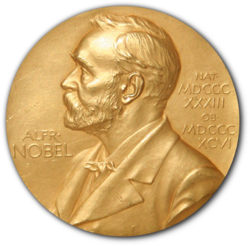
Levi-Montalcini earned the 1986 Nobel Prize in Physiology or Medicine jointly with colleague Stanley Cohen for the discovery of nerve growth factor (NGF).
Image source: Nobel Prize in Physiology or Medicine
1997
% complete
She described her wartime experience decades later in the science documentary film Death by Design: The Life and Times of Life and Times (1997).
Aug 1, 2001 - Dec 30, 2012
% complete
On 1 August 2001, she was appointed as senator for life by the President of Italy, Carlo Azeglio Ciampi. From 2001 until her death, she served in the Italian Senate.
Image source: Senate of the Republic (Italy)
Sep 21, 2002
% complete
Gustavo Raffi, Grand Master of the Grand Orient of Italy, recalled his feelings of friendship and sincere dialogue with her, noting that she was a guest at Villa del Vascello on 21 September 2002, together with Rigoberta Menchú, to talk about science and peace in the service of mankind.
Image source: Grand Orient of Italy
2003
% complete
Apr 28, 2006 - Apr 29, 2006
% complete
On 28–29 April 2006, Levi-Montalcini, aged 97, attended the opening assembly of the newly elected Senate, at which the President of the Senate was elected. In a 2006 interview, she said, 'I never had any hesitation or regrets in this sense...'
Apr 22, 2009
% complete
On 22 April 2009, she became the first Nobel laureate to reach the age of 100, and the event was feted with a party at Rome's City Hall.
Dec 30, 2012
% complete
Levi-Montalcini died in her home in Rome on 30 December 2012 at the age of 103.
Apr 2016
% complete
In April 2016, a spontaneous orchid (a hybrid between Ophrys incubacea and Ophrys sphegodes subsp. ...) was named in connection with her legacy.
Image source: Ophrys sphegodes
Or browse the full history timeline directory, with more than 2,000 topics.
This Rita Levi-Montalcini timeline was generated with the help of AI, using information found on the internet.
We work hard to keep these timelines accurate, but mistakes do get through. If you spot one, email us at [email protected] and we'll fix it for future visitors.
Generate yours with AI or build it from scratch, for free.
Export your timeline, add your own events, edit or remove AI-generated events, and much more
No credit card required.
Cancel anytime.
Cancel anytime.
You can create an unlimited number of timelines with up to 10 events on each one, customize how they look, export them to PDF, PNG, PowerPoint, CSV, and Excel, and share them with a link. Paid plans raise the event limit and add features like spreadsheet imports and collaborators.
Yes. You can cancel your subscription from your account page at any time, and you will not be charged again. Your subscription stays active for the rest of the period you already paid for.
Yes. We will email you a reminder before the annual renewal, and we will also email you a receipt.
Yes. You can email us within 15 days of any payment, and we will issue you a full refund.
Check out our pricing docs or send us an email anytime: [email protected].