-
Use Cases
-
Resources
-
Pricing
The Rwandan Genocide was a mass slaughter of the Tutsi minority and moderate Hutus in Rwanda, carried out between April and July 1994 by extremist Hutu militias and government forces. Sparked by longstanding ethnic tensions and the assassination of President Juvénal Habyarimana, the genocide resulted in the deaths of an estimated 800,000 people in approximately 100 days. The international community's failure to intervene remains a significant lesson in human rights and global responsibility. More Less
1897
% complete
Germany colonized Rwanda in the late 19th century, incorporating it into German East Africa. Colonial administrators ruled indirectly through the Tutsi monarchy, reinforcing existing social hierarchies and beginning the process of formalizing ethnic distinctions between Tutsi and Hutu populations.
Image source: Ruanda-Urundi
1916
% complete
Belgian forces occupied Rwanda during World War I, and the League of Nations formally granted Belgium a mandate over Ruanda-Urundi in 1922. Belgium continued and intensified the pro-Tutsi policies of indirect rule begun under German administration.
1933
% complete
Belgian colonial authorities introduced mandatory identity cards labeling every Rwandan as Hutu, Tutsi, or Twa, largely based on arbitrary criteria such as cattle ownership and physical features. These rigid classifications hardened previously fluid social categories and later became tools for identifying victims during the genocide.
Nov 1959 - 1961
% complete
Sparked by attacks on Hutu chiefs, widespread violence erupted as Hutu peasants rose against Tutsi elites. Belgium shifted its support to the Hutu majority, and thousands of Tutsi were killed or fled into exile. The monarchy was abolished in 1961, ending centuries of Tutsi dominance.
Image source: Rwandan Revolution
Jul 1, 1962
% complete
Rwanda became an independent republic with Grégoire Kayibanda, leader of the Hutu Parmehutu party, as president. The new government institutionalized ethnic quotas and discrimination against Tutsi, prompting continued waves of exile and periodic massacres of Tutsi communities.
Image source: Rwanda
Jul 5, 1973
% complete
Major General Juvénal Habyarimana overthrew President Grégoire Kayibanda in a bloodless coup, establishing a one-party state under his National Revolutionary Movement for Development (MRND). His regime maintained anti-Tutsi discrimination while presenting itself as a period of relative stability.
Image source: Juvénal Habyarimana
1987
% complete
Exiled Tutsi, many descended from refugees who fled the 1959 revolution, formed the Rwandan Patriotic Front in Uganda. Led by Fred Rwigyema and Paul Kagame, the RPF sought the right of return for refugees and ultimately aimed to overthrow Habyarimana's government.
Image source: Rwandan Patriotic Front
Oct 1, 1990
% complete
The RPF crossed from Uganda into northern Rwanda, killing commander Fred Rwigyema in the first days of fighting. The invasion gave Hutu hardliners a pretext to portray all Tutsi as enemies within, fueling propaganda campaigns and the formation of extremist militias.
Image source: Rwandan Civil War
Dec 1990
% complete
The extremist Kangura newspaper published the 'Hutu Ten Commandments,' which declared any Hutu who married a Tutsi woman, did business with Tutsi, or befriended them a traitor. The document was a landmark in dehumanizing hate propaganda that prepared the ground for genocide.
Image source: Kangura
Jan 1991
% complete
Following RPF advances, local officials organized killings of hundreds of Tutsi civilians in Bagogwe communities in the northwest. These massacres served as rehearsals for the larger violence to come, testing methods of mobilizing civilian participation in mass murder.
Image source: Rwandan genocide
Jul 8, 1993
% complete
Radio Télévision Libre des Mille Collines (RTLM) began broadcasting, spreading virulent anti-Tutsi propaganda, calling Tutsis 'inyenzi' (cockroaches), and broadcasting lists of targets. The radio played a central role in coordinating and inciting the genocide.
Image source: Radio Télévision Libre des Mille Collines
Aug 4, 1993
% complete
After years of negotiations brokered by Tanzania and regional leaders, the Rwandan government and the RPF signed peace accords providing for power-sharing, integration of armies, and refugee returns. Hutu extremists rejected the agreement, viewing concessions to the RPF as betrayal.
Oct 5, 1993
% complete
The UN Security Council authorized the United Nations Assistance Mission for Rwanda (UNAMIR) to monitor implementation of the Arusha Accords. Canadian General Roméo Dallaire commanded roughly 2,500 troops, but the mission was given a limited mandate and inadequate resources.
Image source: United Nations Assistance Mission for Rwanda
Oct 21, 1993
% complete
Burundi's first democratically elected Hutu president was assassinated by Tutsi army officers, triggering massacres in Burundi and sending shockwaves through Rwanda. Extremist Rwandan media used the assassination to argue that Hutus faced existential threats from Tutsi everywhere.
Image source: Melchior Ndadaye
Jan 11, 1994
% complete
General Dallaire sent a cable to UN headquarters warning that an informant revealed plans to stockpile weapons and exterminate Tutsi, requesting permission to raid arms caches. UN officials rejected the plan, instructing him instead to inform President Habyarimana — a decision later seen as a fatal failure of prevention.
Image source: Roméo Dallaire
Apr 6, 1994
% complete
A missile shot down the plane carrying Presidents Habyarimana of Rwanda and Cyprien Ntaryamira of Burundi as it approached Kigali airport. Within hours, extremist Hutu forces began executing their carefully prepared plans for mass slaughter, blaming the RPF for the crash.
Image source: Assassination of Juvénal Habyarimana and Cyprien Ntaryamira
Apr 7, 1994
% complete
The moderate Hutu prime minister was assassinated along with her husband by the Presidential Guard. Ten Belgian UNAMIR soldiers protecting her were captured, tortured, and killed, a calculated provocation designed to drive Western peacekeepers out of Rwanda.
Image source: Agathe Uwilingiyimana
Apr 7, 1994
% complete
Within hours of the presidential plane crash, Interahamwe and Impuzamugambi militias manned roadblocks throughout Kigali, checking identity cards and slaughtering Tutsi. Killers used pre-distributed lists to hunt down moderates and Tutsi, moving systematically neighborhood by neighborhood.
Image source: Impuzamugambi
Apr 7, 1994 - Jul 4, 1994
% complete
The RPF restarted its civil war offensive immediately after the genocide began, fighting southward and eastward across the country. On July 4, 1994, RPF forces took Kigali, bringing an end to the three-month slaughter in the capital and most of Rwanda.
Apr 8, 1994
% complete
Extremists formed an interim government led by Prime Minister Jean Kambanda, bypassing the Arusha Accords' power-sharing arrangements. The new authorities actively directed and encouraged the nationwide campaign of extermination rather than attempting to stop it.
Apr 15, 1994 - Apr 16, 1994
% complete
Thousands of Tutsi who had taken refuge at Nyarubuye Roman Catholic church in Kibungo prefecture were attacked over two days by interahamwe militia, soldiers, and local officials using machetes, grenades, and guns. An estimated 20,000 people were killed in one of the genocide's deadliest single episodes.
Apr 21, 1994
% complete
As the killing raged, the UN voted to cut UNAMIR from about 2,500 to just 270 troops, abandoning those it had been protecting. Belgium had already withdrawn its contingent. The withdrawal sent a signal of international indifference that emboldened the killers.
Jun 22, 1994
% complete
France secured UN authorization for a humanitarian intervention in southwestern Rwanda late in the genocide. Critics argued the operation created a safe zone that allowed many génocidaires to escape across the border into Zaire, and that France had earlier armed and trained the Hutu regime.
Image source: Opération Turquoise
Jul 18, 1994
% complete
The RPF completed its takeover of the country, capturing the northwestern strongholds of the former regime. Roughly 800,000 to 1,000,000 Tutsi and moderate Hutu had been killed in approximately 100 days, one of the fastest and most intense genocides in history.
Jul 1994
% complete
Over two million Hutu fled Rwanda, including many génocidaires who mingled among genuine refugees in enormous camps in Zaire and Tanzania. Militia and former army elements reorganized in the camps, launching cross-border raids and setting the stage for future conflicts in the region.
Image source: Great Lakes refugee crisis
Nov 8, 1994 - Dec 31, 2015
% complete
The UN Security Council established the ICTR in Arusha, Tanzania, to prosecute organizers of the genocide. Over two decades it tried high-profile figures including Prime Minister Jean Kambanda, the first head of government to plead guilty to genocide, closing in December 2015.
Image source: International Criminal Tribunal for Rwanda
Oct 24, 1996 - May 16, 1997
% complete
Rwanda invaded eastern Zaire to dismantle the exiled génocidaire camps, backing Laurent-Désiré Kabila's rebellion that toppled Mobutu Sese Seko. The war and subsequent Second Congo War drew Rwanda deeply into the devastating conflicts of the Great Lakes region.
Image source: First Congo War
Apr 17, 2000
% complete
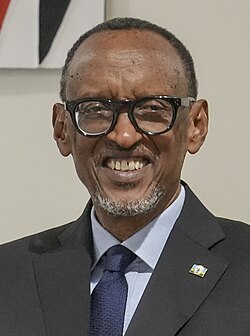
Paul Kagame, the former RPF commander who had halted the genocide, was elected president by parliament after serving as vice president and minister of defense. He has dominated Rwandan politics since, credited with reconstruction and economic growth but criticized for authoritarian rule.
Image source: Paul Kagame
2001 - 2012
% complete
Facing overcrowded prisons with over 100,000 suspected perpetrators, Rwanda revived traditional community-based gacaca courts to try genocide suspects locally. Over a decade, the courts processed nearly two million cases, promoting confession, reconciliation, and punishment, though critics questioned their fairness.
Image source: Gacaca court
Jul 1, 2007
% complete
Fifteen years after the genocide, Rwanda joined the East African Community alongside Kenya, Tanzania, Uganda, and Burundi, marking its reintegration into regional institutions and signaling its post-genocide economic and diplomatic recovery.
Image source: East African Community
Or browse the full history timeline directory, with more than 2,000 topics.
This Rwandan Genocide timeline was generated with the help of AI, using information found on the internet.
We work hard to keep these timelines accurate, but mistakes do get through. If you spot one, email us at [email protected] and we'll fix it for future visitors.
Generate yours with AI or build it from scratch, for free.
Export your timeline, add your own events, edit or remove AI-generated events, and much more
No credit card required.
Cancel anytime.
Cancel anytime.
You can create an unlimited number of timelines with up to 10 events on each one, customize how they look, export them to PDF, PNG, PowerPoint, CSV, and Excel, and share them with a link. Paid plans raise the event limit and add features like spreadsheet imports and collaborators.
Yes. You can cancel your subscription from your account page at any time, and you will not be charged again. Your subscription stays active for the rest of the period you already paid for.
Yes. We will email you a reminder before the annual renewal, and we will also email you a receipt.
Yes. You can email us within 15 days of any payment, and we will issue you a full refund.
Check out our pricing docs or send us an email anytime: [email protected].