-
Use Cases
-
Resources
-
Pricing
May 5, 1813
% complete
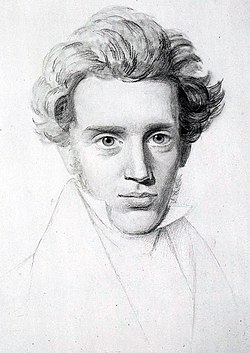
Søren Aabye Kierkegaard is born in Copenhagen, Denmark, the seventh and youngest child of Michael Pedersen Kierkegaard, a wealthy wool merchant, and his second wife Ane Sørensdatter Lund. He would grow up to become one of the most influential philosophers of the 19th century.
Image source: Søren Kierkegaard
Jul 31, 1834
% complete
Kierkegaard's mother dies. By this point, five of his seven siblings had also died, contributing to the gloomy, melancholy atmosphere of his childhood home and his lifelong preoccupation with suffering, death, and Christianity.
May 8, 1837
% complete
Kierkegaard meets fifteen-year-old Regine Olsen, who becomes the great love of his life. Their relationship profoundly shapes his emotional life and his authorship, as themes of love, sacrifice, and loss recur throughout his writings.
Image source: Regine Olsen
Aug 9, 1838
% complete
Kierkegaard's father dies, leaving him a substantial inheritance that allows him financial independence for the rest of his life. The death also deepens his sense of a religious mission inherited from his father's strict Pietist faith.
Image source: Søren Kierkegaard
Sep 8, 1840 - Oct 11, 1841
% complete
Kierkegaard proposes to and becomes engaged to Regine Olsen. The engagement lasts barely a year; tormented by doubts about whether he could ever make her happy given his inner turmoil, he breaks it off, an event that haunts his entire authorship.
Oct 11, 1841
% complete
Kierkegaard returns Regine's engagement ring and ends their relationship, though she remains devoted to him. The break devastates both and becomes the psychological catalyst for his burst of literary creativity in the early 1840s.
1848
% complete
In 1848 Kierkegaard experiences what he describes as a decisive religious awakening, feeling called to serve Christianity directly. He writes 'The Point of View for My Work as an Author,' clarifying that all his writing was aimed at introducing Christianity into Christendom.
Oct 1855
% complete
From his hospital bed, Kierkegaard writes to Regine Olsen, entrusting his papers to her and asking forgiveness for how he ended things decades earlier. She visits him once before his death, a poignant closure to their long, painful story.
Oct 2, 1855
% complete
Exhausted by the pamphlet campaign, Kierkegaard collapses on a street in Copenhagen and is taken to Frederik's Hospital. He refuses communion from a state church pastor, insisting he wants no part of official Christianity's sacraments.
Oct 1830
% complete
Kierkegaard enrolls at the University of Copenhagen to study theology, though he also immerses himself in literature, philosophy, and aesthetics. His student years are marked by restless intellectual exploration rather than steady academic progress.
Image source: University of Copenhagen
Jul 3, 1840
% complete
After nearly a decade of desultory study, Kierkegaard passes his theological preliminary examination with distinction. Shortly afterward he becomes engaged, signaling an attempt to settle into ordinary bourgeois life.
Sep 29, 1841
% complete
Kierkegaard defends his dissertation on irony, focusing on Socrates and the German Romantics. The work establishes his lifelong fascination with Socrates and earns him the degree that formally qualified him to teach philosophy.
Image source: Irony
Nov 1841 - Mar 1842
% complete
Kierkegaard travels to Berlin to hear Friedrich Schelling's lectures on philosophy, initially hoping for insight into Hegel's system. Disillusioned by Schelling's rambling style, he returns to Copenhagen determined to write.
Image source: Friedrich Wilhelm Joseph Schelling
Feb 20, 1843
% complete
Kierkegaard publishes his first major work, Either/Or, presenting two contrasting modes of existence: the aesthetic life of pleasure and the ethical life of commitment. The book creates a sensation in Danish intellectual circles.
Oct 16, 1843
% complete
Two books appear on the same day: Fear and Trembling, under pseudonym Johannes de Silentio, exploring Abraham's 'teleological suspension of the ethical,' and Repetition, examining recurring experience. Both become classics of existential literature.
Image source: Fear and Trembling
Jun 17, 1844
% complete
Kierkegaard publishes Philosophical Fragments (as Johannes Climacus) and The Concept of Anxiety (as Vigilius Haufniensis), the latter pioneering the analysis of anxiety as the dizziness of freedom — a key concept for later existentialism.
Image source: The Concept of Anxiety
Apr 30, 1845
% complete
Continuing the structure of Either/Or, Stages on Life's Way explores aesthetic, ethical, and religious existence through interconnected narratives, including the famous diary of 'Quidam' reflecting his broken engagement.
Image source: Stages on Life's Way
Feb 28, 1846
% complete
Under pseudonym Johannes Climacus, Kierkegaard publishes his longest work, attacking Hegelian systematic thought and arguing that truth is subjectivity — that passionate inward commitment matters more than objective abstraction.
Image source: Concluding Unscientific Postscript to Philosophical Fragments
Mar 30, 1846
% complete
Kierkegaard publishes his review of Thomasine Gyllembourg's novel Two Ages, containing sharp analysis of the present age's leveling public opinion and reflection. He had intended this to conclude his pseudonymous authorship, but the Corsair affair changed his plans.
Image source: Two Ages: A Literary Review
Mar 13, 1847
% complete
Writing now under his own name, Kierkegaard releases religious discourses on purity of heart, love, and the good conscience. Works like Purity of Heart Is to Will One Thing became enduring spiritual classics.
Image source: Edifying Discourses in Diverse Spirits
Sep 29, 1847
% complete
A major signed religious work analyzing Christian love as commanded duty toward one's neighbor, contrasting it with erotic love and friendship. It remains one of his most profound meditations on ethics and Christianity.
Image source: Works of Love
Apr 26, 1848
% complete
Amid the upheavals of 1848 Europe, Kierkegaard publishes Christian Discourses and a small book on the crisis in the life of an actress, continuing his dual output of religious edification and cultural criticism.
Image source: Christian Discourses
Sep 27, 1850
% complete
Published under the pseudonym Anti-Climacus, this work presents New Testament Christianity in its radical demands — imitation of Christ and offense at the God-man — challenging the comfortable Christianity of Danish society.
Dec 27, 1845 - 1846
% complete
After Kierkegaard criticizes the satirical paper Corsair, its editor Goldschmidt turns the paper's mockery onto him. Months of cruel caricatures make him a laughingstock on the streets of Copenhagen, deeply wounding him but intensifying his resolve as a religious writer.
Jan 1854
% complete
Following Bishop Jakob Peter Mynster's death, Kierkegaard is outraged when Martensen eulogizes Mynster as a 'witness to truth.' This sparks Kierkegaard's final assault on the Danish State Church, which he saw as corrupting genuine Christianity.
Image source: Jacob Peter Mynster
Dec 18, 1854
% complete
Kierkegaard breaks his silence with a series of articles in the newspaper Fædrelandet denouncing the established church as un-Christian. Over the following months he publishes pamphlets exposing clergy as careerists who betray the New Testament.
May 24, 1855 - Aug 1855
% complete
Kierkegaard self-publishes nine pamphlets titled Øieblikket (The Moment), escalating his polemic against the State Church with increasing ferocity, declaring that official Christianity has abolished Christianity while pretending to preserve it.
Nov 11, 1855
% complete
Kierkegaard dies in Frederik's Hospital at age 42, reportedly saying 'life can only be understood backwards.' He is buried in Assistens Cemetery in Copenhagen amid controversy, as crowds protest the clergy conducting the service for such a fierce critic of the church.
1859
% complete
His brother Peter Christian Kierkegaard oversees publication of Kierkegaard's account of his authorial strategy, revealing the deliberate 'deception' by which his pseudonyms led readers from aesthetics toward Christianity.
1877
% complete
Danish critic Georg Brandes publishes a landmark study of Kierkegaard, reviving interest in his work decades after his death and beginning the process by which Kierkegaard gained international recognition as a major philosopher.
Image source: Georg Brandes
1909 - 1922
% complete
Systematic German translations of Kierkegaard's works introduce him to Central European thinkers. Philosophers including Karl Barth, Martin Heidegger, and Karl Jaspers engage deeply with his ideas, shaping dialectical theology and existential philosophy.
Or browse the full history timeline directory, with more than 2,000 topics.
This Soren Kierkegaard timeline was generated with the help of AI, using information found on the internet.
We work hard to keep these timelines accurate, but mistakes do get through. If you spot one, email us at [email protected] and we'll fix it for future visitors.
Generate yours with AI or build it from scratch, for free.
Export your timeline, add your own events, edit or remove AI-generated events, and much more
No credit card required.
Cancel anytime.
Cancel anytime.
You can create an unlimited number of timelines with up to 10 events on each one, customize how they look, export them to PDF, PNG, PowerPoint, CSV, and Excel, and share them with a link. Paid plans raise the event limit and add features like spreadsheet imports and collaborators.
Yes. You can cancel your subscription from your account page at any time, and you will not be charged again. Your subscription stays active for the rest of the period you already paid for.
Yes. We will email you a reminder before the annual renewal, and we will also email you a receipt.
Yes. You can email us within 15 days of any payment, and we will issue you a full refund.
Check out our pricing docs or send us an email anytime: [email protected].