-
Use Cases
-
Resources
-
Pricing
The Space Race was a 20th-century competition between the United States and the Soviet Union to achieve superior spaceflight capability, driven by Cold War rivalry. It produced landmark achievements including the first artificial satellite, the first human in space, and the first crewed Moon landing. More Less
Sep 8, 1944
% complete
Nazi Germany launched the V-2, the world's first long-range guided ballistic missile, at Allied targets. Developed under Wernher von Braun, it demonstrated that rockets could reach the edge of space and laid the technological foundation for postwar space programs in both the United States and the Soviet Union.
Image source: V-2 rocket
Sep 1945
% complete
The United States secretly recruited more than 1,600 German scientists, engineers, and technicians, including Wernher von Braun, to work for the American government after World War II. Their expertise proved crucial to the development of American rocketry and eventually the Apollo program.
Image source: Operation Paperclip
Jul 26, 1947
% complete
The National Security Act reorganized the American military and intelligence apparatus at the start of the Cold War. It created the Central Intelligence Agency and National Security Council, institutions that would later play significant roles in monitoring foreign missile and space developments.
Image source: National Security Act of 1947
Aug 29, 1949
% complete
The Soviet Union detonated its first atomic bomb, RDS-1, ending the American nuclear monopoly. The test intensified Cold War rivalry and spurred both superpowers to develop long-range missiles capable of delivering nuclear warheads, technology directly transferable to spaceflight.
Image source: RDS-1
Jul 1, 1957 - Dec 31, 1958
% complete
Sixty-seven nations participated in this coordinated global scientific program studying Earth's geophysics. Both the United States and Soviet Union announced plans to launch artificial satellites during the IGY, providing a peaceful pretext for what would become a fierce technological competition.
Image source: International Geophysical Year
Oct 4, 1957
% complete
The Soviet Union launched Sputnik 1, a 184-pound metal sphere that orbited Earth every 96 minutes, transmitting radio signals detectable by amateur operators worldwide. The launch shocked the American public, triggered fears of Soviet technological superiority, and is widely considered the start of the Space Race.
Image source: Sputnik 1
Nov 3, 1957
% complete
Just one month after Sputnik 1, the Soviets launched Sputnik 2 carrying Laika, a stray dog from Moscow who became the first living creature to orbit Earth. The mission proved living beings could survive launch and weightlessness, though Laika died hours into the flight due to overheating.
Image source: Laika
Jan 2, 1959
% complete
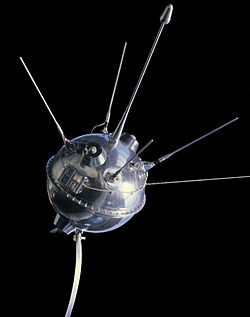
Soviet Luna 1 was intended to impact the Moon but instead became the first spacecraft to reach escape velocity and fly past it, entering an orbit around the Sun. It confirmed the Moon has no significant magnetic field and discovered the solar wind.
Image source: Luna 1
Sep 13, 1959
% complete
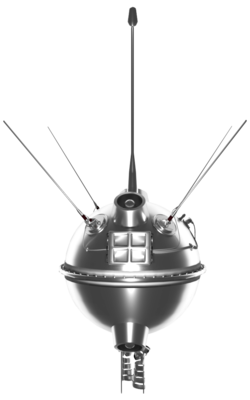
Luna 2 impacted the Moon east of the Sea of Serenity, becoming the first human-made object to reach another celestial body. The mission demonstrated Soviet leadership in lunar exploration and carried Soviet pennants to the lunar surface.
Image source: Luna 2
Oct 7, 1959
% complete
Luna 3 swung around the Moon and transmitted the first-ever images of its far side, which is never visible from Earth. The grainy photographs revealed terrain strikingly different from the near side and were a major propaganda triumph for the USSR.
Image source: Luna 3
Apr 12, 1961
% complete
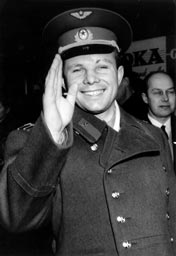
Soviet cosmonaut Yuri Gagarin completed one orbit of Earth aboard Vostok 1, becoming the first human in space. His 108-minute flight made him an international celebrity and dealt a stunning blow to American prestige, intensifying the Space Race dramatically.
Image source: Vostok 1
Jun 16, 1963 - Jun 19, 1963
% complete
Soviet cosmonaut Valentina Tereshkova flew aboard Vostok 6, spending nearly three days in space and completing 48 orbits. She remains the only woman to have flown a solo space mission, and her flight was another Soviet first in the ongoing competition.
Image source: Valentina Tereshkova
Mar 18, 1965
% complete
Alexei Leonov exited Voskhod 2 and spent about 12 minutes floating free in space tethered to his spacecraft, performing humanity's first extravehicular activity. His spacesuit ballooned in the vacuum, making reentry through the airlock dangerously difficult but ultimately successful.
Image source: Voskhod 2
Apr 24, 1967
% complete
Soyuz 1 suffered multiple malfunctions in orbit, and Vladimir Komarov died when his parachute failed during reentry, making him the first spaceflight fatality. The disaster grounded the Soviet crewed program for 18 months and exposed serious quality-control problems in the Soviet lunar effort.
Image source: Soyuz 1
Sep 24, 1970
% complete
After losing the crewed Moon race, the Soviet Union pivoted to robotic exploration. Luna 16 drilled into the lunar surface, collected about 100 grams of soil, and returned it to Earth automatically — the first successful robotic sample return, achieved without any human presence.
Image source: Luna 16
Nov 17, 1970 - Oct 4, 1971
% complete
Luna 17 delivered Lunokhod 1, the first remote-controlled rover to operate on another world. Over ten months it traveled more than six miles across the lunar surface, taking thousands of photographs and analyzing soil, pioneering the robotic exploration techniques used today on Mars.
Image source: Lunokhod 1
Jan 31, 1958
% complete
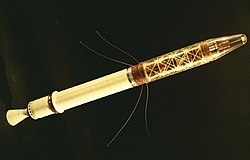
Explorer 1 became the first American satellite to reach orbit, launched on a Jupiter-C rocket developed by Wernher von Braun's team. Its instruments discovered the Van Allen radiation belts surrounding Earth, the first major scientific discovery of the Space Age.
Image source: Explorer 1
Oct 1, 1958
% complete
In response to Sputnik, President Eisenhower signed the National Aeronautics and Space Act establishing NASA, a civilian agency charged with conducting the nation's space program. NASA absorbed earlier efforts like Project Vanguard and NACA, consolidating American space exploration under one organization.
Image source: NASA
May 5, 1961
% complete
Alan Shepard became the first American in space aboard Freedom 7, completing a 15-minute suborbital flight. Though shorter than Gagarin's orbital mission, it restored some American confidence and demonstrated the Mercury program could safely carry astronauts.
Image source: Mercury-Redstone 3
May 25, 1961
% complete
Before a joint session of Congress, President John F. Kennedy declared the national goal of landing a man on the Moon and returning him safely before the decade's end. This bold commitment transformed the Space Race and mobilized billions of dollars and hundreds of thousands of workers toward Apollo.
Image source: Apollo program
Feb 20, 1962
% complete
John Glenn became the first American to orbit Earth, completing three orbits aboard Friendship 7. His flight matched Gagarin's achievement for the United States and made Glenn a national hero, though a faulty heat shield indicator caused tense moments during reentry.
Image source: Mercury-Atlas 6
Jul 10, 1962
% complete
AT&T's Telstar 1 became the first active communications satellite, relaying live television pictures, telephone calls, and data between the United States and Europe. It demonstrated the practical commercial potential of space technology beyond military and prestige applications.
Image source: Telstar
Mar 23, 1965 - Nov 11, 1966
% complete
Project Gemini bridged Mercury and Apollo, flying ten crewed missions that perfected rendezvous, docking, long-duration flight, and spacewalking techniques essential for lunar missions. Ed White performed America's first spacewalk during Gemini 4, answering Leonov's feat.
Image source: Project Gemini
Jan 27, 1967
% complete
A flash fire broke out in the Apollo 1 command module during a ground test at Cape Kennedy, killing Gus Grissom, Ed White, and Roger Chaffee. The tragedy forced a sweeping redesign of the Apollo spacecraft and delayed the program, but led to safety improvements that enabled later success.
Image source: Apollo 1
Dec 21, 1968 - Dec 27, 1968
% complete
Frank Borman, Jim Lovell, and Bill Anders became the first humans to leave Earth's gravity and orbit the Moon, circling it ten times. On Christmas Eve they broadcast live readings from Genesis while photographing Earthrise, an image that became iconic for the environmental movement.
Image source: Apollo 8
Jul 20, 1969
% complete
Neil Armstrong and Buzz Aldrin landed the Eagle lunar module in the Sea of Tranquility while Michael Collins orbited above. Armstrong's 'one small step' fulfilled Kennedy's goal, won the Space Race for the United States, and was watched by an estimated 600 million people worldwide.
Image source: Apollo 11
Nov 19, 1969
% complete
Pete Conrad and Alan Bean landed Intrepid within walking distance of the Surveyor 3 probe, demonstrating pinpoint landing capability. They retrieved parts of Surveyor for analysis and conducted two moonwalks deploying scientific instruments, proving Apollo missions could target specific sites.
Image source: Apollo 12
Apr 11, 1970 - Apr 17, 1970
% complete
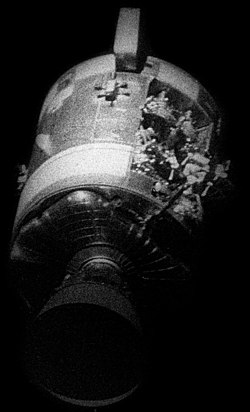
An oxygen tank explosion crippled Apollo 53 hours into its flight, forcing the crew to abandon their lunar landing. Using the lunar module as a lifeboat, Jim Lovell, Jack Swigert, and Fred Haise limped home safely in a dramatic rescue that showcased NASA's problem-solving under pressure.
Image source: Apollo 13
Jul 15, 1975 - Jul 24, 1975
% complete
An American Apollo module docked with a Soviet Soyuz in orbit, and the crews exchanged gifts and conducted joint experiments. The first international human spaceflight marked a symbolic end to the Space Race and established the groundwork for future cooperation like Shuttle-Mir and the ISS.
Image source: Apollo–Soyuz
Apr 12, 1981 - Apr 14, 1981
% complete
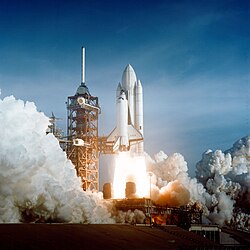
Exactly twenty years after Gagarin's flight, John Young and Robert Crippen piloted Columbia on STS-1, the maiden voyage of the reusable Space Shuttle. The shuttle era transformed access to space, enabling satellite deployment, Hubble servicing, and construction of the International Space Station.
Image source: STS-1
Nov 20, 1998
% complete
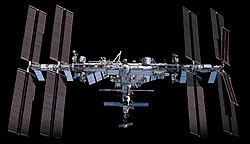
Russia launched Zarya, the first module of the International Space Station, followed weeks later by America's Unity node. The station united former Space Race rivals alongside European, Japanese, and Canadian partners in continuous human habitation of low Earth orbit since November 2000.
Image source: International Space Station
Or browse the full history timeline directory, with more than 2,000 topics.
This Space Race timeline was generated with the help of AI, using information found on the internet.
We work hard to keep these timelines accurate, but mistakes do get through. If you spot one, email us at [email protected] and we'll fix it for future visitors.
Generate yours with AI or build it from scratch, for free.
Export your timeline, add your own events, edit or remove AI-generated events, and much more
No credit card required.
Cancel anytime.
Cancel anytime.
You can create an unlimited number of timelines with up to 10 events on each one, customize how they look, export them to PDF, PNG, PowerPoint, CSV, and Excel, and share them with a link. Paid plans raise the event limit and add features like spreadsheet imports and collaborators.
Yes. You can cancel your subscription from your account page at any time, and you will not be charged again. Your subscription stays active for the rest of the period you already paid for.
Yes. We will email you a reminder before the annual renewal, and we will also email you a receipt.
Yes. You can email us within 15 days of any payment, and we will issue you a full refund.
Check out our pricing docs or send us an email anytime: [email protected].