-
Use Cases
-
Resources
-
Pricing
The RMS Titanic was a British passenger liner, the largest ship of its time, operated by the White Star Line. On its maiden voyage from Southampton to New York City, it struck an iceberg on April 14, 1912, and sank in the early hours of April 15, resulting in over 1,500 deaths. The disaster led to major changes in maritime safety regulations. More Less
1907
% complete
The three Olympic-class ships had their genesis in a discussion in mid-1907 between White Star Line chairman J. Bruce Ismay and Lord Pirrie. Olympic and Titanic were intended to replace RMS Teutonic of 1889, RMS Majestic of 1890, and RMS Adriatic of 1907.
Image source: Olympic-class ocean liner
1907
% complete
Since its founding in 1845, most of White Star Line's operations had taken place from Liverpool. In 1907, however, the company established a new service from Southampton on England's south coast, which became known as White Star's 'Express Service'.
Image source: White Star Line
Jul 29, 1908
% complete
On 29 July 1908, Harland and Wolff presented the drawings to J. Bruce Ismay and other White Star Line executives. The Belfast shipbuilder had a long-established relationship with the White Star Line dating back to 1867.
Image source: Titanic
Dec 16, 1908
% complete
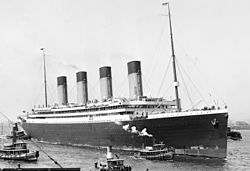
The construction of Olympic and Titanic took place virtually in parallel at Harland & Wolff in Belfast, with Olympic's keel laid down first on 16 December 1908.
Image source: RMS Olympic
Mar 31, 1909
% complete
Titanic's keel was laid down on 31 March 1909 at Harland & Wolff's shipyard in Belfast, beginning her construction alongside her sister ship Olympic.
1911
% complete
The deep-water dock at Southampton, then known as the 'White Star Dock', had been specially constructed to accommodate the new Olympic-class liners, and opened in 1911.
May 31, 1911
% complete
Titanic was launched at 12:15 pm on 31 May 1911 in the presence of Lord Pirrie, J. Bruce Ismay, and other dignitaries, sliding into the water at the Harland & Wolff yard in Belfast.
Jun 1911
% complete
When the Olympic entered service in June 1911, the ship replaced Teutonic, which after completing a last run on the service in late April was transferred to the Dominion Line's Canadian service.
Sep 1911
% complete
Work on Titanic took longer than expected due to design changes requested by Ismay and a temporary pause occasioned by the need to repair Olympic, which had been in a collision in September 1911.
Jan 1912
% complete
In January 1912, the hulls and equipment of Titanic and Olympic were insured through Lloyd's of London and London Marine Insurance ahead of Titanic's maiden voyage.
Feb 3, 1912
% complete
On 3 February 1912, Titanic was pulled into Thompson Graving Dock in Belfast for final fitting out work.
Mar 6, 1912
% complete
On 6 March 1912, Titanic was moved out of Thompson Graving Dock again to allow Olympic in, as Olympic had lost a propeller blade.
1912
% complete
The United States government passed the Radio Act of 1912 following the disaster. It required ships to maintain contact with vessels in their vicinity as well as coastal onshore radio stations, and it was agreed that rockets at sea would be interpreted as distress signals only.
Image source: Radio Act of 1912
May 1912
% complete
In mid-May 1912, RMS Oceanic recovered three bodies over 200 miles (320 km) from the site of the sinking who were among the original occupants of Collapsible A.
Image source: RMS Oceanic
Jun 18, 1912
% complete
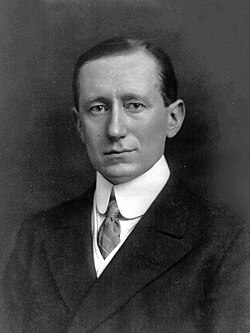
On 18 June 1912, Guglielmo Marconi gave evidence to the Court of Inquiry regarding wireless telegraphy aboard Titanic.
Image source: Guglielmo Marconi
Aug 1912
% complete
In August 1912, the liner Corsican struck an iceberg in the Atlantic, severely damaging her bow, underscoring the ongoing iceberg danger that had doomed Titanic.
Image source: Allan Line
1913
% complete
Following the Titanic disaster, the International Ice Patrol was established to monitor iceberg danger in the North Atlantic. Except for the years of the two World Wars, it has worked each season since 1913.
Image source: International Ice Patrol
1914
% complete
Claims against White Star totalled $16,804,112 (equivalent to $560,619,943 in 2025). Because the bulk of the litigants were in the United States, White Star petitioned the United States Supreme Court in 1914, which ruled in its favour that it qualified as a limited liability company and found the causes of the sinking largely unforeseeable rather than due to negligence.
1914
% complete
Many recommendations from the inquiries into the disaster were incorporated into the International Convention for the Safety of Life at Sea passed in 1914. The convention has since been updated by periodic amendments, with a completely new version adopted in 1974.
Image source: SOLAS Convention
May 8, 1914
% complete
In Britain, new 'Rules for Life Saving Appliances' were passed by the Board of Trade on 8 May 1914 and then applied at a meeting of British steamship companies in Liverpool in June 1914.
Image source: Lifeboat (shipboard)
Dec 1915
% complete
The settlement was agreed to by 44 of the claimants in December 1915, with $500,000 ($17 million today) set aside for the American claimants, $50,000 ($2 million today) for the British, and $114,000 ($4 million today) towards interest and legal expenses.
1912
% complete
A national coal strike in the UK caused considerable disruption to shipping schedules in the spring of 1912, causing many crossings to be cancelled before Titanic's maiden voyage.
Apr 2, 1912
% complete
Titanic's sea trials began at 6 am on Tuesday, 2 April 1912, two days after the fitting out was finished and eight days before departure from Southampton on the maiden voyage.
Image source: Sea trial
Apr 10, 1912
% complete
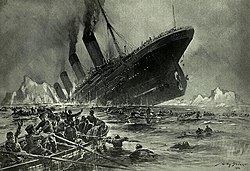
Titanic's maiden voyage began on Wednesday, 10 April 1912, from Southampton, England, bound for New York City. She carried passengers, mail, regular cargo ranging from furniture to foodstuffs, and a 1912 Renault Type CE Coupe de Ville motor car.
Image source: Sinking of the Titanic
Apr 14, 1912
% complete
On the night of 14 April 1912, Titanic struck an iceberg in the North Atlantic during her maiden voyage from Southampton to New York City, fatally damaging her hull.
Apr 15, 1912
% complete
In the early hours of 15 April 1912, Titanic sank after striking an iceberg. Her lifeboats were lowered into the North Atlantic from the boat deck. It was long believed she sank in one piece, but the 1985 discovery of the wreck revealed that the ship had broken in two.
1955
% complete
Several survivors wrote books about their experiences, but it was not until 1955 that the first historically accurate book – A Night to Remember – was published. The British film adaptation released in 1958 is still widely regarded as the most historically accurate movie portrayal of the sinking.
Image source: A Night to Remember (book)
Sep 1, 1985
% complete
A number of expeditions were mounted to find Titanic, but it was not until 1 September 1985 that a Franco-American expedition led by Jean-Louis Michel and Robert Ballard succeeded, revealing that the ship had broken in two as she sank.
Image source: Wreck of the Titanic
1995
% complete
Despite over 1,600 ships being built by Harland and Wolff in Belfast Harbour, Queen's Island became rebranded after its most famous ship as Titanic Quarter in 1995.
Image source: Titanic Quarter
1997
% complete
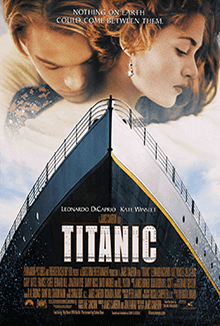
James Cameron's Titanic (1997) became the highest-grossing film in history up to that time and won 11 Oscars at the 70th Academy Awards, including Best Picture and Best Director. During filming, his replica of the Grand Staircase was ripped from its foundations by the force of inrushing water on the set.
Image source: Titanic (1997 film)
May 31, 2009
% complete
The last living survivor, Millvina Dean from England, who at only nine weeks old was the youngest passenger on board, died aged 97 on 31 May 2009.
Image source: Millvina Dean
2012
% complete
In 2012, the centenary of the sinking was marked by plays, radio programmes, parades, exhibitions and special trips to the site of the sinking, together with commemorative stamps and coins.
2012
% complete
On the ship's centenary in 2012, the Titanic Belfast visitor attraction opened on the site of the shipyard where Titanic was built. It became Northern Ireland's second most visited tourist attraction with almost 700,000 visitors in 2016.
Image source: Titanic Belfast
Apr 16, 2012
% complete
On 16 April 2012, the day after the 100th anniversary of the sinking, photos were released showing possible human remains resting on the ocean floor. Taken by Robert Ballard during a 2004 NOAA expedition, they show a boot and coat near the stern, called 'compelling evidence' of where somebody came to rest.
Nov 2016
% complete
A Chinese shipbuilding company, Wuchang Shipbuilding Industry Group Co., Ltd, commenced construction in November 2016 to build a full-scale replica of Titanic for use in a resort. As of 2022, however, it was reportedly only 25% complete, and its website and Twitter account are offline.
Image source: Romandisea Titanic
Oct 17, 2018
% complete
In late August 2018, several groups vied for the right to purchase the 5,500 Titanic relics that were assets of the bankrupt Premier Exhibitions. The minimum bid for the 11 October 2018 auction was US$21.5 million, and on 17 October 2018 The New York Times reported that a consortium of three hedge funds—Apollo Global Management, Alta Fundamental Advisers, and PacBridge Capital Partners—had paid US$19.5 million for the collection.
Image source: Premier Exhibitions
Jul 29, 2019 - Aug 4, 2019
% complete
Between 29 July and 4 August 2019, a two-person submersible vehicle conducting research and filming a documentary crashed into the wreck. Submersible dives in 2019 also found further deterioration of the wreck, including loss of the captain's bathtub.
May 2023
% complete
In May 2023, Magellan Ltd., a deep-water seabed-mapping company, announced it had created a 'digital twin' of the Titanic, showing the wreckage in unprecedented detail. The model was created from some 715,000 3D images captured over a six-week expedition in summer 2022 using two submersibles named Romeo and Juliet.
Jun 18, 2023
% complete
On 18 June 2023, the submersible Titan, operated by OceanGate Expeditions, imploded in the North Atlantic Ocean off the coast of Newfoundland during an expedition to visit the Titanic wreck.
Image source: Titan submersible implosion
Or browse the full history timeline directory, with more than 2,000 topics.
This Titanic timeline was generated with the help of AI, using information found on the internet.
We work hard to keep these timelines accurate, but mistakes do get through. If you spot one, email us at [email protected] and we'll fix it for future visitors.
Generate yours with AI or build it from scratch, for free.
Export your timeline, add your own events, edit or remove AI-generated events, and much more
No credit card required.
Cancel anytime.
Cancel anytime.
You can create an unlimited number of timelines with up to 10 events on each one, customize how they look, export them to PDF, PNG, PowerPoint, CSV, and Excel, and share them with a link. Paid plans raise the event limit and add features like spreadsheet imports and collaborators.
Yes. You can cancel your subscription from your account page at any time, and you will not be charged again. Your subscription stays active for the rest of the period you already paid for.
Yes. We will email you a reminder before the annual renewal, and we will also email you a receipt.
Yes. You can email us within 15 days of any payment, and we will issue you a full refund.
Check out our pricing docs or send us an email anytime: [email protected].