-
Use Cases
-
Resources
-
Pricing
This timeline chronicles the life of Ulysses S. Grant, the 18th President of the United States and commanding general of the Union Army during the Civil War. It covers his humble beginnings in Ohio, his rise to military fame at Vicksburg and Appomattox, his two-term presidency focused on Reconstruction and civil rights, and his final years writing his celebrated memoirs. More Less
Apr 27, 1822
% complete
Hiram Ulysses Grant was born on April 27, 1822, in Point Pleasant, Ohio, the first of six children born to Jesse Root Grant and Hannah Simpson Grant. His family later moved to Georgetown, Ohio, where he spent his boyhood working in his father's tannery and on the family farm.
Image source: Ulysses S. Grant
Jul 1, 1839
% complete
Through his father's efforts, Grant secured an appointment to West Point. A clerical error registered him as 'Ulysses S. Grant,' a name he eventually adopted permanently, since his mother's maiden name was Simpson.
Image source: United States Military Academy
Jul 1, 1843
% complete
Grant graduated 21st out of 39 cadets in the Class of 1843. Though unremarkable academically, he excelled in horsemanship and was commissioned as a brevet second lieutenant in the 4th U.S. Infantry.
May 13, 1846 - Feb 2, 1848
% complete
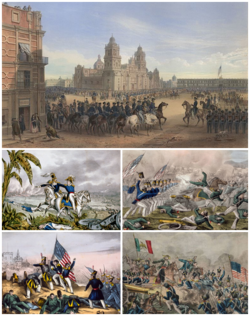
As a junior officer under Generals Zachary Taylor and Winfield Scott, Grant fought in major battles including Palo Alto, Resaca de la Palma, Monterrey, and Vera Cruz. The war provided invaluable combat experience that would shape his Civil War leadership, though he privately considered it an unjust conflict.
Image source: Mexican–American War
Aug 22, 1848
% complete
Grant married Julia Boggs Dent, the daughter of a Missouri slaveholding family, after a long courtship interrupted by the Mexican-American War. Their marriage endured for decades through hardship and produced four children.
Image source: Julia Grant
Apr 11, 1854
% complete
Stationed far from his family at Fort Humboldt, California, Grant resigned his commission in 1854, reportedly due to struggles with alcohol. He then faced years of failure as a farmer in Missouri and a real estate agent and clerk in St. Louis and Galena, Illinois.
Jun 17, 1861
% complete
After the outbreak of the Civil War, Grant helped recruit volunteers in Galena, Illinois. Governor Richard Yates appointed him colonel of the unruly 21st Illinois regiment, which he quickly whipped into disciplined shape, launching his remarkable wartime ascent.
Image source: 21st Illinois Infantry Regiment
Aug 7, 1861
% complete
With backing from Congressman Elihu Washburne, Grant was promoted to brigadier general of volunteers in August 1861. He took command of the District of Cairo, positioning himself at the strategic junction of the Ohio and Mississippi Rivers.
Image source: Brigadier general (United States)
Feb 6, 1862
% complete
In cooperation with Union gunboats under Flag Officer Andrew Foote, Grant captured Fort Henry on the Tennessee River, securing the first significant Union victory in the western theater and opening Tennessee to invasion.
Image source: Battle of Fort Henry
Feb 16, 1862
% complete
After intense fighting, Confederate General Simon Bolivar Buckner requested terms; Grant replied demanding 'unconditional and immediate surrender,' earning him the nickname 'Unconditional Surrender' Grant. Roughly 12,000 Confederates were captured, delivering a massive boost to Northern morale.
Image source: Battle of Fort Donelson
Apr 6, 1862 - Apr 7, 1862
% complete
Confederate forces under Albert Sidney Johnston launched a surprise attack on Grant's army near Pittsburg Landing, Tennessee. Despite nearly being driven into the river on the first day, Grant counterattacked on April 7 and won a costly victory with over 23,000 total casualties, the bloodiest battle in American history up to that time.
Image source: Battle of Shiloh
Mar 29, 1863 - Jul 4, 1863
% complete
Grant conducted one of the most brilliant campaigns of the war, running gunboats past Vicksburg's batteries, crossing the Mississippi south of the city, winning five victories in three weeks, and besieging Pemberton's army until its surrender on July 4, 1863, giving the Union control of the Mississippi River and splitting the Confederacy.
Image source: Vicksburg campaign
Nov 23, 1863 - Nov 25, 1863
% complete
Placed in overall command in the West, Grant relieved the besieged Union army at Chattanooga, driving Braxton Bragg's Confederates from Missionary Ridge and Lookout Mountain, opening the gateway to the Deep South and cementing his reputation as the North's premier general.
Image source: Chattanooga campaign
Mar 9, 1864
% complete
Reviving the rank last held by George Washington, Congress authorized the promotion and Lincoln appointed Grant General-in-Chief of all Union armies. Grant established headquarters with the Army of the Potomac and devised coordinated offensives against all Confederate forces simultaneously.
Image source: General-in-chief
May 5, 1864 - Jun 24, 1864
% complete
Grant waged relentless, grinding combat against Lee's Army of Northern Virginia through the Wilderness, Spotsylvania Court House, and Cold Harbor. Sustaining enormous casualties but refusing to retreat, he pinned Lee's army and set the stage for the siege of Petersburg, declaring he would 'fight it out on this line if it takes all summer.'
Image source: Overland Campaign
Jun 15, 1864 - Apr 2, 1865
% complete
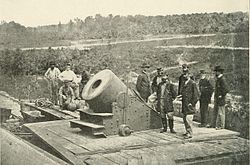
Grant's forces entrenched around Petersburg, Virginia, conducting trench warfare reminiscent of World War I while extending lines westward to cut Lee's supply routes. After nine months, the Union breakthrough in April 1865 forced Lee to abandon both Petersburg and Richmond.
Image source: Siege of Petersburg
Apr 9, 1865
% complete
At Appomattox Court House, Virginia, Grant accepted the surrender of Lee's Army of Northern Virginia. His generous terms—allowing paroled soldiers to keep horses and go home—set a conciliatory tone for reunion, effectively ending the American Civil War.
Image source: Battle of Appomattox Court House
Nov 3, 1868
% complete
Running under the banner 'Let Us Have Peace,' Grant defeated Democrat Horatio Seymour in the 1868 election, winning the popular vote by about 300,000 votes thanks largely to the votes of newly enfranchised Black men in the South.
Image source: 1868 United States presidential election
Mar 4, 1869
% complete
Grant was inaugurated on March 4, 1869, becoming the youngest president elected to that point at age 46. He pledged to pursue peace, honorably settle sectional questions, and protect civil rights during Reconstruction.
Image source: First inauguration of Ulysses S. Grant
Feb 3, 1870
% complete
The Fifteenth Amendment prohibited denying the vote based on race, color, or previous condition of servitude. Grant championed ratification, calling it 'the greatest civil event' of the century, though enforcement proved uneven across the South.
Image source: Fifteenth Amendment to the United States Constitution
May 31, 1870 - Apr 20, 1871
% complete
Grant signed a series of Enforcement Acts empowering the federal government to suppress white supremacist terrorism in the South. In October 1871, he suspended habeas corpus in parts of South Carolina and sent federal troops, crushing the original Klan's power.
Jul 1, 1870
% complete
Congress created the Department of Justice at Grant's urging to centralize federal law enforcement, enabling more vigorous prosecution of Ku Klux Klan violence and enforcement of Reconstruction laws.
Image source: United States Department of Justice
Mar 1, 1872
% complete
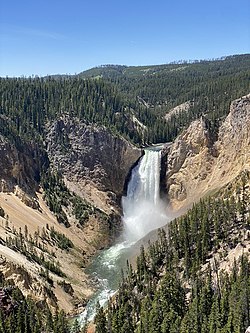
Grant signed the act establishing Yellowstone National Park, setting aside over two million acres in Wyoming and Montana territories for public enjoyment—a landmark achievement in conservation history.
Image source: Yellowstone National Park
Nov 5, 1872
% complete
Grant won re-election in a landslide over Liberal Republican nominee Horace Greeley, carrying 31 states and over 55 percent of the popular vote, aided by continued support from Black voters and the fractured opposition.
Image source: 1872 United States presidential election
Sep 18, 1873
% complete
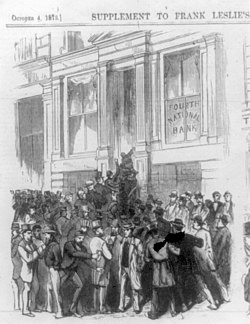
The failure of banking house Jay Cooke & Company sparked a financial panic that plunged the nation into the Long Depression. Grant's response, including vetoing an inflationary currency bill in 1874, was praised by conservatives but drew criticism from debtors and farmers suffering through years of hardship.
Image source: Panic of 1873
May 10, 1875
% complete
Treasury officials and distillers were exposed for defrauding the government of millions in liquor tax revenue. Grant moved decisively to prosecute the conspirators, famously saying 'Let no guilty man escape,' but the scandal deepened perceptions of corruption surrounding his administration.
Image source: Whiskey Ring
Mar 4, 1877
% complete
Grant left office after two terms, having achieved successes in foreign policy, civil rights enforcement, and conservation, but burdened by scandals among subordinates. He departed on a celebrated world tour that began later that year.
Image source: Presidency of Ulysses S. Grant
May 17, 1877 - Sep 19, 1879
% complete
Grant and Julia traveled extensively through Europe, the Middle East, and Asia, meeting Queen Victoria, Emperor Meiji, and other heads of state. The tour restored his popularity at home and made him an international celebrity.
Image source: World tour of Ulysses S. Grant
Jul 23, 1885
% complete
Grant died of throat cancer at age 63 at Mount McGregor, New York, having just completed his memoirs. His state funeral procession in New York City stretched seven miles and was attended by hundreds of thousands of mourners, including former Confederate generals, honoring the man who had reunited the nation.
Image source: Death and state funeral of Ulysses S. Grant
Dec 1885
% complete
Facing bankruptcy from the collapse of Grant & Ward and terminal cancer, Grant wrote his memoirs with encouragement from Mark Twain's publisher Charles L. Webster. Completed days before his death, the memoirs sold spectacularly and are considered among the finest military autobiographies ever written.
Image source: Personal Memoirs of U. S. Grant
Or browse the full history timeline directory, with more than 2,000 topics.
This Ulysses S. Grant timeline was generated with the help of AI, using information found on the internet.
We work hard to keep these timelines accurate, but mistakes do get through. If you spot one, email us at [email protected] and we'll fix it for future visitors.
Generate yours with AI or build it from scratch, for free.
Export your timeline, add your own events, edit or remove AI-generated events, and much more
No credit card required.
Cancel anytime.
Cancel anytime.
You can create an unlimited number of timelines with up to 10 events on each one, customize how they look, export them to PDF, PNG, PowerPoint, CSV, and Excel, and share them with a link. Paid plans raise the event limit and add features like spreadsheet imports and collaborators.
Yes. You can cancel your subscription from your account page at any time, and you will not be charged again. Your subscription stays active for the rest of the period you already paid for.
Yes. We will email you a reminder before the annual renewal, and we will also email you a receipt.
Yes. You can email us within 15 days of any payment, and we will issue you a full refund.
Check out our pricing docs or send us an email anytime: [email protected].