-
Use Cases
-
Resources
-
Pricing
The War in Afghanistan was a prolonged armed conflict that began in October 2001, when a U.S.-led coalition invaded Afghanistan to dismantle al-Qaeda and remove the Taliban from power following the September 11 attacks. The war evolved into a two-decade-long counterinsurgency involving NATO forces, Afghan government troops, and Taliban fighters, ending with the U.S. withdrawal in August 2021 and the Taliban's recapture of Kabul. More Less
Apr 27, 1978
% complete
The People's Democratic Party of Afghanistan, backed by military officers, overthrew President Mohammed Daoud Khan in a coup known as the Saur Revolution. The new communist government under Nur Muhammad Taraki launched sweeping secular reforms, provoking resistance from rural and religious communities across the country.
Image source: Saur Revolution
Mar 1979
% complete
A major anti-communist uprising erupted in the western city of Herat, with rebels killing government officials and Soviet advisors before being suppressed by regime forces with heavy casualties, foreshadowing widespread rebellion.
Image source: 1979 Herat uprising
Jul 3, 1979
% complete
The CIA's Operation Cyclone funneled billions of dollars in weapons and funding, largely through Pakistan, to the mujahideen fighting the Soviet occupation, becoming one of the longest covert operations in US history.
Image source: Operation Cyclone
Dec 24, 1979
% complete
The Soviet Union deployed thousands of troops into Afghanistan to prop up its faltering communist ally, overthrowing Hafizullah Amin and installing Babrak Karmal as leader, beginning a decade-long war.
Image source: Soviet–Afghan War
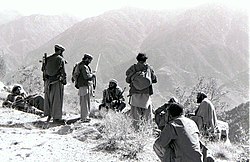
Dec 27, 1979
% complete
Soviet special forces stormed the Tajbeg Palace in Kabul, assassinating President Hafizullah Amin and installing Babrak Karmal as the new head of the Afghan government.
Image source: Operation Storm-333
Mar 21, 1980
% complete
In protest of the Soviet invasion of Afghanistan, the United States led a boycott of the 1980 Summer Olympics in Moscow, joined by more than 60 other countries.
Image source: 1980 Summer Olympics boycott
Sep 1981
% complete
Mujahideen forces besieged the strategic southern city of Kandahar, one of the largest urban battles of the war, demonstrating the growing strength of the insurgency.
Image source: Arghun dynasty
Apr 14, 1988 - May 15, 1988
% complete
Afghanistan and Pakistan signed the Geneva Accords under UN auspices, guaranteeing non-interference and setting a timetable for the withdrawal of Soviet troops, which began in May 1988.
May 15, 1988 - Feb 15, 1989
% complete
The last Soviet soldiers crossed the Friendship Bridge out of Afghanistan on February 15, 1989, ending nearly a decade of costly occupation that killed over a million Afghans.
Image source: Soviet withdrawal from Afghanistan
Jan 1, 1992 - Dec 31, 1996
% complete
Rival militia factions, particularly those of Gulbuddin Hekmatyar and Ahmad Shah Massoud, fought devastating artillery duels for control of Kabul, killing tens of thousands of civilians.
Image source: Battle of Kabul (1992–1996)
Apr 1992
% complete
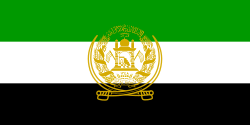
The Soviet-backed government of Mohammad Najibullah collapsed as mujahideen forces closed in on Kabul, and the Islamic State of Afghanistan was proclaimed under interim leader Sibghatullah Mojaddedi.
Image source: Islamic State of Afghanistan
Apr 24, 1992
% complete
Mujahideen factions signed the Peshawar Accord to establish a transitional power-sharing state, but rivalries between commanders soon descended into civil war.
Image source: Peshawar Accord
Nov 3, 1994
% complete
The Taliban, a movement of religious students emerging from southern Afghanistan, captured Kandahar, marking their rise as a major military force promising order amid lawlessness.
Image source: Taliban
Sep 5, 1995
% complete
Taliban forces seized the key western city of Herat from Ismail Khan's forces after months of fighting, expanding their control across much of Afghanistan.
Image source: Herat
Sep 27, 1996
% complete
The Taliban captured Kabul, ousted the Rabbani government, publicly executed former president Najibullah, and imposed strict Sharia rule including bans on education and employment for women.
Image source: Fall of Kabul (2001)
Oct 9, 1996
% complete
Opposing factions united as the United Islamic Front, commonly known as the Northern Alliance, holding northern Afghanistan against Taliban advances throughout the late 1990s.
Image source: Northern Alliance
Aug 7, 1998
% complete
Al-Qaeda, sheltering in Afghanistan under Taliban protection, bombed US embassies in Kenya and Tanzania, leading the US to launch cruise missile strikes on training camps in Afghanistan.
Image source: 1998 United States embassy bombings
Oct 15, 1999
% complete
UN Security Council Resolution 1267 imposed sanctions on the Taliban for harboring al-Qaeda leader Osama bin Laden, demanding his extradition.
Image source: United Nations Security Council Resolution 1267
Mar 2001
% complete
The Taliban dynamited the monumental sixth-century Bamiyan Buddha statues, drawing international condemnation and symbolizing the regime's cultural intolerance.
Image source: Buddhas of Bamiyan
Sep 9, 2001
% complete
Two al-Qaeda operatives posing as journalists assassinated Northern Alliance commander Ahmad Shah Massoud at Khwaja Bahauddin, removing the Taliban's most formidable opponent two days before the September 11 attacks.
Image source: Ahmad Shah Massoud
Sep 11, 2001
% complete
Al-Qaeda hijackers attacked New York and Washington, DC, killing nearly 3,000 people. The attacks, traced back to bin Laden in Afghanistan, triggered the US-led intervention.
Image source: September 11 attacks
Oct 7, 2001
% complete
The United States and Britain launched air strikes and special operations against Taliban and al-Qaeda targets in Afghanistan after the Taliban refused to hand over Osama bin Laden.
Image source: Operation Enduring Freedom
Nov 9, 2001
% complete
Northern Alliance forces backed by US airstrikes captured Mazar-i-Sharif, the first major city to fall, opening supply lines into northern Afghanistan.
Image source: Fall of Mazar-i-Sharif
Nov 13, 2001
% complete
Taliban forces abandoned Kabul without a fight, allowing Northern Alliance troops to enter the capital and end five years of Taliban rule.
Dec 5, 2001
% complete
Afghan factions met in Bonn, Germany, and agreed on an interim administration under Hamid Karzai and a roadmap toward elections and constitutional government.
Image source: Bonn Agreement (Afghanistan)
Dec 12, 2001 - Dec 17, 2001
% complete
US and allied Afghan forces attacked the Tora Bora cave complex where bin Laden was believed to be hiding, but he escaped across the border into Pakistan.
Image source: Battle of Tora Bora
Dec 22, 2001
% complete
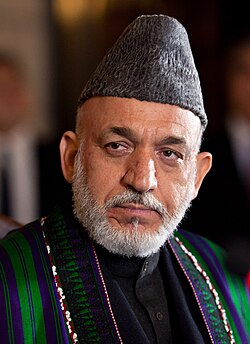
Hamid Karzai was inaugurated as chairman of the Afghan Interim Administration in Kabul, beginning more than a decade of leadership of the country.
Image source: Hamid Karzai
Aug 11, 2003
% complete
NATO assumed command of the International Security Assistance Force, which had been established by UN mandate in December 2001 to provide security in and around Kabul.
Image source: International Security Assistance Force
Jan 26, 2004
% complete
Afghanistan adopted a new constitution establishing an Islamic republic with a strong presidential system, enshrining equal rights for men and women on paper.
Image source: Politics of Afghanistan
Oct 9, 2004 - Oct 10, 2004
% complete
Afghans voted in the country's first direct presidential election, overwhelmingly electing Hamid Karzai with about 55 percent of the vote despite security concerns and technical irregularities.
Feb 13, 2010 - Feb 25, 2010
% complete
US, British, and Afghan troops launched the largest operation since 2001 to clear the Taliban stronghold of Marjah in Helmand province, aiming to restore government authority.
May 2, 2011
% complete
US Navy SEALs killed al-Qaeda leader Osama bin Laden during a raid on his compound in Abbottabad, Pakistan, where he had been hiding for years after fleeing Afghanistan.
Image source: Killing of Osama bin Laden
Sep 29, 2014
% complete
Following a disputed election and a power-sharing deal brokered by the US, Ashraf Ghani was inaugurated as president with Abdullah Abdullah appointed chief executive officer.
Image source: 2014 Afghan presidential election
Dec 28, 2014
% complete
The NATO combat mission formally concluded, transitioning to the Resolute Support training and advisory mission while Afghan forces took primary responsibility for security.
Image source: Resolute Support Mission
Sep 28, 2015 - Oct 13, 2015
% complete
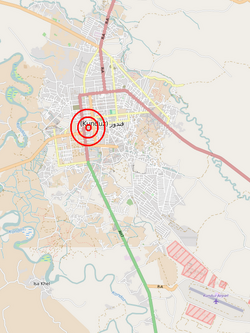
Taliban fighters seized the major northern city of Kunduz, the first provincial capital to fall to them since 2001, before being driven out by Afghan forces weeks later.
Image source: Battle of Kunduz (2015)
Oct 3, 2015
% complete
A US airstrike hit a Doctors Without Borders trauma center in Kunduz, killing at least 42 people and prompting international outrage and investigations.
Image source: Kunduz hospital airstrike
Sep 28, 2019 - Feb 18, 2020
% complete
President Ashraf Ghani narrowly won re-election according to final results announced in February 2020, though Abdullah Abdullah also claimed victory, deepening political division.
Image source: 2019 Afghan presidential election
Feb 29, 2020
% complete
The United States signed an agreement with the Taliban in Doha providing for a full American troop withdrawal by May 2021 in exchange for Taliban counterterrorism assurances and talks with the Afghan government.
Sep 12, 2020
% complete
Representatives of the Afghan government and the Taliban began historic face-to-face negotiations in Doha, Qatar, though violence continued and little progress was made.
Image source: 2020–2021 US troop withdrawal from Afghanistan
May 1, 2021 - Aug 30, 2021
% complete
President Joe Biden set a deadline of August 31, 2021, and the final US-led military withdrawal began on May 1, accelerating the collapse of Afghan government forces.
Image source: 2020–2021 U.S. troop withdrawal from Afghanistan
Aug 6, 2021 - Aug 15, 2021
% complete
In a rapid summer campaign, the Taliban seized most provincial capitals within days as demoralized Afghan forces surrendered or fled, encircling Kabul with little organized resistance.
Image source: 2021 Taliban offensive
Aug 14, 2021 - Aug 30, 2021
% complete
Amid chaotic scenes at Hamid Karzai International Airport, including a deadly suicide bombing on August 26 that killed 183 people, Western nations evacuated over 120,000 people before the last US aircraft departed on August 30, 2021.
Image source: 2021 Kabul airlift
Aug 15, 2021
% complete
Taliban fighters entered Kabul unopposed as President Ashraf Ghani fled abroad, ending the twenty-year war and restoring the Islamic Emirate of Afghanistan.
Image source: Fall of Kabul (2021)
Or browse the full history timeline directory, with more than 2,000 topics.
This War in Afghanistan timeline was generated with the help of AI, using information found on the internet.
We work hard to keep these timelines accurate, but mistakes do get through. If you spot one, email us at [email protected] and we'll fix it for future visitors.
Generate yours with AI or build it from scratch, for free.
Export your timeline, add your own events, edit or remove AI-generated events, and much more
No credit card required.
Cancel anytime.
Cancel anytime.
You can create an unlimited number of timelines with up to 10 events on each one, customize how they look, export them to PDF, PNG, PowerPoint, CSV, and Excel, and share them with a link. Paid plans raise the event limit and add features like spreadsheet imports and collaborators.
Yes. You can cancel your subscription from your account page at any time, and you will not be charged again. Your subscription stays active for the rest of the period you already paid for.
Yes. We will email you a reminder before the annual renewal, and we will also email you a receipt.
Yes. You can email us within 15 days of any payment, and we will issue you a full refund.
Check out our pricing docs or send us an email anytime: [email protected].