
-
Use Cases
-
Resources
-
Pricing
The Anglo-Zulu War was fought in 1879 between the British Empire and the Zulu Kingdom in southern Africa. Sparked by British imperial ambitions under High Commissioner Sir Bartle Frere, the war saw the Zulu army achieve a stunning victory at Isandlwana before ultimately being defeated by superior British firepower and organization. The war ended with the capture of King Cetshwayo and the dismantling of the independent Zulu Kingdom. More Less
1825
% complete
Shaka Zulu, the first Zulu king, had through war and conquest built the small Zulu tribe into the Zulu Kingdom, which by 1825 encompassed an area of around 11,500 square miles (30,000 km2).
Image source: Shaka
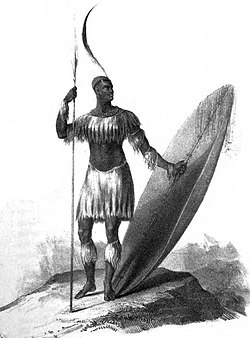
1828
% complete
In 1828 Shaka was assassinated at Dukuza by one of his inDunas and two of his half-brothers, one of whom, Dingane kaSenzangakhona, succeeded him as king.
Dec 16, 1838
% complete
Dingane suffered a crushing defeat on 16 December 1838, when he attacked a group of 470 Voortrekker settlers led by Pretorius at the Battle of Blood River.
Image source: Battle of Blood River
1839
% complete
In 1839, the Boer Voortrekkers, under Pretorius, formed the Boer Republic of Natalia, south of the Tugela, and west of the British settlement of Port Natal (now Durban).
Image source: Natalia Republic
1842
% complete
In 1842, war broke out between the British and the Boers, resulting in the British annexation of Natalia. Natal was claimed by the British as a colony on 4 May 1843.
Image source: Colony of Natal
1843
% complete
In 1843, Mpande ordered a purge of perceived dissidents within his kingdom.
1852
% complete
Mpande began raiding the surrounding areas, culminating in the invasion of Swaziland in 1852.
Image source: Mpande kaSenzangakhona
1856
% complete
This culminated in 1856 with the Battle of Ndondakusuka, which left Mbuyazi dead.
Image source: Battle of Ndondakusuka
1861
% complete
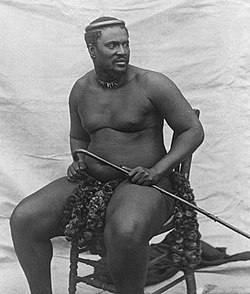
In 1861, Umtonga, another son of Mpande, fled to the Utrecht district, prompting Cetshwayo to assemble an army on the nearby frontier. The Boers complied on the condition that Umtonga's life was spared, and Mpande signed a deed transferring land to the Boers.
Image source: Cetshwayo
1865
% complete
When in 1865 Umtonga again fled from Zululand to Natal, Cetshwayo, fearing that the still living Umtonga might be used to supplant him, removed the beacon and claimed the land ceded by the Swazis to Lydenburg.
Image source: Anglo-Zulu War
1867
% complete
The discovery of diamonds in 1867 near the Vaal River, some 550 mi (890 km) northeast of Cape Town, ended the isolation of the Boers in the interior and had a significant effect on events.
1869
% complete
Questions were raised as to the validity of documents signed by the Zulus concerning the Utrecht strip; in 1869 the services of the lieutenant-governor of Natal, Robert William Keate, were accepted by both parties as arbitrator, but the attempt to settle disagreements proved unsuccessful.
1873
% complete
Such was the political background when Cetshwayo became absolute ruler of the Zulus upon his father's death in 1873. One grievance later cited was his apparent breaking of promises made to Theophilus Shepstone at the king's 'coronation' in 1872.
1873
% complete
Langalibalele had been falsely accused of rebellion in 1873 and, following a charade of a trial, was found guilty and imprisoned on Robben Island. In 1874 Bishop Colenso took up the cause of Langalibalele and the Hlubi and Ngwe tribes with Lord Carnarvon.
Image source: Langalibalele
1874
% complete
In 1874, Sir Bartle Frere was appointed as British High Commissioner for Southern Africa to effect plans, inspired by the British North America Act 1867, for a ruling white minority over a black majority in South Africa.
Image source: Henry Bartle Frere
1875
% complete
Lord Carnarvon, Secretary of State for the Colonies, who had brought about federation in Canada in 1867, thought a similar scheme might work in South Africa. In 1875 he approached the Orange Free State and the Transvaal Republic, but the Boer leaders turned him down.
1877
% complete
By 1877, Sir Theophilus Shepstone, the British Secretary for Native Affairs in Natal, annexed the Transvaal Republic for Britain using a special warrant. He also persuaded the Boers to give up their independence.
Image source: Theophilus Shepstone
Oct 1877
% complete
Earlier in October 1877, Shepstone attended a meeting with Zulu leaders near the Blood River to resolve the land dispute between the Zulus and the Boers. His paternal speeches failed to placate them, and they accused him of betraying them.
Dec 1877
% complete
In December 1877, Shepstone wrote to Carnarvon: 'Cetshwayo is the secret hope of every petty independent chief hundreds of miles from him who feels a desire that his colour shall prevail.'
Feb 1878
% complete
In February 1878 a commission was appointed by Henry Bulwer, the lieutenant-governor of Natal since 1875, to report on the boundary question.
Jul 1878
% complete
Following a commission inquiry on the border dispute which reported in favour of the Zulu nation in July 1878, Sir Henry Bartle Frere, acting on his own, added an ultimatum to the commission meeting, much to the surprise of the Zulu representatives.
Jul 28, 1878
% complete
On 28 July 1878 a party of Zulus under Mehlokazulu, chief son of Sihayo, seized a woman at the kraal where she had taken refuge and carried her back to Zululand, where she was put to death in accordance with Zulu law.
Oct 14, 1878
% complete
The first intimation to the British government of Frere's intention to make 'demands' on the Zulu was in a private letter to Hicks Beach written on 14 October 1878.
Nov 1878
% complete
Sir Michael Hicks Beach, who replaced Carnarvon as Secretary of State for the Colonies, wrote in November 1878 that matters in Eastern Europe and India wore so serious an aspect that Britain could not have a Zulu war in addition to other greater troubles.
Image source: Michael Hicks Beach, 1st Earl St Aldwyn
Dec 11, 1878
% complete
Frere sent a provocative ultimatum on 11 December 1878 to King Cetshwayo, delivered on the banks of the Thukela river at the Ultimatum Tree. It demanded the Zulu army be disbanded, acceptance of a British resident, and that missionaries be allowed to return to their stations.
Image source: Harold Johnson Nature Reserve
Jan 2, 1879
% complete
The full text of Frere's demands did not reach London until 2 January 1879, after the ultimatum had already been issued.
Jan 1879 - Jul 1879
% complete
The Anglo-Zulu War, or simply the Zulu War, was fought in present-day South Africa from January to early July 1879 between forces of the British Empire and the Zulu Kingdom.
Jan 11, 1879
% complete
Cetshwayo returned no answer to the demands of Bartle Frere, and in January 1879 a British force under Lieutenant General Frederic Thesiger, 2nd Baron Chelmsford invaded Zululand without authorization by the British Government. On 9 January they moved to Rorke's Drift, and early on 11 January commenced crossing the Buffalo River into Zululand.
1880
% complete
Together with famines, diplomatic misadventures, and other unpopular wars overseas (such as the Second Anglo-Afghan War), the Zulu War contributed to the ejection of Benjamin Disraeli's government from office in 1880, after only one term.
Image source: Benjamin Disraeli
1882
% complete
This arrangement led to much bloodshed and disturbance, and in 1882 the British government determined to restore Cetshwayo to power.
1883
% complete
Following the conclusion of the Anglo-Zulu War, Bishop Colenso interceded on behalf of Cetshwayo with the British government and succeeded in getting him released from Robben Island and returned to Zululand in 1883.
Jul 22, 1883
% complete
A collision very soon took place; Usibepu's forces were victorious, and on 22 July 1883, led by a troop of mounted Boer mercenary troops, he made a sudden descent upon Cetshwayo's kraal at Ulundi, destroying it and massacring many of its inhabitants.
Image source: Zibhebhu kaMaphitha
1887
% complete
The British Empire made the Zulu Kingdom a protectorate and later annexed it in 1887.
1964
% complete
Zulu (1964) depicts the Battle at Rorke's Drift. Colour Sergeant Frank Bourne (1854–1945), last survivor of Rorke's Drift, later became a Lieutenant-Colonel and OBE recipient.
Image source: Zulu (1964 film)
1979
% complete
1983
% complete
Monty Python's The Meaning of Life (1983) includes a chapter depicting a British officer trying to shave during the Battle at Rorke's Drift.
Image source: Monty Python's The Meaning of Life
Or browse the full history timeline directory, with more than 2,000 topics.
This Zulu War timeline was generated with the help of AI, using information found on the internet.
We work hard to keep these timelines accurate, but mistakes do get through. If you spot one, email us at [email protected] and we'll fix it for future visitors.
Generate yours with AI or build it from scratch, for free.
Export your timeline, add your own events, edit or remove AI-generated events, and much more
No credit card required.
Cancel anytime.
Cancel anytime.
You can create an unlimited number of timelines with up to 10 events on each one, customize how they look, export them to PDF, PNG, PowerPoint, CSV, and Excel, and share them with a link. Paid plans raise the event limit and add features like spreadsheet imports and collaborators.
Yes. You can cancel your subscription from your account page at any time, and you will not be charged again. Your subscription stays active for the rest of the period you already paid for.
Yes. We will email you a reminder before the annual renewal, and we will also email you a receipt.
Yes. You can email us within 15 days of any payment, and we will issue you a full refund.
Check out our pricing docs or send us an email anytime: [email protected].