-
Use Cases
-
Resources
-
Pricing
The Akkadian Empire, centered in the city of Akkad in Mesopotamia, was the first known multi-ethnic empire in world history. Founded by Sargon the Great around 2334 BCE, it united the Sumerian city-states under a single ruler and spread Akkadian language and culture across the Fertile Crescent before collapsing around 2154 BCE. More Less
2334 BC
% complete
The Akkadian Empire, or the Kingdom of Akkad/Agade, was established around 2334 BCE. It was the first empire in world history, succeeding the long-lived city-states of Sumer.
Image source: Akkadian Empire
2334 BC - 2279 BC
% complete
The empire reached its political peak between the 24th and 22nd centuries BC, following the conquests by its founder Sargon, who built the first true empire in world history.
Image source: Sargon of Akkad
2334 BC - 2154 BC
% complete
The Akkadian period is generally dated to 2334–2154 BC according to the middle chronology, while short-chronology dates of 2270–2083 BC are now considered less likely.
2300 BC
% complete
Sargon of Akkad (circa 2300 or 2250 BC) was the first Mesopotamian ruler to make an explicit reference to the region of Meluhha, generally understood as Balochistan or the Indus area, indicating expanding Indus-Mesopotamia relations.
Image source: Indo-Mesopotamia relations
2285 BC - 2250 BC
% complete
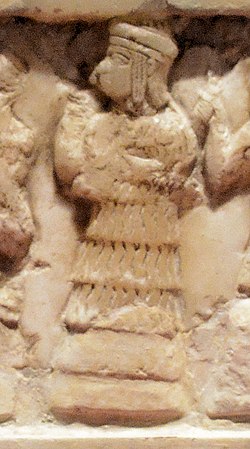
Enheduanna, wife (dam = high priestess) of Nanna the moon god and daughter of Sargon at the temple of Sin at Ur, lived c. 2285–2250 BC and is the first poet in history whose name is known.
Image source: Enheduanna
2334 BC - 2154 BC
% complete
Spanning roughly 180 years, from its founding around 2334 BCE to its fall around 2154 BC, the Akkadian Empire remains celebrated as the first empire in world history, succeeding the long-lived city-states of Sumer and shaping later Mesopotamian ideals of kingship.
2100 BC - 2000 BC
% complete
Composed in the Ur III period, a century or at most two after the events it describes, the text is essentially artistic propaganda concerning Naram-Sin.
2000 BC
% complete
Akkadian gradually replaced Sumerian as a spoken language somewhere around 2000 BC (the exact dating being debated), but Sumerian continued to be used as a sacred, ceremonial, literary, and scientific language in Mesopotamia until the 1st century AD.
Image source: Akkadian language
1958
% complete
The Me-sag Archive, which commenced publication in 1958, is considered one of the most significant collections for the study of the Akkadian period.
1976
% complete
In 1976, Pierre Amiet published his influential work on the art of Agadé held at the Louvre Museum, contributing to the scholarly study of the Akkadian Empire.
1997
% complete
In 1997, Joan Goodnick Westenholz published important scholarship on the royal inscriptions and cultural record of the Old Akkadian period.
Image source: Joan Goodnick Westenholz
1999
% complete
Aage Westenholz published scholarship in 1999 examining the Old Akkadian school of literature, advancing understanding of literary production under the empire.
Image source: Karen Blixen
2012
% complete
In 2012, Augusta McMahon published research contributing to archaeological understanding of the Akkadian period and its sites such as Tell Leilan.
Image source: Nippur
2017
% complete
In 2017, Bertrand Lafont published 'Akkad, l'empire charismatique (2330-2100)', a major contribution to the historiography of the Akkadian Empire.
Image source: Sumer
2019
% complete
In 2019, Melissa Eppihimer published scholarship exploring the enduring artistic and political legacy of the Akkadian Empire in later Mesopotamian tradition.
Image source: Abzu
2020
% complete
In 2020, Ingo Schrakamp published research addressing warfare and military organization during the Akkadian period.
Image source: Enakalle
2020
% complete
In 2020, Piotr Michalowski contributed new scholarly research on the history and administration of the Akkadian Empire.
Image source: Piotr Michałowski
2021
% complete
In 2021, Piotr Steinkeller published scholarship examining the economic structures and administrative practices of the Akkadian Empire.
Image source: Piotr Steinkeller
2278 BC - 2270 BC
% complete
Difficulties broke out during the nine-year reign of Rimush (2278–2270 BC), who fought hard to retain the empire through revolts and was successful until he was assassinated by some of his own courtiers.
Image source: Rimush
2270 BC
% complete
After successfully suppressing revolts during his nine-year reign, Rimush was assassinated by some of his own courtiers, ending his rule over the Akkadian Empire.
2269 BC - 2255 BC
% complete
Rimush's elder brother, Manishtushu (2269–2255 BC), succeeded him as king of the Akkadian Empire and continued to consolidate imperial control.
Image source: Manishtushu
2254 BC - 2218 BC
% complete
Manishtushu's son and successor, Naram-Sin (2254–2218 BC), due to vast military conquests, assumed the imperial title 'King Naram-Sin, king of the four-quarters' (Lugal Naram-Sîn, Šar kibrat 'arbaim), a reference to the entire world.
Image source: Naram-Sin of Akkad
2230 BC - 2210 BC
% complete
The submission of some Sumerian rulers to the Akkadian Empire is recorded in seal inscriptions of rulers such as Lugal-ushumgal, governor (ensi) of Lagash ('Shirpula'), circa 2230–2210 BC.
Image source: Lagash
2200 BC
% complete
Water levels within the Tigris and Euphrates fell 1.5 meters beneath the level of 2600 BC; although they stabilized for a time during the following Ur III period, rivalries between pastoralists and farmers increased.
2200 BC
% complete
At 2200 BC, a marked increase in aridity and wind circulation, subsequent to a volcanic eruption, induced a considerable degradation of land-use conditions across the region.
Image source: 4.2-kiloyear event
2200 BC
% complete
After four centuries of urban life, abrupt climatic change evidently caused abandonment of Tell Leilan, regional desertion, and the collapse of the Akkadian Empire based in southern Mesopotamia.
Image source: Tell Leilan
2154 BC
% complete
The empire of Akkad likely fell in the 22nd century BC, within 180 years of its founding, ushering in a 'Dark Age' with no prominent imperial authority until the Third Dynasty of Ur.
2112 BC - 2095 BC
% complete
The Sumerian king Ur-Nammu (2112–2095 BC) cleared the Gutians from Mesopotamia during his reign, restoring order after the fall of Akkad.
Image source: Ur-Nammu
2112 BC - 2004 BC
% complete
The period between c. 2112 BC and 2004 BC is known as the Ur III period, which followed the collapse of the Akkadian Empire and its ensuing Dark Age.
Image source: Third Dynasty of Ur
2019
% complete
In 2019, a study by Hokkaido University on fossil corals in Oman provided evidence that prolonged winter shamal seasons led to salinization of irrigated fields; hence, a dramatic decrease in crop production triggered widespread famine and eventually the collapse of the ancient Akkadian Empire.
Or browse the full history timeline directory, with more than 2,000 topics.
This Akkadian Empire timeline was generated with the help of AI, using information found on the internet.
We work hard to keep these timelines accurate, but mistakes do get through. If you spot one, email us at [email protected] and we'll fix it for future visitors.
Generate yours with AI or build it from scratch, for free.
Export your timeline, add your own events, edit or remove AI-generated events, and much more
No credit card required.
Cancel anytime.
Cancel anytime.
You can create an unlimited number of timelines with up to 10 events on each one, customize how they look, export them to PDF, PNG, PowerPoint, CSV, and Excel, and share them with a link. Paid plans raise the event limit and add features like spreadsheet imports and collaborators.
Yes. You can cancel your subscription from your account page at any time, and you will not be charged again. Your subscription stays active for the rest of the period you already paid for.
Yes. We will email you a reminder before the annual renewal, and we will also email you a receipt.
Yes. You can email us within 15 days of any payment, and we will issue you a full refund.
Check out our pricing docs or send us an email anytime: [email protected].