-
Use Cases
-
Resources
-
Pricing
The Austro-Hungarian Empire, also known as the Dual Monarchy, was a Central European state formed in 1867 through the Austro-Hungarian Compromise, which granted Hungary equal status with Austria under Emperor Franz Joseph I. It was one of Europe's great powers, encompassing diverse ethnic groups including Germans, Hungarians, Czechs, Slovaks, Poles, Ukrainians, Romanians, Croats, Serbs, and Italians. The empire collapsed at the end of World War I in 1918, dissolving into several independent nation-states. More Less
Mar 30, 1867
% complete
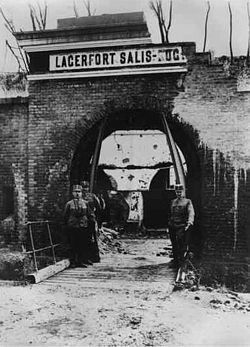
The Austro-Hungarian Compromise of 1867, known as the Ausgleich, transformed the Austrian Empire into the dual monarchy of Austria-Hungary. Following Austria's defeat by Prussia in 1866, Emperor Franz Joseph I negotiated with Hungarian leaders to create two equal states sharing a monarch, a common army, and joint foreign and financial policies, while each retained its own parliament and internal administration.
Image source: Austro-Hungarian Compromise of 1867
Jun 8, 1867
% complete
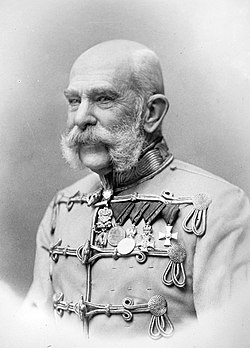
On June 8, 1867, Franz Joseph I was crowned King of Hungary in Budapest's Matthias Church, formally sealing the dual monarchy. The coronation symbolized the restoration of Hungary's historic constitution and marked the beginning of a partnership between Vienna and Budapest that would define Central European politics for half a century.
Image source: Franz Joseph I of Austria
Dec 21, 1867
% complete
The December Constitution of 1867 established fundamental rights and constitutional structures for the Austrian half of the empire. It guaranteed civil liberties including freedom of religion, speech, and assembly, and created a parliamentary system with an elected Reichsrat, laying the legal groundwork for Cisleithania's administration.
Image source: Constitution of Austria
Nov 21, 1868
% complete
Following the Compromise, common institutions were established to govern both halves of the empire: the Imperial and Royal Foreign Ministry, the Common Army, the Joint Finance Ministry, and the Delegations, a shared parliamentary body. These institutions managed affairs affecting both Austria and Hungary while leaving domestic matters to separate governments.
Image source: Austria-Hungary
Nov 21, 1916
% complete
Emperor Franz Joseph I died at Schönbrunn Palace after reigning for 68 years, having ruled since 1848. His death removed a unifying figure who embodied the empire's continuity, and he was succeeded by his grandnephew Karl I, who inherited a war-weary and increasingly fragmented state.
Jun 13, 1878 - Jul 13, 1878
% complete
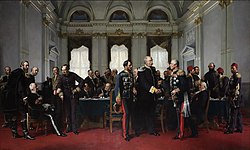
The Congress of Berlin, chaired by Otto von Bismarck, revised the Treaty of San Stefano and redrew the map of the Balkans. Austria-Hungary gained the right to occupy Bosnia and Herzegovina, expanding its influence in the region but also deepening tensions with Serbia and Russia that would haunt the empire for decades.
Image source: Congress of Berlin
Oct 7, 1879
% complete
Austria-Hungary and Germany concluded the Dual Alliance, a defensive pact promising mutual support against Russian attack. Negotiated largely by Gyula Andrássy and Bismarck, the alliance anchored the empire's foreign policy for the rest of its existence and became the cornerstone of the later Triple Alliance.
Image source: Dual Alliance (1879)
May 20, 1882
% complete
Italy joined the Dual Alliance, creating the Triple Alliance between Germany, Austria-Hungary, and Italy. The pact aimed to isolate France and manage Italian ambitions, though underlying rivalries—especially Italian claims to Austrian-held Trentino and Trieste—would eventually lead Italy to abandon the alliance during World War I.
Image source: Triple Alliance (1882)
Oct 6, 1908 - Mar 31, 1909
% complete
Austria-Hungary formally annexed Bosnia and Herzegovina, provoking outrage in Serbia and Russia, which had expected compensation. Backed firmly by Germany, Vienna weathered the crisis, but the annexation humiliated Russia and inflamed Serbian nationalism, poisoning international relations in the years before World War I.
Image source: Bosnian Crisis
Jul 23, 1914 - Jul 28, 1914
% complete
During the July Crisis, Austria-Hungary delivered a deliberately harsh ultimatum to Serbia on July 23, 1914. Serbia's partial compliance failed to satisfy Vienna, which declared war on July 28. Russia's mobilization in support of Serbia drew Germany and the other great powers into a continent-wide conflict.
Image source: July Crisis
Nov 30, 1916
% complete
Karl I ascended the throne determined to reform the empire and seek peace. He attempted federalization of nationalities and pursued secret peace negotiations, but his efforts came too late to reverse the empire's wartime decline or satisfy the growing demands of its subject peoples.
Image source: Charles I of Austria
Apr 1917
% complete
Karl I's secret letter to French President Raymond Poincaré, brokered via his brother-in-law Prince Sixtus of Bourbon-Parma, offered concessions to end the war. When the correspondence leaked in 1918, Germany reacted angrily, forcing Karl to publicly disavow the letter and undermining his credibility both abroad and with his own ally.
Image source: Sixtus Affair
Jul 29, 1878 - Oct 20, 1878
% complete
Under the terms of the Congress of Berlin, Austria-Hungary occupied Bosnia and Herzegovina, formerly Ottoman provinces. The occupation met fierce resistance from local Muslim and Orthodox populations, requiring roughly 200,000 troops and heavy fighting before control was secured. The acquisition added a large South Slavic population to the empire, complicating its ethnic balance.
Image source: Austro-Hungarian campaign in Bosnia and Herzegovina in 1878
Jul 28, 1914
% complete
A month after the Sarajevo assassination, Austria-Hungary declared war on Serbia, beginning bombardment of Belgrade. This declaration was the first formal act of war among the great powers in 1914 and directly precipitated the escalation of the regional crisis into World War I.
Image source: Russian entry into World War I
Aug 16, 1914 - Aug 19, 1914
% complete
In the Battle of Cer, the Serbian army defeated the invading Austro-Hungarian forces near Mount Cer, marking the first Allied victory of World War I. The defeat shattered expectations of a quick victory over Serbia and forced Austria-Hungary into a prolonged and costly Balkan front.
Image source: Battle of Cer
Aug 23, 1914 - Sep 11, 1914
% complete
The Battle of Galicia saw Russian forces inflict a catastrophic defeat on the Austro-Hungarian army in the empire's eastern province. Austria-Hungary suffered around 400,000 casualties and lost Lemberg (Lviv), exposing its military weakness relative to Russia and forcing dependence on German assistance for the rest of the war.
Image source: Battle of Galicia
Sep 24, 1914 - Mar 22, 1915
% complete
The Austro-Hungarian fortress of Przemyśl endured a grueling Russian siege lasting months. After failed relief attempts and severe starvation within the garrison, some 120,000 troops surrendered in March 1915—one of the largest capitulations of the war—dealing another severe blow to imperial prestige.
Image source: Siege of Przemyśl
May 2, 1915 - Jun 22, 1915
% complete
A combined German-Austro-Hungarian offensive at Gorlice–Tarnów shattered Russian lines and drove them out of Galicia, recapturing Przemyśl and Lemberg. The victory stabilized the Eastern Front and restored some of Austria-Hungary's lost territory, though it depended heavily on German forces.
Image source: Gorlice–Tarnów offensive
May 23, 1915
% complete
Despite its Triple Alliance membership, Italy entered World War I on the Allied side after being promised Austrian territory in the secret Treaty of London. Italy's declaration opened a new front along the Alps and Isonzo River, forcing Austria-Hungary to fight on three fronts simultaneously.
Image source: Italian entry into World War I
Oct 7, 1915 - Nov 24, 1915
% complete
A combined German, Austro-Hungarian, and Bulgarian offensive finally conquered Serbia in late 1915, avenging earlier defeats. The Serbian army retreated through Albania to Corfu, and Austria-Hungary briefly achieved its Balkan objectives, though guerrilla resistance and the eventual Allied return would undo these gains.
Image source: Serbian campaign
Jun 4, 1916 - Sep 20, 1916
% complete
Russia's Brusilov Offensive inflicted enormous losses on Austria-Hungary, killing or capturing hundreds of thousands of soldiers and causing mass desertions, particularly among Czech and other Slavic units. The disaster left the imperial army dependent on German command integration and hastened the erosion of morale and cohesion.
Image source: Brusilov offensive
Oct 24, 1917 - Nov 19, 1917
% complete
German and Austro-Hungarian forces under Rommel and others broke through Italian lines at Caporetto, advancing nearly 100 kilometers and taking hundreds of thousands of prisoners. Though a dramatic victory, it exhausted Central Powers resources and prompted Allied reinforcement of Italy, blunting any strategic advantage.
Image source: Battle of Caporetto
Dec 7, 1917
% complete
The United States declared war on Austria-Hungary several months after entering the war against Germany. President Woodrow Wilson's Fourteen Points, announced weeks earlier, had called for autonomy for the peoples of Austria-Hungary, signaling growing Allied support for the empire's dismemberment.
Image source: United States declaration of war on Austria-Hungary
Oct 24, 1918 - Nov 3, 1918
% complete
The final Italian offensive at Vittorio Veneto routed the collapsing Austro-Hungarian army, whose multinational units were already disintegrating. The decisive defeat forced Austria-Hungary to sign the Armistice of Villa Giusti on November 3, 1918, ending its participation in World War I.
Image source: Battle of Vittorio Veneto
Jun 28, 1914
% complete
Archduke Franz Ferdinand, heir to the Habsburg throne, and his wife Sophie were assassinated in Sarajevo by Bosnian Serb nationalist Gavrilo Princip. The murder triggered the July Crisis, as Austria-Hungary, backed by Germany, issued an ultimatum to Serbia, setting off the chain reaction that ignited World War I.
Image source: Assassination of Archduke Franz Ferdinand
Oct 28, 1918
% complete
As the empire collapsed, Czech and Slovak leaders proclaimed the independence of Czechoslovakia in Prague, with Tomáš Masaryk recognized as president. The new state seized Bohemia, Moravia, and Slovakia from Austria-Hungary, becoming one of the empire's principal successor states.
Image source: Czechoslovak declaration of independence
Oct 29, 1918
% complete
South Slavic peoples of the empire declared their own state in Zagreb, uniting Slovenes, Croats, and Serbs from former Habsburg lands. Within a month it merged with Serbia to form the Kingdom of Serbs, Croats and Slovenes (later Yugoslavia), removing the empire's southern territories entirely.
Image source: State of Slovenes, Croats and Serbs
Oct 31, 1918
% complete
The Aster Revolution in Budapest brought Mihály Károlyi to power, and Hungary terminated the real union with Austria, declaring itself an independent republic days later. The dissolution of the Hungarian half ended the dual monarchy's structure after just over fifty years.
Image source: Aster Revolution
Nov 11, 1918
% complete
Facing the empire's total collapse, Emperor Karl I issued a proclamation renouncing any share in the affairs of state, though not formally abdicating. The next day the Republic of German-Austria was proclaimed, ending more than six centuries of Habsburg rule over Austria.
Sep 10, 1919
% complete
The Treaty of Saint-Germain-en-Laye formally dissolved Austria-Hungary, recognized the independence of its successor states, reduced Austria to a small rump republic, barred the Anschluss with Germany, and required Karl I to renounce his rights. The treaty codified the territorial settlement that replaced the old empire.
Image source: Treaty of Saint-Germain-en-Laye (1919)
Jun 4, 1920
% complete
The Treaty of Trianon stripped Hungary of roughly two-thirds of its prewar territory and population, ceding land to Romania, Czechoslovakia, Yugoslavia, and Austria. The treaty's harsh terms left enduring grievances in Hungary and completed the postwar reordering of Central Europe.
Image source: Treaty of Trianon
Or browse the full history timeline directory, with more than 2,000 topics.
This Austro-Hungarian Empire timeline was generated with the help of AI, using information found on the internet.
We work hard to keep these timelines accurate, but mistakes do get through. If you spot one, email us at [email protected] and we'll fix it for future visitors.
Generate yours with AI or build it from scratch, for free.
Export your timeline, add your own events, edit or remove AI-generated events, and much more
No credit card required.
Cancel anytime.
Cancel anytime.
You can create an unlimited number of timelines with up to 10 events on each one, customize how they look, export them to PDF, PNG, PowerPoint, CSV, and Excel, and share them with a link. Paid plans raise the event limit and add features like spreadsheet imports and collaborators.
Yes. You can cancel your subscription from your account page at any time, and you will not be charged again. Your subscription stays active for the rest of the period you already paid for.
Yes. We will email you a reminder before the annual renewal, and we will also email you a receipt.
Yes. You can email us within 15 days of any payment, and we will issue you a full refund.
Check out our pricing docs or send us an email anytime: [email protected].