-
Use Cases
-
Resources
-
Pricing
Buddhism is a religion and philosophy founded by Siddhartha Gautama (the Buddha) in northeastern India around the 5th–6th century BCE. It teaches the path to enlightenment through the Four Noble Truths and the Eightfold Path, emphasizing mindfulness, compassion, and liberation from suffering. Buddhism spread throughout Asia, diversifying into traditions such as Theravada, Mahayana, and Vajrayana. More Less
600 BCE
% complete
Several Śramaṇa movements are known to have existed in India before the 6th century BCE, prior to the Buddha and Mahavira. These movements influenced both the āstika and nāstika traditions of Indian philosophy, laying the groundwork for the rise of Buddhism.
Image source: Śramaṇa
500 BCE
% complete
The Buddha, a śramaṇa and religious teacher, lived in the 6th or 5th century BCE. His social background and life details are difficult to substantiate, and the precise dates are uncertain, although the 5th century BCE seems to be the best estimate.
Image source: The Buddha
500 BCE
% complete
Buddhism originated in the eastern Gangetic plain as a śramaṇa movement in the 5th century BCE, based on teachings attributed to the Buddha. It would gradually spread throughout much of Asia via the Silk Road.
Image source: History of Buddhism
400 CE - 600 CE
% complete
During the Gupta period (4th–6th centuries) and the empire of Harṣavardana (c. 590–647 CE), Buddhism continued to be influential in India, with large Buddhist learning institutions such as Nalanda and Valabahi Universities at their peak.
Image source: Gupta Empire
450 CE
% complete
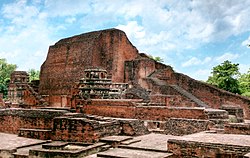
Large monastic university complexes such as Nalanda (established by the 5th-century CE Gupta emperor Kumaragupta I) became quite powerful and influential centers of Mahāyāna Buddhist learning.
Image source: Nalanda mahavihara
500 CE - 600 CE
% complete
During the fifth and sixth centuries CE, there seems to have been a rapid growth of Mahāyāna Buddhism, shown by a large increase in epigraphic and manuscript evidence in this period.
Image source: Mahayana
783 CE - 820 CE
% complete
Mahāyāna Buddhist institutions continued to grow in influence, with large monastic university complexes such as Vikramashila (established under Dharmapala c. 783 to 820) becoming quite powerful and influential.
Image source: Vikramashila
800 CE - 1200 CE
% complete
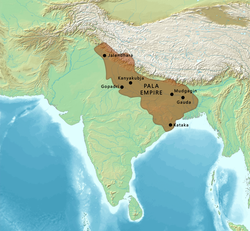
Buddhism also flourished under the support of the Pāla Empire (8th–12th centuries), one of the last major Buddhist dynasties in India before the religion's decline on the subcontinent.
Image source: Pala Empire
500 BCE
% complete
While evidence suggests meditation was practised in the centuries preceding the Buddha, the meditative methodologies described in the Buddhist texts are some of the earliest among texts that have survived into the modern era.
Image source: Meditation
300 BCE - 1000 CE
% complete
The doctrine details in the Abhidharmas of various Buddhist schools differ significantly, and these were composed starting about the third century BCE and through the 1st millennium CE.
Image source: Abhidharma
150 BCE
% complete
The Milindapanha describes a conversation between a Buddhist monk and the 2nd-century BCE Greek king Menander, after which Menander abdicates and himself goes into monastic life in the pursuit of nirvana.
Image source: Milinda Panha
100 BCE
% complete
Some scholars have traditionally considered the earliest Mahāyāna sūtras to include the first versions of the Prajnaparamita series, along with texts concerning Akṣobhya, which were probably composed in the 1st century BCE in the south of India.
Image source: Mahayana sutras
100 BCE - 200 CE
% complete
The first Mahāyāna works were written sometime between the 1st century BCE and the 2nd century CE. The Mahayana tradition reveres the Canon but also derivative literature developed during the 1st millennium CE.
100 CE
% complete
Some of the earliest written documents of the Buddhist faith are the Gandharan Buddhist texts, dating from about the 1st century CE, and connected to the Dharmaguptaka school.
Image source: Gandhāran Buddhist texts
200 CE
% complete
Scholarly Buddhist commentary texts, with named authors, appeared in India around the 2nd century CE, marking an important development in Buddhist scholastic literature.
Image source: Buddhist texts
200 CE - 300 CE
% complete
According to Karl Brunnhölzl, the earliest mahayana sutras discussing tathāgatagarbha as the buddha potential innate in all sentient beings began to appear in written form in the late second and early third century. For some, the doctrine seems to conflict with the anatta doctrine, leading scholars to posit they were written to promote Buddhism to non-Buddhists.
Image source: Tathāgatagarbha sūtras
800 CE
% complete
By the 8th century, the tantric tradition was very influential in India and beyond, shaping esoteric forms of Buddhist practice across Asia.
Image source: Vajrayana
300 BCE
% complete
The Theravada school arrived in Sri Lanka sometime in the 3rd century BCE. Sri Lanka later became a base for its spread to Southeast Asia after the 5th century CE.
Image source: Theravada
100 CE - 200 CE
% complete
From China, Buddhism was introduced into its neighbours Korea (4th century), Japan (6th–7th centuries), and Vietnam (c. 1st–2nd centuries), spreading Buddhist teachings across East Asia.
Image source: Buddhism in Vietnam
100 CE
% complete
The Silk Road transmission of Buddhism to China is most commonly thought to have started in the late 2nd or the 1st century CE, though the literary sources are all open to question.
Image source: Silk Road transmission of Buddhism
200 CE
% complete
The first documented translation efforts by foreign Buddhist monks in China were in the 2nd century CE, probably as a consequence of the expansion of the Kushan Empire into the Chinese territory of the Tarim Basin.
Image source: Chinese Buddhism
500 CE
% complete
After the 5th century CE, Sri Lanka became a base for Theravada's later spread to Southeast Asia, including Myanmar, Malaysia, Indonesia, Thailand, Cambodia and coastal Vietnam.
800 CE
% complete
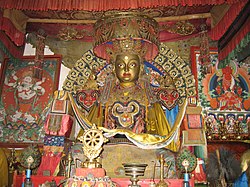
During the Indian period of Esoteric Buddhism (from the 8th century onwards), Buddhism spread from India to Tibet and Mongolia, establishing enduring Vajrayana traditions in these regions.
Image source: Tibetan Buddhism
960 CE - 1279 CE
% complete
Chan continued to grow in the Song dynasty (960–1279), and it was during this era that it strongly influenced Korean Buddhism and Japanese Buddhism.
Image source: Chan Buddhism
1237 CE - 1298 CE
% complete
Theravada Buddhism became dominant in the Thai Sukhothai Kingdom during the reign of Ram Khamhaeng (1237/1247–1298), cementing its place in Thai culture.
Image source: Ram Khamhaeng Inscription
1287 CE - 1552 CE
% complete
Theravada Buddhism was the dominant religion in Burma during the Mon Hanthawaddy kingdom (1287–1552), reinforcing the faith's centrality in Burmese society.
Image source: Hanthawaddy kingdom
1300 CE - 1400 CE
% complete
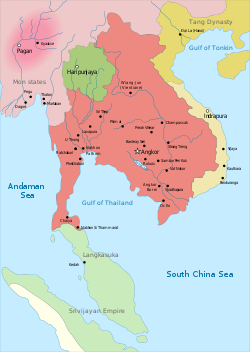
Theravada Buddhism became dominant in the Khmer Empire during the 13th and 14th centuries, transforming the religious landscape of Cambodia.
Image source: Khmer Empire
700 CE
% complete
The Islamic conquest of the Iranian Plateau in the 7th century, followed by Muslim conquests of Afghanistan and the establishment of the Ghaznavid kingdom with Islam as state religion in Central Asia between the 10th and 12th centuries, led to the decline and disappearance of Buddhism from most of these regions.
Image source: Muslim conquest of Persia
1000 CE - 1200 CE
% complete
The Islamic invasions and conquest of India (10th to 12th century) further damaged and destroyed many Buddhist institutions, leading to its eventual near disappearance from India by the 1200s.
Image source: Muslim conquests in the Indian subcontinent
1924 CE - 1990 CE
% complete
In Central Asia, Communist repression in Mongolia (between 1924 and 1990) had a strong negative impact on Buddhist institutions, though the situation has improved somewhat since the 80s and 90s.
Image source: Buddhism in Mongolia
1966 CE - 1976 CE
% complete
Though Buddhist institutions were destroyed during the Cultural Revolution (1966–76), there has been a revival of the religion in China after 1977.
Image source: Cultural Revolution
1966 CE - 1980 CE
% complete
The arrival of Communist repression to Tibet (1966–1980) had a strong negative impact on Buddhist institutions, though the situation has improved somewhat since the 80s and 90s.
1800 CE - 1900 CE
% complete
Although early encounters included Francis Xavier and Ippolito Desideri with Buddhist cultures, it was not until the 19th century that Buddhism began to be studied by Western scholars.
1800 CE - 1850 CE
% complete
The English words such as Buddhism, "Boudhist", "Bauddhist" and Buddhist were coined in the early 19th century in the West, shaping how the tradition came to be understood in Europe and America.
1850 CE - 1900 CE
% complete
It was also during the 19th century that Asian Buddhist immigrants (mainly from China and Japan) began to arrive in Western countries such as the United States and Canada, bringing with them their Buddhist religion.
Image source: Buddhism in the United States
1868 CE - 1910 CE
% complete
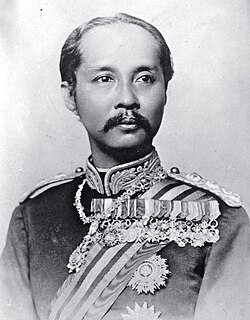
King Chulalongkorn (r. 1868–1910), following his father Mongkut (r. 1851–68), were responsible for modern reforms of Thai Buddhism, reshaping the sangha along modern lines.
Image source: Chulalongkorn
1880 CE - 1933 CE
% complete
Early Buddhist modernist figures such as the American convert Henry Olcott (1832–1907) and Anagarika Dharmapala (1864–1933) reinterpreted and promoted Buddhism as a scientific and rational religion compatible with modern science.
Image source: Buddhist modernism
1881 CE
% complete
In 1881, Rhys Davids founded the Pali Text Society—an influential Western resource of Buddhist literature in the Pali language and one of the earliest publishers of a journal on Buddhist studies.
Sep 1893 CE
% complete
An important event in the introduction of Buddhism to the West was the 1893 World Parliament of Religions, which for the first time saw well-publicised speeches by major Buddhist leaders alongside other religious leaders.
Image source: Parliament of the World's Religions
1912 CE - 1949 CE
% complete
During the Republican period (1912–49), a new movement called Humanistic Buddhism was developed by figures such as Taixu (1899–1947), emphasizing engagement with the modern world.
Image source: Humanistic Buddhism
1924 CE
% complete
The 20th century saw a prolific growth of new Buddhist institutions in Western countries, including the Buddhist Society, London (1924), Das Buddhistische Haus (1924) and Datsan Gunzechoinei in St Petersburg.
Image source: Buddhist Society
1994 CE - 2017 CE
% complete
One notably covered case in media of various Western countries was that of Sogyal Rinpoche, which began in 1994 and ended with his retirement from his position as Rigpa's spiritual director in 2017.
Image source: Sogyal Rinpoche
2020 CE
% complete
Buddhism is practised by an estimated 324 million people in 2020, representing 4.1% of the world's total population. Buddhists are the only major religious group that declined in size between 2010 and 2020, dropping from about 343 million to 324 million people—a decrease of roughly 5%.
Or browse the full history timeline directory, with more than 2,000 topics.
This Buddhism timeline was generated with the help of AI, using information found on the internet.
We work hard to keep these timelines accurate, but mistakes do get through. If you spot one, email us at [email protected] and we'll fix it for future visitors.
Generate yours with AI or build it from scratch, for free.
Export your timeline, add your own events, edit or remove AI-generated events, and much more
No credit card required.
Cancel anytime.
Cancel anytime.
You can create an unlimited number of timelines with up to 10 events on each one, customize how they look, export them to PDF, PNG, PowerPoint, CSV, and Excel, and share them with a link. Paid plans raise the event limit and add features like spreadsheet imports and collaborators.
Yes. You can cancel your subscription from your account page at any time, and you will not be charged again. Your subscription stays active for the rest of the period you already paid for.
Yes. We will email you a reminder before the annual renewal, and we will also email you a receipt.
Yes. You can email us within 15 days of any payment, and we will issue you a full refund.
Check out our pricing docs or send us an email anytime: [email protected].