-
Use Cases
-
Resources
-
Pricing
Taoism (or Daoism) is a philosophical and religious tradition originating in ancient China that emphasizes living in harmony with the Tao, an ineffable source and pattern of existence. Rooted in texts like the Tao Te Ching attributed to Laozi and the Zhuangzi, it developed into organized religious movements, influenced Chinese culture, medicine, martial arts, and spirituality, and remains a living tradition today. More Less
400 BCE
% complete
The Tao Te Ching, attributed to Laozi, was composed between the 4th and 6th century BCE. It became the foundational text of Taoism, teaching the way of the Tao, naturalness, and wu wei (non-action).
Image source: Tao Te Ching
350 BC
% complete
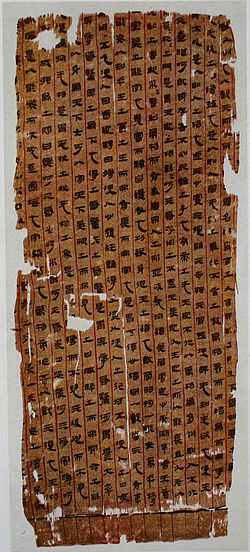
The Neiye (Inward Training), a 4th-century BCE text on self-cultivation, emphasizes breath/qi practices and training the heart-mind (xin), becoming an important early Taoist work.
Image source: Neiye
320 BC
% complete
The earliest manuscripts of the Tao Te Ching, written on bamboo tablets, date back to the late 4th century BCE. These contain significant differences from the later received edition associated with Wang Bi (c. 226–249).
Image source: Bamboo Texts of Guodian
300 BC - 221 BC
% complete
According to modern scholars such as Kirkland and Livia Kohn, Taoist philosophy developed by drawing on numerous schools of thought from the Warring States period, including Mohism, Confucianism, Legalist theorists like Shen Buhai and Han Fei, and the School of Naturalists, from which Taoism draws yin and yang and the five phases.
Image source: Taoism

250 BC
% complete
The Heguanzi is a 3rd-century BCE syncretic collection of writings from the Chinese Hundred Schools of Thought, reflecting the intellectual milieu from which Taoist thought emerged.
Image source: Heguanzi
200 BC
% complete
One of the earliest forms of Taoism was the Han era Huang–Lao movement, which was an influential school of thought at this time, blending the teachings of the Yellow Emperor with those of Laozi.
Image source: Huang–Lao
200 BC - 100 BC
% complete
An unorganized form of Taoism was popular in the Han dynasty that syncretized many preexisting forms in multiple ways for different groups during a rough span of time throughout the 2nd century BCE.
150
% complete
Perhaps the oldest commentary on the Tao Te Ching, the Heshang Gong commentary was most likely written in the 2nd century CE and remains one of the most influential interpretations of the classic.
400
% complete
Monks began assembling the Daozang canon starting in the 5th century CE, forming the core of a body of Taoist writings accrued over the following centuries.
Image source: Daozang

150 BC
% complete
Laozi received imperial recognition as a divinity in the mid-2nd century BCE, elevating the legendary sage to a central place in emerging religious Taoism.
Image source: Laozi
317
% complete
Ge Hong, a 4th century alchemist, wrote a key Taoist work on inner cultivation, the Baopuzi (Master Embracing Simplicity), covering alchemy, immortality practices, and esoteric techniques.
Image source: Ge Hong
500
% complete
Mutual co-existence between Taoism, Confucianism, and Buddhism led to the emergence of Three Teachings discourse by the 6th century CE, which examined how the three traditions could be integrated harmoniously in Chinese society.
Image source: Three teachings
500 - 600
% complete
During the 6th century, Taoists attempted to unify the various traditions into one integrated Taoism that could compete with Buddhism and Confucianism.
627 - 649
% complete
During the reign of the 7th century Emperor Taizong, the Five Dragons Temple, the first temple at the Wudang Mountains, was constructed, beginning the site's long association with Taoism.
Image source: Wudang Mountains
960
% complete
What has become the standardised yin-yang taijitu originated as a Taoist symbol in the 10th century CE during the early Song dynasty, becoming an enduring emblem of Taoist cosmology.
Image source: Taijitu
1075
% complete
Wuzhen pian (Awakening to Reality) is a major Song-dynasty internal alchemy text by Zhang Boduan (987?–1082), becoming a foundational work for neidan practice.
1368 - 1644
% complete
Under the Ming dynasty, aspects of Confucianism, Taoism, and Buddhism were consciously synthesized in the Neo-Confucian school, which eventually became Imperial orthodoxy for state bureaucratic purposes.
Image source: Neo-Confucianism
1445
% complete
Although earlier Taoist canons were compiled and revised in the medieval and Song–Jin periods, the only complete canon extant today is the Ming-dynasty Zhengtong Daozang, published in 1445, containing roughly 1,500 texts.
1690
% complete
The Taiyi Jinhua zongzhi (The Secret of the Golden Flower) is an influential internal alchemy text from the late 17th century, later promoted by Longmen authors like Liu Yiming (1734–1821) and Min Yide (1758–1836).
1700 - 1800
% complete
During the 18th century, the Qing imperial library excluded virtually all Taoist books, reflecting the dynasty's preference for Buddhism and Neo-Confucianism over Taoism.
142
% complete
The first organized form of Taoism was the Way of the Celestial Masters, which developed from the Five Pecks of Rice movement at the end of the 2nd century CE, establishing a structured religious community with priests and parishes.
397 - 402
% complete
Between 397 and 402, Ge Chaofu compiled a series of scriptures that later served as the foundation of the Lingbao school, which was most influential during the later Song dynasty and focused on scriptural recitation and talismans for harmony and longevity.
Image source: Lingbao School
1160
% complete
In the 12th century, the Quanzhen (Complete Perfection) School was founded in Shandong by the sage Wang Chongyang (1113–1170) to compete with religious Taoist traditions that worshipped ghosts and gods, and largely displaced them.
Image source: Quanzhen School
1170
% complete
Later, in the 12th century, the Quanzhen School of Taoism was explicitly founded on three teachings philosophy, incorporating Buddhist meditation techniques and monastic organization alongside Confucian ethical discipline and social responsibility.
1180
% complete
Another important Quanzhen lineage is the Qingjing pai, founded by the nun Sun Bu'er (1119–1182), the only female member of Wang Chongyang's 'seven perfected' disciples.
Image source: Sun Bu'er
1200
% complete
Qiu Chuji (1148–1227), one of Wang Chongyang's 'seven perfected' disciples, founded the Dragon Gate lineage, which would become the most prominent branch of Quanzhen Taoism.
Image source: Qiu Chuji
1271 - 1368
% complete
Quanzhen flourished during the 13th and 14th centuries and during the Yuan dynasty, expanding its monasteries and influence across China.
1600
% complete
The Qing era saw the birth of the Longmen (Dragon Gate) school of Wang Kunyang (1552–1641), a branch of Quanzhen from southern China that became established at the White Cloud Temple in Beijing.
Image source: Dragon Gate Taoism
1839 - 1949
% complete
During the 19th and 20th centuries, Taoism suffered much destruction as a result of religious persecution and numerous wars and conflicts that beset China in the so-called century of humiliation.
Image source: Century of humiliation
1900 - 1969
% complete
A key Taoist figure during this turbulent period was Chen Yingning (1880–1969), who worked to modernize and preserve Taoist inner alchemy teachings despite widespread upheaval.
Image source: Taoism
1956
% complete
In 1956, the Chinese Taoist Association was formed to administer the activities of all registered Taoist orders, and received official approval in 1957.
Image source: Chinese Taoist Association
1966 - 1976
% complete
During the Cultural Revolution (1966–1976), many Taoist priests were laicized and sent to work camps, many Taoist sites and temples were destroyed or converted to secular use, and the Chinese Taoist Association was disbanded.
Image source: Cultural Revolution
1979
% complete
Taoism began to recover during the reform and opening up period beginning in 1979, during which mainland China experienced increased religious freedom.
Image source: Chinese economic reform
1980
% complete
The Chinese Taoist Association, disbanded during the Cultural Revolution, was reestablished in 1980. Since then, many Taoist monasteries and temples have been reopened or rebuilt, both belonging to the Zhengyi or Quanzhen schools, and ordination has been resumed.
1986
% complete
Scholar and Taoist initiate Kristofer Schipper proposed in The Taoist Body (1986) the definition of Taoism as a liturgical framework for the development of local cults, a scheme or structure for Chinese religion.
Image source: Kristofer Schipper
1990
% complete
During the late 20th century, Taoism began to spread to the Western world, leading to various forms of Taoist communities in the West, with Taoist publications, websites, meditation and Tai chi centers, and translations of Taoist texts.
2000
% complete
'Dao' is the romanized spelling in the Hanyu Pinyin system, officially adopted in China in the 1950s and by the Library of Congress in 2000, largely replacing Wade–Giles romanization ('Tao') in academic sources.
Image source: Romanization of Chinese
2010
% complete
According to a survey of religion in China in 2010, the number of people practicing some form of Chinese folk religion is near to 950 million, about 70% of Chinese, within which Taoism continues as an order of the larger body of Chinese religion.
Image source: Chinese folk religion
Or browse the full history timeline directory, with more than 2,000 topics.
This Taoism timeline was generated with the help of AI, using information found on the internet.
We work hard to keep these timelines accurate, but mistakes do get through. If you spot one, email us at [email protected] and we'll fix it for future visitors.
Generate yours with AI or build it from scratch, for free.
Export your timeline, add your own events, edit or remove AI-generated events, and much more
No credit card required.
Cancel anytime.
Cancel anytime.
You can create an unlimited number of timelines with up to 10 events on each one, customize how they look, export them to PDF, PNG, PowerPoint, CSV, and Excel, and share them with a link. Paid plans raise the event limit and add features like spreadsheet imports and collaborators.
Yes. You can cancel your subscription from your account page at any time, and you will not be charged again. Your subscription stays active for the rest of the period you already paid for.
Yes. We will email you a reminder before the annual renewal, and we will also email you a receipt.
Yes. You can email us within 15 days of any payment, and we will issue you a full refund.
Check out our pricing docs or send us an email anytime: [email protected].