-
Use Cases
-
Resources
-
Pricing
The Dalai Lama is the spiritual leader of Tibetan Buddhism, believed to be the reincarnation of Avalokiteshvara, the Bodhisattva of Compassion. The current and 14th Dalai Lama, Tenzin Gyatso, was born in 1935, recognized as Dalai Lama in 1937, assumed political leadership of Tibet in 1950, fled to India after China's suppression of the 1959 Tibetan uprising, and has since advocated worldwide for peace, human rights, and a 'Middle Way' approach to Tibetan autonomy. He was awarded the Nobel Peace Prize in 1989. More Less
1578
% completado
The Mongolian king Altan Khan bestowed the title 'Dalai Lama' upon Sonam Gyatso, a leader of the Gelug school of Tibetan Buddhism. The title, meaning 'Ocean Teacher', was applied retroactively to his two predecessors, establishing the lineage of reincarnated spiritual leaders that continues today.
Image source: Dalai Lama
1642
% completado
With the support of Gushri Khan of the Khoshut Mongols, the Fifth Dalai Lama, Ngawang Lobsang Gyatso, established the Ganden Phodrang government, uniting Tibet under both spiritual and temporal authority for the first time in the lineage's history.
Image source: 5th Dalai Lama
1645 - 1694
% completado
The Fifth Dalai Lama initiated construction of the Potala Palace on Red Hill in Lhasa. Completed decades later, it became the winter residence of the Dalai Lamas and an enduring symbol of Tibetan Buddhism, later designated a UNESCO World Heritage Site.
Image source: Potala Palace
May 14, 1995
% completado
The Dalai Lama recognized six-year-old Gedhun Choekyi Nyima as the reincarnation of the 10th Panchen Lama. Days later Chinese authorities detained the boy and his family, and Beijing installed its own rival candidate, deepening the dispute over reincarnation recognition.
Image source: Gedhun Choekyi Nyima
Sep 2011
% completado
Amid Chinese claims of authority over reincarnation selection, the Dalai Lama declared that his successor might be born outside Chinese-controlled territory or even chosen before his death, insisting only his institution could identify the next Dalai Lama.
Image source: Succession of the 14th Dalai Lama
Jul 6, 1935
% completado
Lhamo Dhondup was born to a farming family in the small village of Taktser in northeastern Tibet, in Amdo province. He was one of seven children in a modest household far from the centers of Tibetan religious life.
Image source: 14th Dalai Lama
1937
% completado
A search party of senior lamas, following signs and visions including those at the sacred lake Lhamo La-tso, identified the two-year-old Lhamo Dhondup as the reincarnation of the 13th Dalai Lama, Thubten Gyatso.
Feb 22, 1940
% completado
The young boy was formally enthroned as the 14th Dalai Lama at the Potala Palace in Lhasa and given the name Tenzin Gyatso. He began monastic education that would span nearly two decades, culminating in advanced Buddhist philosophical studies.
1959
% completado
At the age of 23, during his final year in Tibet, the Dalai Lama passed his final examinations at the Jokhang temple in Lhasa, earning the highest academic degree of Geshe Lharampa, equivalent to a doctorate in Buddhist philosophy.
Image source: Geshe
Oct 1950
% completado
Chinese forces entered eastern Tibet, overwhelming the poorly equipped Tibetan army. The crisis prompted the Tibetan government to invest full temporal authority in the 15-year-old Dalai Lama ahead of schedule.
Image source: Annexation of Tibet by the People's Republic of China
Nov 17, 1950
% completado
Facing the Chinese invasion, the Dalai Lama was enthroned early as Tibet's head of state, assuming political responsibilities years before reaching the traditional age of majority.
May 23, 1951
% completado
Under duress, Tibetan representatives signed an agreement with the People's Republic of China affirming Chinese sovereignty over Tibet while promising autonomy. The Dalai Lama later repudiated the agreement after fleeing Tibet.
Image source: Seventeen Point Agreement
1954 - 1955
% completado
The Dalai Lama traveled to Beijing for meetings with Chinese leaders including Mao Zedong, hoping to secure peaceful coexistence. His hopes were dashed as repression in Tibet intensified, fueling growing resistance.
1959
% completado
One of the first institutions of the exile community, the institute was created to preserve Tibetan opera, music, and dance traditions threatened in Chinese-controlled Tibet, part of a broader cultural preservation effort.
Image source: Tibetan Institute of Performing Arts
Mar 1959
% completado
Disguised as a soldier, the Dalai Lama escaped from Lhasa on foot through the Himalayas, enduring a perilous two-week journey. He crossed into India on March 31, 1959, beginning more than six decades of exile.
Mar 10, 1959
% completado
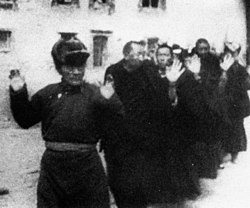
Tens of thousands of Tibetans rose up in Lhasa amid fears that the Chinese planned to abduct the Dalai Lama. The revolt was brutally suppressed by Chinese forces, with thousands killed, marking a turning point in Tibetan history.
Image source: 1959 Tibetan uprising
Jun 20, 1959
% completado
In his first press conference in India, the Dalai Lama repudiated the Seventeen Point Agreement, declaring it had been signed under coercion, and called for the self-determination of the Tibetan people.
1960
% completado
Shortly after arriving in India, the Dalai Lama reorganized the exile government along democratic lines, with refugees electing deputies to a new representative assembly, laying foundations for Tibetan democracy in exile.
Image source: Central Tibetan Administration
1960
% completado
The Dalai Lama set up the exile government, known as the Central Tibetan Administration, in McLeod Ganj, Dharamshala, India. The town became known as 'Little Lhasa' and the center of the Tibetan diaspora.
1963
% completado
The Dalai Lama introduced a democratic constitution for a future free Tibet, envisioning an elected parliament and separation of powers, marking his commitment to democratization even while heading a government-in-exile.
Mar 14, 2011
% completado
The Dalai Lama formally relinquished his political authority, transferring it to the democratically elected Sikyong, ending the tradition of Dalai Lamas serving as heads of state and completing the democratization of the Central Tibetan Administration.
Image source: Sikyong
Mar 31, 2019
% completado
Marking six decades since his escape from Tibet, the aging Dalai Lama reflected on the resilience of the Tibetan people, the growth of the exile community, and continued hopes for dialogue with China over Tibet's future.
1962
% completado
His first autobiography recounted the invasion of Tibet, the uprising, and his escape into exile, bringing the Tibetan cause to international readers and establishing him as a global spokesperson for his people.
Image source: Voice for the Voiceless (book)
1973
% completado
Starting in the early 1970s, the Dalai Lama undertook numerous international travels across Europe, North America, and Asia, meeting leaders, addressing parliaments, and teaching Buddhism, dramatically raising global awareness of Tibet.
Sep 21, 1987
% completado
Addressing the US Congressional Human Rights Caucus in Washington, D.C., the Dalai Lama proposed a peace plan calling for Tibet to become a zone of peace, an end to Chinese population transfer, and genuine autonomy rather than independence.
Jun 15, 1988
% completado
In a speech to the European Parliament in Strasbourg, the Dalai Lama elaborated on the Five Point Plan, proposing genuine self-government for Tibet within the People's Republic of China, a significant shift from calls for full independence.
Image source: RC Strasbourg Alsace
Dec 10, 1989
% completado
The Norwegian Nobel Committee awarded the Dalai Lama the Nobel Peace Prize for his consistent opposition to the use of violence in his people's struggle and his advocacy of peaceful solutions based on tolerance and mutual respect.
Image source: Nobel Peace Prize
1990
% completado
Following the Nobel Peace Prize, the Dalai Lama published a fuller autobiography detailing his spiritual development, political struggles, and philosophy of compassion, further cementing his status as a global moral figure.
Image source: Freedom in Exile
1997
% completado
Formalizing his Middle Way Approach, the Dalai Lama publicly stated he sought genuine autonomy for Tibet rather than independence, seeking dialogue with Beijing while facing criticism from some younger Tibetans who favored full independence.
Oct 17, 2007
% completado
The United States Congress conferred its highest civilian honor on the Dalai Lama in a ceremony attended by President George W. Bush, prompting strong protests from China despite the Dalai Lama's insistence that he sought autonomy, not independence.
Image source: Congressional Gold Medal
2009
% completado
Collaborating with academics, the Dalai Lama helped establish initiatives exploring ethics, mindfulness, and science, reflecting his lifelong engagement with neuroscience and secular ethics as tools for human flourishing.
Image source: Massachusetts Institute of Technology
Jul 6, 2020
% completado
Celebrations worldwide honored the Dalai Lama's 85th birthday, with tributes from global figures highlighting his message of compassion, interfaith harmony, and nonviolence even as the question of his succession loomed increasingly large.
Or browse the full history timeline directory, with more than 2,000 topics.
This Dalai Lama timeline was generated with the help of AI, using information found on the internet.
We work hard to keep these timelines accurate, but mistakes do get through. If you spot one, email us at [email protected] and we'll fix it for future visitors.
Generate yours with AI or build it from scratch, for free.
Export your timeline, add your own events, edit or remove AI-generated events, and much more
No credit card required.
Cancel anytime.
Cancel anytime.
You can create an unlimited number of timelines with up to 10 events on each one, customize how they look, export them to PDF, PNG, PowerPoint, CSV, and Excel, and share them with a link. Paid plans raise the event limit and add features like spreadsheet imports and collaborators.
Yes. You can cancel your subscription from your account page at any time, and you will not be charged again. Your subscription stays active for the rest of the period you already paid for.
Yes. We will email you a reminder before the annual renewal, and we will also email you a receipt.
Yes. You can email us within 15 days of any payment, and we will issue you a full refund.
Check out our pricing docs or send us an email anytime: [email protected].