-
Use Cases
-
Resources
-
Pricing
Sikhism is a monotheistic religion founded in the Punjab region of South Asia by Guru Nanak in the late 15th century. It developed through the teachings of ten successive Gurus, whose spiritual wisdom is compiled in the holy scripture, the Guru Granth Sahib. Sikhism emphasizes devotion to one God, equality of all people, honest living, and selfless service. More Less
1469
% complete
Guru Nanak (1469–1539), the founder of Sikhism, was born in the village of Rāi Bhōi dī Talwandī, now called Nankana Sahib in present-day Pakistan. His spiritual teachings became the foundation of the Sikh faith.
Image source: Guru Nanak
1480
% complete
According to the hagiography Puratan Janamsakhi composed more than two centuries after his death and probably based on oral tradition, Nanak as a boy was fascinated by religion and spiritual matters, spending time with wandering ascetics and holy men.
Image source: Janamsakhis
1500
% complete
Sikhism, also known as Sikhi, is an Indian religion and philosophy that originated in the Punjab region of the Indian subcontinent around the end of the 15th century CE.
Image source: Sikhism
1526
% complete
In 1526, Guru Nanak at age 50 started a small commune in Kartarpur, and his disciples came to be known as Sikhs. One account holds that Nanak's teachings were a revelation from God, not a social protest movement nor an attempt to reconcile Hinduism and Islam.
Image source: Kartarpur, Pakistan
1539
% complete
In 1539, Guru Nanak chose his disciple Lahiṇā as successor to the Guruship rather than either of his sons, establishing the tradition of a line of ten gurus that would guide Sikhism from 1469 to 1708.
Image source: Guru Angad
1552
% complete
Guru Amar Das became the third Sikh guru in 1552 at the age of 73, continuing the development of the traditions and philosophy established by the line of gurus.
Image source: Guru Amar Das
1581
% complete
In 1581, Guru Arjan, the youngest son of Guru Ram Das, became the fifth guru of the Sikhs.
Image source: Guru Arjan
1644
% complete
In 1644, Guru Hargobind named his grandson Har Rai as the guru, continuing the lineage of Sikh leadership.
Image source: Guru Har Rai
1661
% complete
Guru Har Rai nominated his younger son Guru Har Krishan to succeed him in 1661.
Image source: Guru Har Krishan
1665
% complete
Guru Tegh Bahadur, the uncle of Guru Har Krishan, became guru in 1665.
Image source: Guru Tegh Bahadur
1603 - 1604
% complete
The Ādi Granth – literally 'First Volume' – was compiled primarily by Bhai Gurdas under the supervision of Guru Arjan between 1603 and 1604, creating the first version of the central Sikh scripture.
Jun 12, 1606
% complete
The doctrine of the 'Mir' (social and political aspects of life) and the 'Pir' (guides to the spiritual aspect of life) was revealed by Guru Nanak but propounded by the sixth guru, Guru Hargobind, on 12 June 1606. It has been practiced in Sikhism since the seventeenth century.
Image source: Miri Piri
1678
% complete
The final version of the Guru Granth Sahib was compiled by Guru Gobind Singh in 1678, completing the central religious scripture of Sikhism.
1708
% complete
Before his death, Guru Gobind Singh decreed in 1708 that the Gurū Granth Sāhib would be the final and perpetual guru of the Sikhs, ending the line of human gurus that had run from 1469 to 1708.
Image source: Guru Granth Sahib
1719
% complete
A text makes mention of a work composed in 1719, much after the death of Guru Gobind Singh. McLeod dates the work to the late 18th century and believes an unknown poet authored it, which was mistakenly attributed to the tenth guru.
Image source: Guru Gobind Singh
Feb 15, 1980
% complete
The Hukamnama (edict or clarification) issued by Akal Takht Jathedar Sadhu Singh Bhaura dated 15 February 1980 states that eating meat does not go against the code of conduct of the Sikhs.
Image source: Akal Takht
2001
% complete
In 2001, Jathedar Santa Singh, the leader of Budha Dal, along with 20 chiefs of Nihang sects, refused to accept the ban on consumption of shaheedi degh by the apex Sikh clergy of Akal Takht, in order to preserve their traditional practices. Traditionally they drank shaheedi degh, an infusion of cannabis, to become closer with God.
Image source: Nihang
1606
% complete
In 1606, Guru Arjan was tortured and killed by the Mughal emperor Jahangir for refusing to convert to Islam, becoming one of two gurus martyred under Mughal rule.
1675
% complete
Tegh Bahadur resisted the forced conversions of Kashmiri Pandits and non-Muslims to Islam, and was publicly beheaded in 1675 on the orders of Mughal emperor Aurangzeb in Delhi for refusing to convert to Islam.
Mar 30, 1699
% complete
The persecution of the Sikhs triggered the founding of the Khalsa by Guru Gobind Singh in 1699 as an order to protect freedom of conscience and religion, with members expressing the qualities of a sant-sipāhī ('saint-soldier'). The first initiation ceremony took place on Vaisakhi, which fell on 30 March 1699 at Anandpur Sahib in Punjab, where Gobind Rai baptised the Pañj Piārē.
Image source: Khalsa
1982
% complete
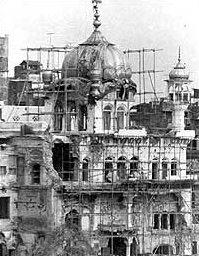
The Golden Temple and Akal Takht were occupied by various militant groups in 1982. Between 1982 and 1983 there were Anandpur Resolution demand-related terrorist attacks against civilians in parts of India. By late 1983, the Bhindranwale-led group had begun building bunkers and observation posts in and around the Golden Temple, with militants involved in weapons training.
Image source: Operation Blue Star
Jun 1984
% complete
In June 1984, then Prime Minister of India Indira Gandhi ordered the Indian Army to begin Operation Blue Star against the militants occupying the Golden Temple complex.
Oct 31, 1984
% complete
Within six months of Operation Blue Star, on 31 October 1984, Indira Gandhi's Sikh bodyguards Satwant and Beant Singh assassinated her. The assassination triggered the 1984 anti-Sikh riots.
Image source: Assassination of Indira Gandhi
1800
% complete
In the 19th century, the Namdharis and Nirankaris sects were formed in Sikhism, seeking to reform and return to what each believed was the pure form of Sikhism.
Image source: Namdhari
1860
% complete
Another significant Sikh sect of the 19th century was the Radhasoami movement in Punjab led by Baba Shiv Dyal.
Image source: Radha Soami
1953
% complete
In 1953, the government of India acceded to the demands of the Sikh leader Master Tara Singh to include Sikh Dalit castes in the list of scheduled castes.
Image source: Scheduled Castes and Scheduled Tribes
1971
% complete
Other contemporary era Sikh sects include the 3HO, formed in 1971, which exists outside India, particularly in North America and Europe.
Image source: 3HO
2011
% complete
Only in the state of Punjab do Sikhs constitute a majority (58% per the 2011 census). The 2011 Indian Census recorded 5,390,484 Scheduled Caste individuals identifying as Sikhs in Punjab, out of the state's total Scheduled Caste population of 8,860,179, representing 33.68% of Punjab's total Sikh population of 16,004,754.
Image source: Sikhism in India
2017
% complete
According to 2017 news reports, only about 20,000 Sikhs remain in Pakistan, and their population is dwindling (0.01% of the country's estimated 200 million population).
Image source: Sikhism in Pakistan
2019
% complete
Estimates as of 2019 state that Sikhism has some 25–30 million followers worldwide. A 2020 estimate by Charles Preston gives a figure of 29,254,000 Sikhs worldwide.
2021
% complete
As of the 2021 Canadian Census, more than half of Canada's Sikhs can be found in one of four cities: Brampton (163,260), Surrey (154,415), Calgary (49,465), and Abbotsford (38,395). Large communities also live in Haryana, home to the second largest Sikh population in India with 1.1 million Sikhs per the 2001 census.
Image source: Sikhism in Canada
1839
% complete
After the death of Ranjit Singh in 1839, the Sikh Empire fell into disorder, weakening Sikh political power in Punjab.
Image source: Sikh Empire
1853
% complete
The last Maharaja of the Sikh Empire, Duleep Singh, converted to Christianity in 1853, a controversial but influential event in Sikh history.
Image source: Duleep Singh
1873
% complete
The first meeting of the movement was in the Golden Temple, Amritsar in 1873, and it was largely launched by the Sanatan Sikhs, Gianis, priests, and granthis.
Image source: Singh Sabha movement
1900 - 1947
% complete
Sikhs participated and contributed to the decades-long Indian independence movement in the first half of the 20th century.
Image source: Indian independence movement
1905
% complete
By the early decades of the 20th century, the influence of Tat Khalsa increased in interpreting the nature of Sikhism and their control over the Sikh gurdwaras. In 1905 they banished Brahmanical practices including the yagna fire, replaced by the Anand Karaj marriage ceremony, and removed idols and images of Sikh gurus from the Golden Temple, traditions which had taken root during the mahants' administration in the 1800s.
Image source: Tat Khalsa
1909
% complete
Its official recognition and adoption came in 1909, during the Singh Sabha Movement, marking an important step in standardising Sikh calendrical practice.
1940
% complete
In 1940, a few Sikhs such as the victims of Komagata Maru in Canada proposed the idea of Khalistan as a buffer state between an independent India and what would become Pakistan.
Image source: Khalistan movement
Jun 1945
% complete
During and after the Simla Conference in June 1945, headed by Lord Wavell, the Sikh leaders initially expressed their desire to be recognised as a third community, but ultimately relegated these demands and sought a United India where Sikhs, Hindus and Muslims would live together, under a Swiss-style constitution.
Image source: Simla Conference
Mar 1947 - Aug 1947
% complete
Between March and August 1947, a series of riots, arson, plunder of Sikh property, assassination of Sikh leaders, and killings in Jhelum, Rawalpindi, Attock and other places led Tara Singh to call the situation in Punjab a 'civil war', while Lord Mountbatten stated 'civil war preparations were going on.' The riots triggered early waves of migration in April, with some 20,000 people leaving northwest Punjab for Patiala.
Image source: Partition of India
Aug 1947
% complete
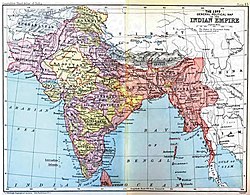
When the British Empire recognised independent India, the land was partitioned into Hindu-majority India and Muslim-majority Pakistan in 1947. When the partition line was formally announced in August 1947, the violence was unprecedented, with Sikhs being one of the most affected communities in terms of deaths, property loss, injury, trauma and disruption. Prior to partition, millions of Sikhs lived in what later became Pakistan.
2003
% complete
In 2003, the SGPC, the Sikh organisation in charge of upkeep of the historical gurdwaras of Punjab, adopted the Nanakshahi calendar. In recent years, instead of Diwali, the post-2003 calendar released by SGPC has named the festival Bandi Chhor Divas.
Or browse the full history timeline directory, with more than 2,000 topics.
This Sikhism timeline was generated with the help of AI, using information found on the internet.
We work hard to keep these timelines accurate, but mistakes do get through. If you spot one, email us at [email protected] and we'll fix it for future visitors.
Generate yours with AI or build it from scratch, for free.
Export your timeline, add your own events, edit or remove AI-generated events, and much more
No credit card required.
Cancel anytime.
Cancel anytime.
You can create an unlimited number of timelines with up to 10 events on each one, customize how they look, export them to PDF, PNG, PowerPoint, CSV, and Excel, and share them with a link. Paid plans raise the event limit and add features like spreadsheet imports and collaborators.
Yes. You can cancel your subscription from your account page at any time, and you will not be charged again. Your subscription stays active for the rest of the period you already paid for.
Yes. We will email you a reminder before the annual renewal, and we will also email you a receipt.
Yes. You can email us within 15 days of any payment, and we will issue you a full refund.
Check out our pricing docs or send us an email anytime: [email protected].