-
Use Cases
-
Resources
-
Pricing
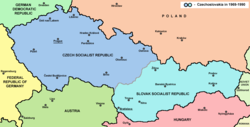
Czechoslovakia was a Central European state founded in 1918 following the collapse of Austria-Hungary. It existed as an independent democracy until Nazi occupation in 1939, was re-established after World War II, fell under communist rule after the 1948 coup, experienced the liberalization movement of the Prague Spring in 1968 (suppressed by Soviet invasion), and finally returned to democracy through the peaceful Velvet Revolution of 1989 before dissolving into the Czech Republic and Slovakia on January 1, 1993. More Less
1848
% completado
Taking advantage of limited opportunities for political participation under Austrian rule, Czech leaders such as historian František Palacký founded various patriotic self-help organizations which gave many compatriots a chance to participate in communal life before independence.
Image source: František Palacký
1891 - 1914
% completado
An advocate of democratic reform and Czech autonomy within Austria-Hungary, Masaryk was elected twice to the Reichsrat (Austrian Parliament), from 1891 to 1893 for the Young Czech Party, and from 1907 to 1914 for the Czech Realist Party, which he had founded in 1889 with Karel Kramář and Josef Kaizl.
Image source: Tomáš Masaryk
1918 - 1923
% completado
Different systems existed in former Austrian territory (Bohemia, Moravia, a small part of Silesia) compared to former Hungarian territory (Slovakia and Ruthenia): three lands plus 21 counties in Slovakia and three counties in Ruthenia, both divided into districts.
Oct 1918
% completado
Czechoslovakia was created in 1918 as Czecho-Slovakia (until 1920), when it declared its independence from Austria-Hungary. It was one of the successor states of the Austro-Hungarian Empire at the end of World War I, formalized by the Treaty of Saint-Germain-en-Laye.
Image source: Czechoslovakia
Nov 14, 1918 - Dec 14, 1935
% completado
The new state was founded by Tomáš Garrigue Masaryk, who served as its first president from 14 November 1918 to 14 December 1935. He championed a democratic republic and was succeeded by his close ally Edvard Beneš.
1921 - 1938
% completado
Foreign minister Beneš became the prime architect of the Czechoslovak-Romanian-Yugoslav alliance known as the Little Entente (1921–38), directed against Hungarian attempts to reclaim lost areas after World War I.
Image source: Little Entente
1923 - 1927
% completado
As before, except that the Slovak and Ruthenian counties were replaced by six grand counties in Slovakia and one grand county in Ruthenia, with the numbers and boundaries of districts changed in those territories.
1928 - 1938
% completado
Czechoslovakia was reorganized into four lands: Bohemia, Moravia-Silesia, Slovakia and Sub-Carpathian Ruthenia, each divided into districts.
1937
% completado
Prague's civil airport in Ruzyně became one of the most modern terminals in the world when it was finished in 1937, reflecting the country's rapid infrastructure development after its founding.
Image source: Václav Havel Airport Prague
Sep 1938
% completado
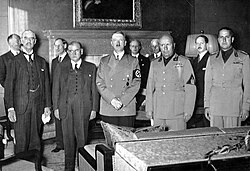
In September 1938, Adolf Hitler demanded control of the Sudetenland, a border region of Czechoslovakia with a large ethnic German population, escalating tensions that had grown since the German element became allied with the Nazis after 1933.
Image source: Munich Agreement
Sep 29, 1938
% completado
On 29 September 1938, Britain and France ceded control of the Sudetenland to Germany in the Appeasement at the Munich Conference; France ignored the military alliance it had with Czechoslovakia, collapsing the nation's military alliance with France.
Oct 1938
% completado
During October 1938, Nazi Germany occupied the Sudetenland border region, effectively crippling Czechoslovak defences. Poland also occupied Zaolzie, an area whose population was majority Polish. Slovakia became autonomous in the fall of 1938.
Image source: Sudetenland
1939 - 1945
% completado
After the outbreak of World War II, former Czechoslovak president Edvard Beneš formed a government-in-exile and sought recognition from the Allies, keeping the cause of a restored Czechoslovakia alive throughout the war.
Image source: Edvard Beneš
1939
% completado
Construction of the first motorways in Czechoslovakia began in 1939, but the work was stopped after the German occupation during World War II.
Image source: Transport in Czechoslovakia
1939 - 1945
% completado
The Jewish populations of Bohemia and Moravia (118,000 according to the 1930 census) were virtually annihilated. Many Jews emigrated after 1939; more than 70,000 were killed, while 8,000 survived at Terezín.
Image source: The Holocaust in Bohemia and Moravia
Mar 14, 1939 - Mar 16, 1939
% completado
On 14 March 1939, the remainder of Czechoslovakia was dismembered by the proclamation of the Slovak State; the next day the rest of Carpathian Ruthenia was occupied and annexed by Hungary; the following day the German Protectorate of Bohemia and Moravia was proclaimed.
Image source: Protectorate of Bohemia and Moravia
1940
% completado
In 1940, in a secret Nazi plan for the Germanization of the Protectorate of Bohemia and Moravia, it was declared that those considered to be of racially Mongoloid origin and the Czech intelligentsia were not to be Germanized.
Jun 4, 1942
% completado
On 4 June 1942, Reinhard Heydrich died after being wounded by an assassin in Operation Anthropoid, a daring resistance operation against the Nazi leadership in the Protectorate of Bohemia and Moravia.
Image source: Assassination of Reinhard Heydrich
1943
% completado
In 1943 the German war effort was accelerated, intensifying exploitation of the Protectorate's industry and population for the Nazi war machine.
May 6, 1945
% completado
On 6 May 1945, the third US Army of General Patton entered Plzeň from the south west during the liberation of Czechoslovakia near the end of the war in Europe.
Image source: Plzeň
May 9, 1945
% completado
On 9 May 1945, Soviet Red Army troops entered Prague, marking the end of the German occupation of the Czech lands and the conclusion of World War II in Europe.
Image source: Prague offensive
1945 - 1948
% completado
Those who remained were collectively accused of supporting the Nazis after the Munich Agreement, as 97.32% of Sudeten Germans had voted for the NSDAP in the December 1938 elections. In 1948 this provision was cancelled for Hungarians but only partially for Germans.
Image source: Expulsion of Germans from Czechoslovakia
Jun 1945
% completado
After World War II, Czechoslovakia was re-established under its pre-1938 borders, with the exception of Carpathian Ruthenia, which was occupied by and in June 1945 formally ceded to the Soviet Union, becoming part of the Ukrainian SSR.
Image source: Transcarpathia
1946
% completado
In the 1946 parliamentary election, the Communist Party of Czechoslovakia won in the Czech lands, and the Democratic Party won in Slovakia. The party's membership had surged from 80,000 in 1938 to 500,000 at Liberation and 1.3 million by the end of 1947.
Feb 1948
% completado
In February 1948 the Communists seized power in a coup, ending the coalition government era and transforming Czechoslovakia into a Marxist-Leninist state under Soviet domination with a command economy.
Image source: 1948 Czechoslovak coup d'état
1949
% completado
Following the expulsion of the ethnic German population, parts of the former Sudetenland, especially around Krnov and the Jeseníky mountain region, were settled in 1949 by Communist refugees from Northern Greece who had fled the Greek Civil War.
Image source: Krnov
1949
% completado
From 1948 to 1989, Czechoslovakia was part of the Eastern Bloc with a planned economy. Its economic status was formalized in membership of Comecon from 1949.
Image source: Comecon
Jun 1953 - Jun 2, 1953
% completado
The currency reform of June 1953 caused dissatisfaction among Czechoslovak citizens, reflected in riots in the town of Plzeň from 31 May to 2 June 1953 expressing economic discontent.
Image source: Czechoslovak koruna
1955
% completado
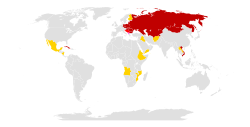
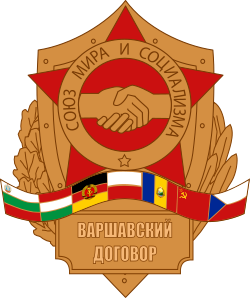
Czechoslovakia's defense status within the Soviet bloc was formalized through its membership in the Warsaw Pact, established in 1955 as a military alliance of Eastern Bloc states.
Image source: Warsaw Pact
1960
% completado
In 1960, the country officially became a socialist republic, the Czechoslovak Socialist Republic, under a new Communist constitution that would later see major amendments in 1968, 1971, 1975, 1978, and 1989.
Image source: Czechoslovak Socialist Republic
Jan 5, 1968
% completado
On 5 January 1968, the reformer Alexander Dubček was appointed to the key post of First Secretary of the Czechoslovak Communist Party, launching the period of liberalization known as the Prague Spring.
Image source: Alexander Dubček
Aug 3, 1968
% completado
On 3 August 1968, representatives of the Communist and Worker's parties of Bulgaria, Hungary, East Germany, Poland, the USSR, and Czechoslovakia signed the Bratislava Declaration. Afterward, Soviet troops left Czechoslovak territory but soon returned.
Aug 21, 1968
% completado
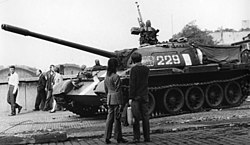
The Prague Spring ended when the Soviet Union, assisted by troops of Bulgaria, Poland and Hungary, invaded Czechoslovakia on the night of 20–21 August 1968, crushing the reform movement.
Image source: Warsaw Pact invasion of Czechoslovakia
1969
% completado
One plank of the reform program was carried out: in 1968–69, Czechoslovakia was turned into a federation of the Czech Socialist Republic and Slovak Socialist Republic, formalized by the Constitutional Law of Federation.
1969 - 1989
% completado
Gustáv Husák was elected first secretary of the KSČ in 1969 (changed to general secretary in 1971) and president of Czechoslovakia in 1975, presiding over the normalization era following the invasion.
Image source: Gustáv Husák
Mar 1985
% completado
In March 1985, Mikhail Gorbachev became leader of the Soviet Union. Since 1986, he and his advisers promoted Glasnost and Perestroika, weakening the grip of communist regimes across Eastern Europe.
Image source: Mikhail Gorbachev
Nov 17, 1989 - Nov 28, 1989
% completado
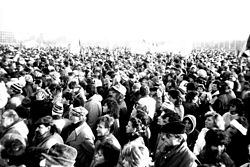
As Marxist-Leninist governments collapsed across Central and Eastern Europe, Czechoslovaks peacefully deposed their communist government during the Velvet Revolution, which began on 17 November 1989 and ended 11 days later on 28 November when all top Communist leaders and the party itself resigned, restoring democracy.
Image source: Velvet Revolution
Nov 24, 1989
% completado
Miloš Jakeš, a hardliner and communist leader since 17 December 1987 of the Communist Party of Czechoslovakia, resigned on 24 November 1989 along with the CPC's entire Presidium during the Velvet Revolution.
Image source: Miloš Jakeš
1990 - 1992
% completado
Shortly after the Velvet Revolution, the state was renamed the Czech and Slovak Federative Republic, consisting of the Czech Republic and the Slovak Republic, until its peaceful dissolution on 31 December 1992.
1992
% completado
In 1992, because of growing nationalist tensions in the government, Czechoslovakia was peacefully dissolved by parliament, setting the stage for the creation of two independent states.
Image source: Dissolution of Czechoslovakia
Dec 31, 1992
% completado
On 31 December 1992, Czechoslovakia formally separated into two independent countries, the Czech Republic and the Slovak Republic, in what became known as the Velvet Divorce.
Or browse the full history timeline directory, with more than 2,000 topics.
This Czechoslovakia timeline was generated with the help of AI, using information found on the internet.
We work hard to keep these timelines accurate, but mistakes do get through. If you spot one, email us at [email protected] and we'll fix it for future visitors.
Generate yours with AI or build it from scratch, for free.
Export your timeline, add your own events, edit or remove AI-generated events, and much more
No credit card required.
Cancel anytime.
Cancel anytime.
You can create an unlimited number of timelines with up to 10 events on each one, customize how they look, export them to PDF, PNG, PowerPoint, CSV, and Excel, and share them with a link. Paid plans raise the event limit and add features like spreadsheet imports and collaborators.
Yes. You can cancel your subscription from your account page at any time, and you will not be charged again. Your subscription stays active for the rest of the period you already paid for.
Yes. We will email you a reminder before the annual renewal, and we will also email you a receipt.
Yes. You can email us within 15 days of any payment, and we will issue you a full refund.
Check out our pricing docs or send us an email anytime: [email protected].