-
Use Cases
-
Resources
-
Pricing
The Labor Movement is a collective effort by workers to improve wages, working conditions, and rights through unions and activism. Spanning from the late 19th century to today, it has shaped labor laws, workplace safety standards, and the modern concept of fair employment across industries worldwide. More Less
1550 - 1700
% complete
As the increasingly unequal and oligarchic guild system deteriorated in the 16th and 17th centuries, spontaneous formations of journeymen within the guilds would occasionally act together to demand better wage rates and conditions. These ad hoc groupings can be considered the forerunners of the modern labour movement.
Image source: Guild
1555
% complete
Parliament responded to petitions made by English weavers in 1555 who asserted that the owners were 'giving much less wages and hire for weaving of clothes than they did in the past.' This led to legislation intended to ensure just compensation for workers throughout the country so they could maintain a 'competent livelihood'.
Image source: Statute of Artificers 1562
1562
% complete
In England the guild system was usurped in its regulation of wages by parliament with the passage of the Elizabethan Era apprentice laws such as the Statute of Artificers 1562, which placed the power to regulate wages and employment in the hands of local officials in each parish.
1700 - 1800
% complete
These formations were succeeded by trade unions forming in the United Kingdom in the 18th century. There is no record of enduring trade unions existing prior to the 18th century.
Image source: Trade union
1700
% complete
Friendly societies had increasingly cropped up in British society since 1700. Workers could also use these ubiquitous societies as cover for union activities.
Image source: Friendly society
1751
% complete
In 1751 wool-combers in Leicestershire formed a union which both disallowed hiring non-members and provided aid for out-of-work members.
1760 - 1830
% complete
The labour movement is usually marked as beginning concurrently with the Industrial Revolution in the United Kingdom, roughly around 1760–1830. Agricultural and cottage industry jobs disappeared as mechanization moved employment to factory towns, causing an influx of low-skilled labour and a decline in real wages and living standards for urban workers.
Image source: Industrial Revolution
1760
% complete
Consequently, from 1760 on, real wages began to fall and food prices began to rise giving increased motivation for political and social agitation.
1765 - 1773
% complete
In the Spitalfields area of London, weavers went on strike and rioted in 1765, 1769, and 1773 until parliament relented and allowed justices in the area to fix wage rates.
Image source: Spitalfields
1768
% complete
When John Wilkes was imprisoned for criticizing King George III, his followers protested and were fired upon by the government at the Massacre of St George's Fields in 1768, which resulted in a round of strikes and riots throughout England.
Image source: Massacre of St George's Fields
1805
% complete
The Scottish weavers of Glasgow went on strike around 1805, demanding enforcement of the old Elizabethan laws empowering magistrates to fix wages to meet the costs of living; however, after three weeks the strike was ended when the police arrested the strike leaders.
1818
% complete
In spite of government suppression, the labour movement in the United Kingdom continued, and 1818 marked a new round of strikes as well as the first attempt at establishing a single national union that encompassed all trades, led by John Gast and named the 'Philanthropic Hercules'. Although this enterprise quickly folded, pro-labour political agitation continued to grow.
1718
% complete
As early as 1718 a royal proclamation was given in opposition to the formation of any unsanctioned bodies of journeymen attempting to affect wages and employment. Despite the presumption that unionising was illegal, it continued throughout the 18th century.
Image source: Combination Act 1799
1757
% complete
The practice of wage regulation began to decline around 1700, and in 1757 Parliament outright rescinded the Weavers Act 1756, abandoning its power of wage regulation and signalling its newfound dedication to laissez-faire economics.
Image source: Labour movement
1794
% complete
Thomas Fyshe Palmer, Joseph Gerrald, and Maurice Margarot were transported, and, in 1794, the leadership of the London Corresponding Society was arrested and tried.
Image source: London Corresponding Society
1795
% complete
Speech and public gatherings were tightly restricted by the Two Acts of 1795 which made certain words acts of treason, limited public gatherings to fifty people or fewer, and enforced licensing for anyone who wanted to speak in a public debate or lecture hall.
Image source: Seditious Meetings Act 1795
1799
% complete
Forming unions or combinations was made illegal under legislation such as the 1799 Combination Act. Trade unionism in the United Kingdom illegally continued into the 19th century despite increasing hardship.
1808
% complete
A renewed stimulus to organised labour in the United Kingdom can be traced back to the 1808 failure of the 'Minimum Wage Bill' in parliament which supporters had seen as a needed countermeasure for the endemic poverty among the working classes of industrial United Kingdom.
1813 - 1814
% complete
In 1813 and 1814 Parliament would repeal the last of the apprentice laws which had been intended to protect wage rates and employment, but which had also fallen into serious disuse many decades before. The Elizabethan Apprentice Laws lasted in England until the early 19th century, but were becoming increasingly dead letter by the mid 18th century.
1817
% complete
An outbreak of lawlessness led to a government crackdown on agitation in 1817 known as the Gagging Acts, which included the suppression of the Spencean society, a suspension of habeas corpus, and an extension of power to magistrates which gave them the ability to ban public gatherings.
Image source: Gagging Acts
1817
% complete
The most infamous early case of government anti-labour espionage was that of Oliver the Spy who, in 1817, incited and encouraged the Pentrich Rising, which led to the leadership being indicted on treason charges and executed.
1819
% complete
In 1819 the social reformer Francis Place initiated a reform movement aimed at lobbying parliament into abolishing the anti-union Combination Acts. Pro-labour demonstrations culminated that year with an incident in St Peter's Field, Manchester.
Image source: Francis Place
1824 - 1825
% complete
Unions were legalised in the Combination Acts of 1824 and 1825, however some union actions, such as anti-scab activities were restricted.
1791
% complete
With the advent of the French Revolution, radicalism became even more prominent in English politics with the publication of Thomas Paine's The Rights of Man in 1791.
Image source: Rights of Man
1792 - 1797
% complete
The working-class focused London Corresponding Society was founded in 1792. In 1797 it was outlawed by parliament, temporarily crushing the British labour movement.
1811
% complete
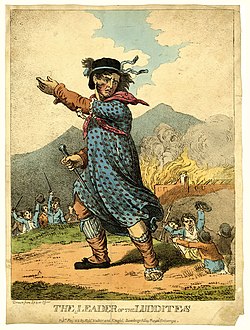
In 1811 in Nottinghamshire, a new movement known as the Luddite, or machine-breaker, movement began. Strikes and riots by miners and framework knitters had occurred throughout England over the course of the 18th century, often resorting to machine breaking and sabotage.
Image source: Luddite
1812 - 1817
% complete
In 1812 the first radical, socialist, pro-labour society, the 'Society of Spencean Philanthropists', named after the radical social agitator Thomas Spence, was formed. Spence, a pamphleteer in London since 1776, believed in the socialized distribution of land and changing England into a federalized government based on democratically elected parish communes.
Image source: Thomas Spence
1815
% complete
This radicalism increased in the aftermath of the end of the Napoleonic Wars, as a general economic downturn in 1815 led to a revival in pro-labour politics.
1838 - 1848
% complete
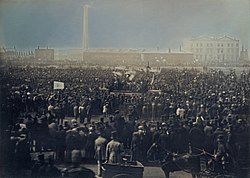
Chartism was possibly the first mass working-class labour movement in the world, originating in England during the mid-19th century between 1838 and 1848. Modern labour parties originated from an increase in organising activities in Europe during this period.
Image source: Chartism
1864
% complete
The International Workingmen's Association, the first attempt at international coordination of labour movements, was founded in London in 1864.
Image source: International Workingmen's Association
1871
% complete
In 1871 workers in France rebelled and the Paris Commune was formed, a landmark event in the history of the international labour movement.
Image source: Paris Commune
1891
% complete
The labour movement gained major impetus during the late 19th and early 20th centuries from the Catholic Social Teaching tradition which began in 1891 with the publication of Pope Leo XIII's foundational document, Rerum novarum, advocating limits on the work day, a living wage, elimination of child labour, the right of labour to organise, and state regulation of labour conditions.
Image source: Rerum novarum
1891
% complete
In 1891, localised labour parties were formed by trade union members in British colonies in Australasia, marking the rise of labour electoral politics.
Image source: Australian Labor Party
1899
% complete
In 1899, the Labour Party for the Colony of Queensland briefly formed the world's first labour government, lasting one week.
Image source: Queensland Labor Party
1900
% complete
The British Labour Party was created as the Labour Representation Committee, following an 1899 resolution by the Trades Union Congress.
Image source: Labour Representation Committee (1900)
1900 - 1920
% complete
Mary Harris Jones, better known as 'Mother Jones', and the National Catholic Welfare Council were important in the campaign to end child labour in the United States during the early 20th century.
Image source: Mother Jones
1900 - 1920
% complete
A degree of strategic biracial cooperation existed among black and white dockworkers on the waterfronts of New Orleans, Louisiana during the early 20th century.
Image source: Labor history of the United States
1900 - 1950
% complete
As core goals were achieved in many advanced economies of Western Europe and North America in the early decades of the 20th century, the labour movement expanded to issues of welfare and social insurance, wealth distribution and income distribution, public services like health care and education, social housing and in some cases common ownership.
1901
% complete
From 1901, when six colonies federated to form the Commonwealth of Australia, several labour parties amalgamated to form the Australian Labor Party (ALP).
Or browse the full history timeline directory, with more than 2,000 topics.
This Labor Movement timeline was generated with the help of AI, using information found on the internet.
We work hard to keep these timelines accurate, but mistakes do get through. If you spot one, email us at [email protected] and we'll fix it for future visitors.
Generate yours with AI or build it from scratch, for free.
Export your timeline, add your own events, edit or remove AI-generated events, and much more
No credit card required.
Cancel anytime.
Cancel anytime.
You can create an unlimited number of timelines with up to 10 events on each one, customize how they look, export them to PDF, PNG, PowerPoint, CSV, and Excel, and share them with a link. Paid plans raise the event limit and add features like spreadsheet imports and collaborators.
Yes. You can cancel your subscription from your account page at any time, and you will not be charged again. Your subscription stays active for the rest of the period you already paid for.
Yes. We will email you a reminder before the annual renewal, and we will also email you a receipt.
Yes. You can email us within 15 days of any payment, and we will issue you a full refund.
Check out our pricing docs or send us an email anytime: [email protected].