-
Use Cases
-
Resources
-
Pricing
The Declaration of Independence is the founding document of the United States, formally adopted by the Second Continental Congress on July 4, 1776. Primarily drafted by Thomas Jefferson, it announced the thirteen American colonies' separation from Great Britain and articulated Enlightenment principles of natural rights, including life, liberty, and the pursuit of happiness. The document marked the birth of the United States as an independent nation and became an enduring symbol of democracy and human freedom worldwide. More Less
Mar 22, 1765
% complete
The Stamp Act required American colonists to pay a tax on printed materials, provoking fierce resistance across the colonies. It was the first direct internal tax levied on the colonists by Parliament and sparked widespread protest under the slogan 'no taxation without representation.'
Image source: Stamp Act 1765
Aug 1765
% complete
The Sons of Liberty, an organization of American patriots, formed to oppose the Stamp Act. They organized protests, boycotts, and sometimes violent resistance against British policies, becoming instrumental in mobilizing colonial opposition to British rule.
Image source: Sons of Liberty
Jun 1767
% complete
The Townshend Acts imposed duties on glass, paint, paper, and tea imported into the colonies. Colonial resistance led to boycotts of British goods and escalating tensions between Britain and its American colonies.
Image source: Townshend Acts
Mar 5, 1770
% complete
British soldiers fired into a crowd of colonists in Boston, killing five men. The incident became powerful anti-British propaganda, fueling revolutionary sentiment throughout the colonies thanks to engravings like Paul Revere's.
Image source: Boston Massacre
Dec 16, 1773
% complete
Colonists disguised as Mohawk Indians boarded three ships in Boston Harbor and dumped 342 chests of tea into the water to protest the Tea Act and taxation without representation, prompting harsh British retaliation.
Image source: Boston Tea Party
Mar 31, 1774 - Jun 22, 1774
% complete
Parliament responded to the Boston Tea Party with a series of punitive laws closing Boston Harbor and curtailing Massachusetts self-government. The acts united the colonies in opposition and led directly to the First Continental Congress.
Image source: Intolerable Acts
Sep 5, 1774 - Oct 26, 1774
% complete
Delegates from twelve colonies met at Carpenters' Hall in Philadelphia to coordinate resistance to the Intolerable Acts. They adopted the Continental Association boycott and petitioned King George III for redress of grievances.
Image source: First Continental Congress
Apr 19, 1775
% complete
British troops marching to seize colonial military supplies clashed with minutemen at Lexington and Concord, marking the outbreak of armed conflict between Britain and the colonies—the 'shot heard round the world.'
Image source: Battles of Lexington and Concord
Jun 17, 1775
% complete
Although the British captured the Charlestown peninsula, the costly victory demonstrated that colonial militia could stand up to professional British troops, hardening attitudes toward independence.
Image source: Battle of Bunker Hill
Aug 23, 1775
% complete
King George III issued a proclamation declaring the American colonies to be in open rebellion and called on officials to suppress it, closing the door on reconciliation efforts.
Image source: Proclamation of Rebellion
Jan 10, 1776
% complete
Thomas Paine's pamphlet Common Sense argued forcefully for independence from Britain and republicanism, selling hundreds of thousands of copies and dramatically shifting public opinion toward breaking away from the Crown.
Image source: Common Sense
Feb 6, 1778
% complete
France signed treaties of alliance and commerce with the United States, becoming the first major power to recognize American independence and entering the war against Britain.
Image source: Franco-American alliance
May 10, 1775
% complete
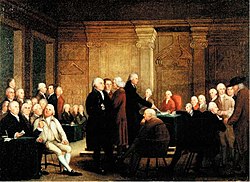
The Second Continental Congress met in Philadelphia shortly after Lexington and Concord, assuming the role of a national government. It organized the Continental Army under George Washington and began steering the colonies toward independence.
Image source: Second Continental Congress
Jun 15, 1775
% complete
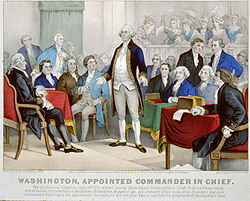
The Continental Congress unanimously chose George Washington of Virginia to lead the newly created Continental Army, a decision that would prove pivotal to the Revolutionary cause and his later presidency.
Image source: George Washington in the American Revolution
Jun 7, 1776
% complete
Virginia delegate Richard Henry Lee introduced a three-part resolution calling for independence, foreign alliances, and confederation, setting the formal process of separation from Britain in motion.
Image source: Lee Resolution
Jun 28, 1776
% complete
The drafting committee presented Jefferson's draft declaration to the Continental Congress, which then debated and revised the text, cutting roughly a quarter including a passage condemning slavery.
Image source: Committee of Five
Jul 2, 1776
% complete
Twelve colonies voted in favor of the Lee Resolution, formally severing political ties with Great Britain. John Adams predicted July 2 would be celebrated as America's great anniversary.
Jul 4, 1776
% complete
The Continental Congress formally approved the final text of the Declaration of Independence in Philadelphia, proclaiming the thirteen colonies free and independent states and asserting that all men are created equal.
Image source: United States Declaration of Independence
Jul 4, 1776 - Jul 5, 1776
% complete
Printer John Dunlap produced roughly 200 broadside copies of the Declaration on the night of July 4–5, distributing them across the colonies; only about 26 copies survive today.
Image source: Physical history of the United States Declaration of Independence
Jul 8, 1776
% complete
Colonel John Nixon read the Declaration aloud from the State House yard in Philadelphia, accompanied by bells and bonfires—one of the first public readings of the new nation's founding document.
Jul 9, 1776
% complete
General George Washington had the Declaration read to his troops in New York City, inspiring the soldiers and prompting celebratory crowds to topple a statue of King George III.
Aug 2, 1776
% complete
Most delegates affixed their signatures to the engrossed parchment copy of the Declaration on August 2, 1776, with additional signers adding their names over subsequent months. All 56 signers risked charges of treason.
Jun 11, 1776 - Jun 28, 1776
% complete
The Continental Congress appointed a Committee of Five—Jefferson, Franklin, Adams, Sherman, and Livingston—to draft a declaration of independence. Jefferson wrote the first draft over about two weeks at the Graff House in Philadelphia.
Oct 26, 1776 - 1785
% complete
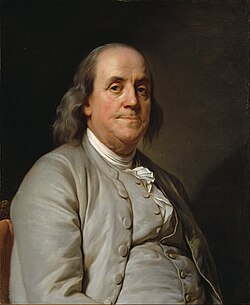
Franklin traveled to Paris as an American diplomat, where his fame as a signer and scientist helped win French support, leading ultimately to the Treaty of Alliance of 1778 that proved decisive in the war.
Image source: Benjamin Franklin
Jul 4, 1826
% complete
On the 50th anniversary of the Declaration's adoption, both Thomas Jefferson and John Adams died within hours of each other, an event contemporaries saw as providential and deeply symbolic for the young nation.
Image source: List of paintings of Thomas Jefferson
Mar 1, 1781
% complete
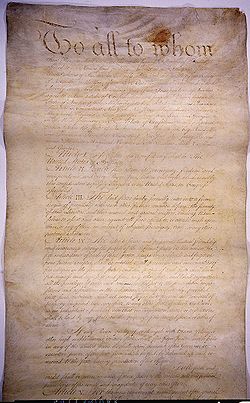
The Articles of Confederation, the first constitution of the United States, were finally ratified by all thirteen states, creating a loose union of states that operated until replaced by the Constitution in 1789.
Image source: Articles of Confederation
Sep 3, 1783
% complete
Britain formally recognized the independence of the United States in the Treaty of Paris, confirming the promise made in the Declaration of Independence seven years earlier and establishing American borders.
Image source: Treaty of Paris (1783)
May 25, 1787 - Sep 17, 1787
% complete
Delegates met in Philadelphia to draft the United States Constitution, building on the principles of self-government articulated in the Declaration while creating a stronger federal government.
Image source: Constitutional Convention (United States)
Jul 19, 1848 - Jul 20, 1848
% complete
Women's rights activists at Seneca Falls issued a 'Declaration of Sentiments,' deliberately modeled on the Declaration of Independence, demanding equal rights for women and extending its egalitarian promises.
Image source: Seneca Falls Convention
Nov 19, 1863
% complete
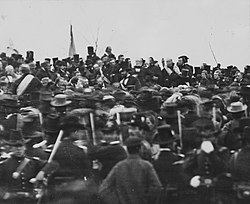
In the Gettysburg Address, Abraham Lincoln described the nation as 'conceived in Liberty, and dedicated to the proposition that all men are created equal,' redefining the Civil War as a fulfillment of the Declaration's ideals.
Image source: Gettysburg Address
May 10, 1876 - Nov 10, 1876
% complete
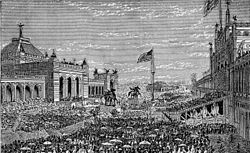
The Centennial International Exhibition in Philadelphia celebrated 100 years since the Declaration, showcasing American industry and innovation and drawing millions of visitors.
Image source: Centennial Exposition
1921
% complete
After decades of varied storage, the signed parchment of the Declaration was transferred to the Library of Congress in 1921 and put on public exhibition for the American people.
Dec 15, 1952
% complete
The Declaration of Independence was moved to the National Archives in Washington, D.C., where it joined the Constitution and Bill of Rights in the Rotunda for the Charters of Freedom, sealed in helium-filled cases.
Image source: National Archives Building
Or browse the full history timeline directory, with more than 2,000 topics.
This Declaration of Independence timeline was generated with the help of AI, using information found on the internet.
We work hard to keep these timelines accurate, but mistakes do get through. If you spot one, email us at [email protected] and we'll fix it for future visitors.
Generate yours with AI or build it from scratch, for free.
Export your timeline, add your own events, edit or remove AI-generated events, and much more
No credit card required.
Cancel anytime.
Cancel anytime.
You can create an unlimited number of timelines with up to 10 events on each one, customize how they look, export them to PDF, PNG, PowerPoint, CSV, and Excel, and share them with a link. Paid plans raise the event limit and add features like spreadsheet imports and collaborators.
Yes. You can cancel your subscription from your account page at any time, and you will not be charged again. Your subscription stays active for the rest of the period you already paid for.
Yes. We will email you a reminder before the annual renewal, and we will also email you a receipt.
Yes. You can email us within 15 days of any payment, and we will issue you a full refund.
Check out our pricing docs or send us an email anytime: [email protected].