-
Use Cases
-
Resources
-
Pricing
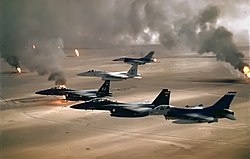
The Gulf War was a conflict triggered by Iraq's invasion of Kuwait in August 1990, prompting a U.S.-led international coalition to launch Operation Desert Shield and later Operation Desert Storm in early 1991. The war featured an extensive air campaign followed by a swift ground offensive that liberated Kuwait and resulted in a ceasefire by the end of February 1991. More Less
Aug 20, 1988
% complete
The eight-year Iran–Iraq War ended with a UN-brokered ceasefire, leaving Iraq heavily indebted, with a large battle-hardened army and a devastated economy. The financial strain from war debts owed largely to Kuwait and Saudi Arabia became a key factor driving Saddam Hussein's later aggression toward Kuwait.
Image source: Iran–Iraq War
Jul 1, 1990
% complete
Iraq accused Kuwait of stealing petroleum through slant drilling across the border and of flooding the oil market to drive prices down. Iraq demanded that its debts be forgiven and claimed Kuwait was waging economic warfare against it, escalating tensions dramatically.
Image source: Gulf War
Jul 25, 1990
% complete
During talks with US Ambassador April Glaspie and at an emergency Arab League summit in Jeddah, Saddam Hussein made increasingly hostile statements about Kuwait. Negotiations between Iraq and Kuwait collapsed on August 1, 1990, setting the stage for invasion.
Aug 1990 - Dec 1990
% complete
Iraq detained thousands of Western nationals in Kuwait and Iraq, using some as 'human shields' at strategic sites to deter military action. Most hostages were released by December 1990 following diplomatic pressure, including visits by figures like Muhammad Ali and Jesse Jackson.
Image source: Human shield
Aug 2, 1990
% complete
Iraqi forces launched a massive invasion of Kuwait, overwhelming the small Kuwaiti military within hours. The ruling Al Sabah family fled to Saudi Arabia as Baghdad installed a puppet government under the so-called 'Republic of Kuwait.'
Image source: Iraqi invasion of Kuwait
Aug 2, 1990
% complete
The UN Security Council passed Resolution 660 condemning the Iraqi invasion and demanding the immediate withdrawal of Iraqi forces from Kuwait. This was followed by Resolution 661 on August 6, imposing sweeping economic sanctions on Iraq.
Image source: United Nations Security Council Resolution 660
Aug 7, 1990 - Jan 17, 1991
% complete
US President George H. W. Bush ordered American troops to Saudi Arabia to defend against possible Iraqi aggression. Operation Desert Shield grew into one of the largest military buildups since World War II, eventually involving over 500,000 coalition troops.
Image source: Gulf War
Aug 28, 1990
% complete
Iraq formally declared Kuwait to be its 19th province, appointing Ali Hassan al-Majid as governor. The annexation was universally condemned and never recognized by any nation or international body.
Nov 29, 1990
% complete
Resolution 678 gave Iraq a deadline of January 15, 1991, to withdraw from Kuwait, and authorized member states to use 'all necessary means' to liberate Kuwait after that date. The resolution set the legal framework for military action.
Image source: United Nations Security Council Resolution 678
Jan 9, 1991
% complete
US Secretary of State James Baker met with Iraqi Foreign Minister Tariq Aziz in Geneva for six hours of last-minute negotiations. Baker handed Aziz a letter from President Bush warning of severe consequences, but Saddam Hussein refused to withdraw, and talks collapsed.
Jan 12, 1991
% complete
After intense debate, both houses of the US Congress narrowly approved the Authorization for Use of Military Force Against Iraq, granting President Bush legal authority to wage war. Congress had earlier debated the issue extensively in January 1991.
Image source: Authorization for Use of Military Force Against Iraq Resolution of 1991
Jan 17, 1991 - Feb 24, 1991
% complete
Coalition forces launched a massive aerial bombardment of Iraq and Kuwait, beginning with strikes on Baghdad broadcast live on CNN. Over 100,000 sorties targeted command centers, air defenses, bridges, and military installations, achieving near-total air supremacy within weeks.
Image source: Gulf War air campaign
Jan 18, 1991 - Feb 26, 1991
% complete
Iraq launched dozens of Scud missiles at Israeli cities, hoping to provoke retaliation that would fracture the Arab-led coalition. Under American pressure, Israel refrained from retaliating, while US Patriot missiles were deployed to intercept incoming Scuds.
Image source: Scud missile
Jan 29, 1991 - Feb 1, 1991
% complete
Iraqi forces launched their first major ground offensive, briefly capturing the Saudi town of Khafji. Saudi and Qatari forces, supported by US Marines and air power, recaptured the town after three days of fighting, inflicting heavy Iraqi casualties.
Image source: Battle of Khafji
Feb 13, 1991
% complete
An airstrike on the Amiriya civilian shelter in Baghdad killed over 400 civilians, becoming one of the most controversial incidents of the air war. Coalition bombing also systematically destroyed Iraq's power grid, water treatment facilities, and communications networks.
Image source: Amiriyah shelter bombing
Feb 24, 1991 - Feb 28, 1991
% complete
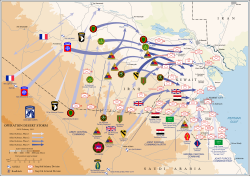
Operation Desert Sabre began with a massive flanking maneuver through the desert west of Kuwait. Marine and Arab coalition forces drove north into Kuwait City while armored units swept around Iraqi defenses, encircling hundreds of thousands of Republican Guard troops.
Image source: Liberation of Kuwait campaign
Feb 26, 1991 - Feb 27, 1991
% complete
Coalition aircraft attacked retreating Iraqi military convoys fleeing Kuwait along Highway 80 toward Basra, destroying hundreds of vehicles and killing many soldiers. The images of devastation sparked international controversy over attacks on withdrawing forces.
Image source: Highway of Death
Feb 27, 1991
% complete
Kuwaiti and coalition forces retook Kuwait City, raising the Kuwaiti flag over the emir's palace. The exiled government of Emir Jaber Al-Ahmad Al-Sabah began planning its return as resistance fighters celebrated in the streets.
Feb 28, 1991
% complete
Exactly 100 hours after the ground offensive began, President Bush announced a unilateral ceasefire, declaring Kuwait liberated. Saddam Hussein's regime survived, a decision that would shape Middle East politics for decades.
Mar 1991 - Apr 1991
% complete
Encouraged by American calls to rise up, Shia Arabs in southern Iraq and Kurds in the north revolted against Saddam Hussein's regime. The uprisings were brutally crushed by Republican Guard forces, creating humanitarian crises along Iraq's borders.
Image source: 1991 Iraqi uprisings
Mar 3, 1991
% complete
General Norman Schwarzkopf met with Iraqi commanders at Safwan, Iraq, to formalize ceasefire terms, including the return of prisoners of war and establishment of demilitarized zones. The meeting set conditions for a permanent peace agreement.
Apr 3, 1991
% complete
Resolution 687 formally established the ceasefire, required Iraq to dismantle its weapons of mass destruction programs under UNSCOM inspections, recognized Kuwait's borders, and created the UN Compensation Fund for damages caused by the invasion.
Apr 6, 1991 - Jul 24, 1991
% complete
A coalition force deployed to northern Iraq to protect Kurdish refugees and deliver humanitarian aid. A no-fly zone was established above the 36th parallel, enforced continuously until the 2003 invasion of Iraq.
Image source: Operation Provide Comfort
May 1991
% complete
The United Nations Special Commission began inspecting and dismantling Iraq's chemical, biological, and nuclear weapons programs. Inspections continued throughout the 1990s amid repeated confrontations with Saddam Hussein's government over access to sites.
Nov 6, 1991
% complete
The last of more than 600 Kuwaiti oil wells ignited by retreating Iraqi forces was capped, ending months of catastrophic environmental damage. Smoke plumes darkened skies across the region, and firefighting teams from around the world worked for nearly ten months.
Image source: Kuwaiti oil fires
1992
% complete
Tens of thousands of Gulf War veterans began reporting chronic symptoms including fatigue, joint pain, and cognitive difficulties, a condition known as Gulf War syndrome. Potential causes studied included exposure to pesticides, depleted uranium, nerve gas, and vaccines.
Image source: Gulf War syndrome
Feb 26, 1992
% complete
Kuwait commemorated the first anniversary of its liberation with national celebrations. February 26 became Liberation Day, a permanent national holiday marking the restoration of Kuwaiti sovereignty.
Image source: Kuwait
Aug 27, 1992
% complete
The US, UK, and France established a no-fly zone below the 32nd parallel in southern Iraq to protect Shia populations. Operation Southern Watch enforced the zone, leading to years of low-level conflict with Iraqi air defenses.
Image source: Iraqi no-fly zones conflict
Apr 14, 1993
% complete
Kuwaiti authorities foiled an alleged Iraqi plot to assassinate former President George H. W. Bush during his visit to Kuwait using a car bomb. In response, the US launched missile strikes against Iraqi intelligence headquarters in Baghdad in June 1993.
Image source: George H. W. Bush
Or browse the full history timeline directory, with more than 2,000 topics.
This Gulf War timeline was generated with the help of AI, using information found on the internet.
We work hard to keep these timelines accurate, but mistakes do get through. If you spot one, email us at [email protected] and we'll fix it for future visitors.
Generate yours with AI or build it from scratch, for free.
Export your timeline, add your own events, edit or remove AI-generated events, and much more
No credit card required.
Cancel anytime.
Cancel anytime.
You can create an unlimited number of timelines with up to 10 events on each one, customize how they look, export them to PDF, PNG, PowerPoint, CSV, and Excel, and share them with a link. Paid plans raise the event limit and add features like spreadsheet imports and collaborators.
Yes. You can cancel your subscription from your account page at any time, and you will not be charged again. Your subscription stays active for the rest of the period you already paid for.
Yes. We will email you a reminder before the annual renewal, and we will also email you a receipt.
Yes. You can email us within 15 days of any payment, and we will issue you a full refund.
Check out our pricing docs or send us an email anytime: [email protected].