-
Use Cases
-
Resources
-
Pricing
The Gupta Empire was an ancient Indian empire that ruled much of the Indian subcontinent from approximately 320 to 550 CE. Often called India's Golden Age, it saw remarkable advancements in mathematics, astronomy, medicine, literature, and the arts under rulers like Chandragupta I, Samudragupta, and Chandragupta II. More Less
250 - 550
% complete
The Gupta Empire was an Indian empire during the classical period of the Indian subcontinent, existing from the mid 3rd century to the mid 6th century CE. It is regarded as a golden age of Indian civilization, marked by advances in science, art, literature, and philosophy.
Image source: Gupta Empire
250 - 290
% complete
Different historians variously date the beginning of Gupta's reign from the mid-to-late 3rd century CE, reflecting uncertainty in the earliest records of the dynasty.
Image source: Gupta (king)
250
% complete
The Gupta Empire existed from the mid 3rd century CE, when its earliest rulers established themselves in the Magadha region, marking the beginning of one of ancient India's most celebrated dynasties.
270 - 300
% complete
Recent numismatic research suggests that Sri Gupta, traditionally regarded as the founder of the Gupta dynasty, likely ruled as an independent monarch in the Magadha region during the late 3rd century CE.
275
% complete
Gupta, whose name appears in the Gupta script as gu-pta, flourished in the late 3rd century CE and is the earliest known king of the Gupta dynasty.
280 - 300
% complete
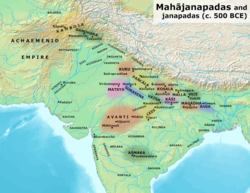
During the late 3rd century CE, the early Gupta kings consolidated their position in Magadha, laying the territorial foundation for the later expansion of the empire.
Image source: Magadha
650
% complete
"Che-li-ki-to", the name of a king mentioned by the 7th century Chinese Buddhist monk Yijing, is believed to be a transcription of "Shri-Gupta" (IAST: Śrigupta), with "Shri" being an honorific prefix.
Image source: Gupta (king)
300 - 550
% complete
The name of the earliest king, Gupta, is recorded in the Gupta script as gu-pta, the writing system used across the empire for inscriptions and administration.
Image source: Gupta script
320 - 550
% complete
Various Mahavihara operated throughout the Gupta Empire serving as centers of education, supporting monastic learning and scholarship across the realm.
Image source: Somapura Mahavihara
400 - 500
% complete
During the fifth century, Mahavihara education centers operated throughout the Gupta Empire, and Nalanda rose to prominence, making this period a high point of classical Indian scholarship.
400 - 550
% complete
Gupta-era metallurgy produced high-phosphorus-content iron whose corrosion resistance results from an even layer of crystalline iron(III) hydrogen phosphate hydrate forming on it, protecting it from corrosion.
Image source: Iron pillar of Delhi
400 - 600
% complete
Nalanda played a vital role in promoting the patronage of arts and academics during the 5th and 6th century CE, attracting scholars from across Asia.
425
% complete
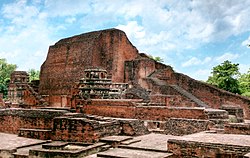
Kumaragupta I was the founder of Nalanda University, a great center of learning that on 15 July 2016 was declared a UNESCO world heritage site.
Image source: Nalanda mahavihara
450
% complete
The earliest evidence of the cotton gin was found in the fifth century, in the form of Buddhist paintings depicting a single-roller gin in the Ajanta Caves, showcasing Gupta-era technological innovation.
Image source: Cotton gin
500 - 600
% complete
A sixth-century play, the Devi Chandragupta, preserved the story of Ramagupta surrendering his queen to the Sakas and Chandragupta's daring rescue, providing key literary evidence about the dynasty.
500
% complete
The game's early form in the 6th century, caturaṅga, translates as "four divisions [of the military]" — infantry, cavalry, chariotry, and elephantry — represented by pieces that would evolve into the modern pawn, knight, rook, and bishop respectively.
Image source: History of chess
Jul 15, 2016
% complete
On 15 July 2016, Nalanda University, founded during the Gupta era, was declared a UNESCO world heritage site, recognizing its enduring significance as a center of learning.
380
% complete
Ramagupta is known from a sixth-century play, the Devichandragupta, in which he surrenders his queen to the enemy Sakas, forcing his brother Chandragupta to sneak into the enemy camp to rescue her and kill the Saka king.
380
% complete
According to the Devichandraguptam, Chandragupta sneaked into the enemy Saka camp to rescue his brother Ramagupta's queen and killed the Saka king, an episode dramatized in the sixth-century play.
400
% complete
The 4th century Sanskrit poet Kalidasa credits Chandragupta Vikramaditya with conquering about twenty-one kingdoms, both in and outside India, highlighting the empire's military reach under his rule.
1076 - 1126
% complete
A source dated 1076–1126 CE mentions Chandragupta with his title and states: "Why should the glory of the Kings Vikramaditya and Nanda be a hindrance any longer? He with a loud command abolished that (era), which has the name of Saka, and made that (era) which has the Chalukya counting."
450
% complete
In the fifth century, the capital of the Gupta Empire was moved to Ayodhya under either Kumaragupta or Skandagupta, shifting the political center of the empire.
Image source: Ayodhya
500 - 600
% complete
Kāśī is sometimes considered by some scholars to have been a capital of the Guptas, either as the original capital, the principal late 6th-century capital, or a minor later capital.
Image source: Varanasi
500 - 550
% complete
The succession of the 6th-century Guptas is not entirely clear, reflecting the weakening authority of the dynasty's main line as the empire declined.
540 - 550
% complete
The tail end recognised ruler of the Gupta dynasty's main line was King Vishnugupta, reigning from 540 to 550, after which the main line of the dynasty ended.
550
% complete
Archaeologist Shanker Sharma concluded, based on a 2019 study, that the cause of the Gupta Empire's downfall was a devastating flood which happened around the middle of the 6th century in Uttar Pradesh and Bihar.
550
% complete
After the collapse of the Gupta Empire in the 6th century, India was again ruled by numerous regional kingdoms, ending the era of unified imperial rule under the Guptas.
550
% complete
Following the collapse of the Gupta Empire in the 6th century, India was again ruled by numerous regional kingdoms, fragmenting political power across the subcontinent.
550
% complete
With the end of King Vishnugupta's reign in 550, the recognised main line of the Gupta dynasty came to a close, marking the effective end of the Gupta Empire.
Image source: Vishnugupta (Gupta Empire)
2019
% complete
In a 2019 study, archaeologist Shanker Sharma concluded that a devastating flood around the middle of the 6th century in Uttar Pradesh and Bihar caused the Gupta Empire's downfall.
Or browse the full history timeline directory, with more than 2,000 topics.
This Gupta Empire timeline was generated with the help of AI, using information found on the internet.
We work hard to keep these timelines accurate, but mistakes do get through. If you spot one, email us at [email protected] and we'll fix it for future visitors.
Generate yours with AI or build it from scratch, for free.
Export your timeline, add your own events, edit or remove AI-generated events, and much more
No credit card required.
Cancel anytime.
Cancel anytime.
You can create an unlimited number of timelines with up to 10 events on each one, customize how they look, export them to PDF, PNG, PowerPoint, CSV, and Excel, and share them with a link. Paid plans raise the event limit and add features like spreadsheet imports and collaborators.
Yes. You can cancel your subscription from your account page at any time, and you will not be charged again. Your subscription stays active for the rest of the period you already paid for.
Yes. We will email you a reminder before the annual renewal, and we will also email you a receipt.
Yes. You can email us within 15 days of any payment, and we will issue you a full refund.
Check out our pricing docs or send us an email anytime: [email protected].