
-
Use Cases
-
Resources
-
Pricing
500 BC - 499 BC
% complete
By the 5th century BC, bread could be purchased from a baker's shop in Athens, showing the established role of professional baking in ancient Greek urban life.
Image source: History of bread
200 BC - 199 BC
% complete
Greek bakers appeared in Rome during the 2nd century BC as Hellenized Asia Minor became the Roman province of Asia and increased cultural exchange brought baking expertise into Roman society.
200 BC - 199 BC
% complete
Foreign bread bakers in Rome were permitted to form a collegium, an organized professional association that reflected the growing importance of specialized baking.
750 CE - 1258 CE
% complete
During the Abbasid Caliphate, bread-making made significant advances compared with the Umayyad period, benefiting from economic prosperity, urban development, and progress in culinary and nutritional sciences.
Image source: Abbasid Caliphate
750 CE - 1258 CE
% complete
The economic prosperity and urban development of the Abbasid period created conditions for more sophisticated and widespread bread production.
900 - 999
% complete
Kitab al-Tabikh by Ibn Sayyar al-Warraq included detailed culinary knowledge from the 10th century, including recipes for preparations associated with bread.
900 - 999
% complete
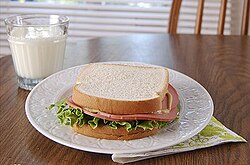
Ibn Sayyar al-Warraq's Kitab al-Tabikh described sandwich recipes known as bazmāward, documenting an early form of bread-based prepared food.
Image source: Sandwich
900 - 999
% complete
The same culinary tradition also described awsāt, another sandwich preparation that demonstrates the variety of bread-based dishes in medieval Islamic cuisine.
900 - 999
% complete
Ibn Sayyar al-Warraq devoted an entire chapter of Kitab al-Tabikh to sandwiches, indicating that such preparations had become a recognized culinary category.
1200 - 1299
% complete
The 13th-century Kitab al-Tabikh by al-Baghdadi later included sandwich recipes, preserving and extending the written tradition of bread-based dishes.
1400 - 1499
% complete
It was not until the 15th century that trenchers made of wood began to replace the bread variety traditionally used as a food-supporting table vessel.
1200 - 1299
% complete
The Statute of English Bakers was another quasi-statute passed later in the 13th century, reinforcing legal controls over the baking trade.
1200 - 1299
% complete
Later in the 13th century, the Judgement of Pillory was passed as one of two quasi-statutes connected with the regulation of English bakers.
1200 - 1299
% complete
In Britain, the Assize of Bread and Ale regulated the price, weight, and quality of bread and beer from the 13th century.
1775 - 1899
% complete
From the late 18th century through the end of the 19th century, bread sold in England and the United States was often adulterated with hazardous materials.
1775 - 1899
% complete
Chalk was among the hazardous materials sometimes added to bread during the period when commercial loaves were frequently adulterated.
1775 - 1899
% complete
Sawdust was one of the adulterants reported in bread sold in England and the United States during the late 18th and 19th centuries.
1775 - 1899
% complete
Alum was among the hazardous substances used to adulterate bread before stronger government action addressed food quality.
1801
% complete
Bread assizes were abandoned in Glasgow in 1801, marking an early retreat from the traditional system of regulating bread by official price and weight.
1815
% complete
London abandoned bread assizes in 1815, continuing the gradual decline of the traditional regulatory system.
1820
% complete
Frederick Accum was the first to raise a public alarm about food adulteration in 1820, drawing attention to unsafe practices affecting bread and other foods.
1836
% complete
The remaining bread assizes were abandoned in the rest of Britain in 1836.
1837
% complete
Graham's instructions for home baking were presented in response to adulterated bread sold in public bakehouses and promoted the use of unrefined wheat flour.
1837
% complete
In 1837, American health reformer Sylvester Graham published Treatise on Bread and Bread-Making, describing how to use unrefined wheat flour to make Graham bread at home.
1860
% complete
The Food Adulteration Act 1860 marked a major step in British government action against adulterated food, helping bring the adulteration of bread gradually to an end.
1869
% complete
After the repeal of the Corn Laws in 1846 substantially reduced cereal duties, the remaining duties were abolished in 1869, changing the economic environment for grain and bread.
Image source: Corn Laws
1899
% complete
The 1899 Food Adulteration Act was part of the government action that gradually ended the widespread adulteration of bread.
1800 - 1899
% complete
The introduction of commercial yeasts during the 19th century sped up baking and made production much easier, but was detrimental to the traditional role of sourdough.
Image source: Sourdough
1912
% complete
Otto Frederick Rohwedder developed a prototype bread-slicing machine in 1912, laying the groundwork for commercial pre-sliced bread.
Image source: Otto Frederick Rohwedder
1928
% complete
In 1928, Rohwedder developed a practical machine that both sliced and wrapped bread, making consistently packaged sliced loaves possible.
1961
% complete
A major change in the United Kingdom came in 1961 with the development of the Chorleywood bread process, an industrial method that reshaped British bread production.
Image source: Chorleywood bread process
1941
% complete
Since 1941, the United States government has mandated fortification of white flour-based foods with nutrients lost during milling, including thiamin, riboflavin, niacin, and iron.
1975 - 1999
% complete
In most Western societies, connotations of bread reversed in the late 20th century: whole-grain bread became preferred for its superior nutritional value.
Image source: Whole wheat bread
1975 - 1999
% complete
By the late 20th century, Chorleywood bread became associated in Western societies with lower-class ignorance of nutrition, contrasting with the growing prestige of whole-grain bread.
1980 - 1989
% complete
During the 1980s, demand for sourdough in the United Kingdom grew substantially, reversing some of the earlier decline caused by commercial yeast.
1986
% complete
Since 1986, domestic bread makers that automate the process of making bread have become popular in homes, bringing mechanized bread production into household kitchens.
1993
% complete
In 1993, regulations were drawn up in the United Kingdom to define what could be sold as sourdough bread after demand had grown during the 1980s.
Or browse the full history timeline directory, with more than 2,000 topics.
This History of Bread timeline was generated with the help of AI, using information found on the internet.
We work hard to keep these timelines accurate, but mistakes do get through. If you spot one, email us at [email protected] and we'll fix it for future visitors.
Generate yours with AI or build it from scratch, for free.
Export your timeline, add your own events, edit or remove AI-generated events, and much more
No credit card required.
Cancel anytime.
Cancel anytime.
You can create an unlimited number of timelines with up to 10 events on each one, customize how they look, export them to PDF, PNG, PowerPoint, CSV, and Excel, and share them with a link. Paid plans raise the event limit and add features like spreadsheet imports and collaborators.
Yes. You can cancel your subscription from your account page at any time, and you will not be charged again. Your subscription stays active for the rest of the period you already paid for.
Yes. We will email you a reminder before the annual renewal, and we will also email you a receipt.
Yes. You can email us within 15 days of any payment, and we will issue you a full refund.
Check out our pricing docs or send us an email anytime: [email protected].