-
Use Cases
-
Resources
-
Pricing
The history of cosmology traces humanity's evolving understanding of the universe's origin, structure, and fate. Beginning with ancient mythological and philosophical models, it advanced through Ptolemy's geocentric system, the Copernican revolution, Newtonian mechanics, and Einstein's relativity, culminating in 20th-century discoveries like Hubble's expanding universe, the Big Bang theory, cosmic microwave background radiation, and modern insights into dark matter and dark energy. More Less
1543
% complete
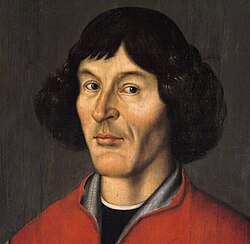
In the 16th century, Nicolaus Copernicus proposed a heliocentric system in which the Sun, rather than Earth, occupied the center of the cosmos. His revolutionary idea overturned the long-dominant Ptolemaic geocentric model and launched the Scientific Revolution.
Image source: Nicolaus Copernicus
1609
% complete
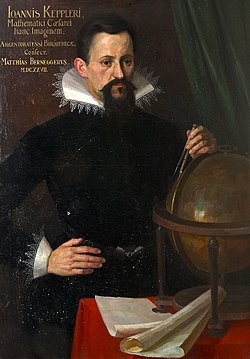
Following Copernicus, Johannes Kepler subsequently developed the heliocentric system further, formulating his laws of planetary motion that described the elliptical orbits of planets and strengthened the case against the geocentric Ptolemaic system.
Image source: Johannes Kepler
1610
% complete
Subsequent to Copernicus and Kepler, Galileo Galilei used his telescope to gather observational evidence supporting the heliocentric system, including observations of Jupiter's moons and the phases of Venus, further undermining the Ptolemaic worldview.
Image source: Galileo Galilei
1687
% complete
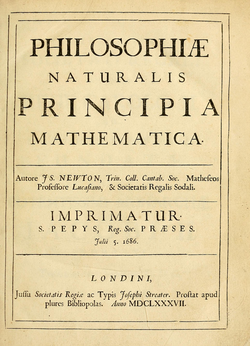
Isaac Newton's Principia Mathematica, published in 1687, was the first description of the law of universal gravitation. It provided a unified physical framework that could explain both terrestrial and celestial phenomena, laying the foundation for Newtonian cosmology.
Image source: Philosophiæ Naturalis Principia Mathematica
1800
% complete
Among the 19th-century cosmological paradoxes related to Newtonian gravity was the Bentley–Seeliger paradox, which questioned why gravitation does not make the universe collapse under its own attraction, exposing weaknesses in static Newtonian models of the cosmos.
Image source: Olbers' paradox
1823
% complete
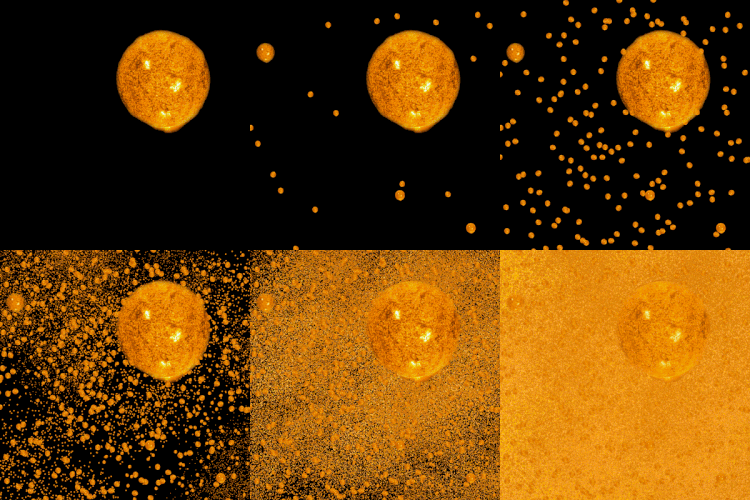
In the 19th century, various cosmological paradoxes appeared related to Newtonian gravity. Olbers' paradox asked why the sky is dark if the universe were infinite, static, and filled with stars — a puzzle that challenged simple Newtonian models of an eternal universe.
Image source: Olbers's paradox
1862
% complete
The heat death paradox, one of the 19th-century cosmological paradoxes tied to Newtonian physics, asked why the universe has not yet reached thermal equilibrium if it has existed forever, challenging the notion of an infinitely old, static universe.
1656
% complete
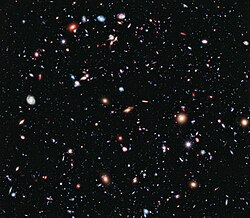
The term cosmology was first used in English in 1656 in Thomas Blount's Glossographia, where it carried the meaning of 'a speaking of the world'. This marked the earliest recorded English usage of the word that would later come to define the scientific study of the universe as a whole.
Image source: Cosmology
1731
% complete
In 1731, German philosopher Christian Wolff used the term cosmology in Latin (cosmologia) to denote a branch of metaphysics that deals with the general nature of the physical world. This helped establish cosmology as a distinct field of philosophical inquiry.
Image source: Christian Wolff (philosopher)
1917 - 1922
% complete
During the Great Debate era, early cosmologists such as Heber Curtis and Ernst Öpik determined that some nebulae seen in telescopes were separate galaxies far distant from our own, reshaping humanity's understanding of the scale of the universe.
Image source: Heber Doust Curtis
1917
% complete
In parallel to the dynamic approach to cosmology, one long-standing debate about the structure of the cosmos was coming to a climax — the Great Debate (1917 to 1922) — concerning whether spiral nebulae were part of our own galaxy or separate distant galaxies.
Image source: Great Debate (astronomy)
1917
% complete
In his 1917 paper, Einstein introduced the cosmological constant into his equations of general relativity. Subsequent modelling of the universe explored the possibility that this constant may result in an expanding universe, depending on its value.
Image source: Cosmological constant
1917
% complete
Modern scientific cosmology is widely considered to have begun in 1917 with Albert Einstein's publication of his final modification of general relativity in the paper 'Cosmological Considerations of the General Theory of Relativity', although this paper was not widely available outside of Germany until the end of World War I.
Apr 26, 1920
% complete
This difference of ideas came to a climax with the organization of the Great Debate on 26 April 1920 at the meeting of the U.S. National Academy of Sciences, where astronomers argued over the nature of spiral nebulae and the scale of the universe.
1922
% complete
In 1922, Alexander Friedmann introduced the idea of an expanding universe that contained moving matter, deriving dynamic solutions to Einstein's equations of general relativity that allowed for cosmic expansion.
Image source: Alexander Friedmann
1927
% complete
Thus the Big Bang model was proposed by the Belgian priest Georges Lemaître in 1927, offering a dynamic picture of a universe expanding from an initial state, which would become the foundation of modern cosmology.
Image source: Georges Lemaître
1923 - 1924
% complete
The Great Debate was resolved when Edwin Hubble detected Cepheid Variables in the Andromeda Galaxy in 1923 and 1924, proving that Andromeda was a separate galaxy far beyond the Milky Way and dramatically expanding the known scale of the universe.
Image source: Edwin Hubble
1929
% complete
Lemaître's Big Bang proposal was subsequently corroborated by Edwin Hubble's discovery of the redshift in 1929, which showed that galaxies are receding from us and provided strong observational evidence for an expanding universe.
Image source: Hubble's law
1964
% complete
The Big Bang model was later corroborated by the discovery of the cosmic microwave background radiation by Arno Penzias and Robert Woodrow Wilson in 1964, providing powerful evidence for the hot early universe predicted by the theory.
Image source: Discovery of cosmic microwave background radiation
1990
% complete
Since around 1990, several dramatic advances in observational cosmology have transformed cosmology from a largely speculative science into a predictive science with precise agreement between theory and observation.
2014
% complete
In 2014, the BICEP2 collaboration claimed that they had detected the imprint of gravitational waves in the cosmic microwave background, a potential signature of cosmic inflation in the very early universe.
Image source: BICEP and Keck Array
Dec 1, 2014
% complete
On 1 December 2014, at the Planck 2014 meeting in Ferrara, Italy, astronomers reported that the universe is 13.8 billion years old and composed of 4.9% atomic matter, 26.6% dark matter and 68.5% dark energy.
Image source: Planck (spacecraft)
Or browse the full history timeline directory, with more than 2,000 topics.
This History of Cosmology timeline was generated with the help of AI, using information found on the internet.
We work hard to keep these timelines accurate, but mistakes do get through. If you spot one, email us at [email protected] and we'll fix it for future visitors.
Generate yours with AI or build it from scratch, for free.
Export your timeline, add your own events, edit or remove AI-generated events, and much more
No credit card required.
Cancel anytime.
Cancel anytime.
You can create an unlimited number of timelines with up to 10 events on each one, customize how they look, export them to PDF, PNG, PowerPoint, CSV, and Excel, and share them with a link. Paid plans raise the event limit and add features like spreadsheet imports and collaborators.
Yes. You can cancel your subscription from your account page at any time, and you will not be charged again. Your subscription stays active for the rest of the period you already paid for.
Yes. We will email you a reminder before the annual renewal, and we will also email you a receipt.
Yes. You can email us within 15 days of any payment, and we will issue you a full refund.
Check out our pricing docs or send us an email anytime: [email protected].